

A hard-segment balance problem often looks like a raw material problem. The parts come out softer than the specification, the hardness drift appears between batches, or the molded surface shows small voids that were not there in the previous run. In many formulations, the practical answer sits in a small-molecule diol on the B-side: diethylene glycol, or DEG. It is not a drop-in replacement for every glycol, and it changes both the chemistry and the machine settings more than its low addition rate suggests.

What DEG Is and Where It Fits
Diethylene glycol is a linear diol with two primary hydroxyl groups and one ether oxygen in the chain. Its CAS number is 111-46-6, the molecular formula is C4H10O3, and the molar mass is about 106.1 g/mol [1]. Because both hydroxyl groups are primary and reactive, DEG behaves as a chain extender rather than a crosslinker. A single DEG molecule completes two urethane links, but it does not by itself introduce a branch point.
The equivalent weight is 53.06 g/eq, and the calculated hydroxyl number is roughly 1057 mg KOH/g [2][3]. That is far higher than the hydroxyl number of a typical long-chain polyol, which is exactly why a small weight change in DEG shifts the stoichiometric balance noticeably. In a 100 kg B-side batch, a few hundred grams of DEG can change hard-segment content, hardness, and cure behavior.
DEG appears in polyurethane work in two different places. It is sometimes used as a free chain extender added to the resin or curative side of a cast elastomer, coating, or flexible foam system. It is also used as a diol building block when polyester polyols are synthesized [4]. This article focuses on the first role, because that is the one most likely to surprise a production manager at the machine.
Why Formulators Use DEG Instead of Other Glycols
Compared with ethylene glycol, DEG is less volatile and introduces an ether segment that disrupts hard-segment packing. The practical result is usually lower hardness and modulus at the same isocyanate index, with better flexibility and lower crystallization tendency. Compared with 1,4-butanediol, DEG generally produces a less ordered, more hydrophilic hard segment. Formulators often use it when they want a softer elastomer or a coating with more flexibility, or when they are looking for a liquid extender that is easier to handle than a solid curative [4].
That does not make DEG a one-to-one substitute for BDO. The two diols have different equivalent weights and different hard-segment structures. BDO favors strong, ordered hard segments and higher hardness for the same index. DEG tilts the part toward toughness, elongation, and a more open hard-segment structure. In any formulation change, the NCO balance must be recalculated, not assumed from the previous glycol.
DEG also brings a practical trade-off: the ether oxygen is more hydrophilic than a pure methylene chain. Parts based heavily on DEG can show higher long-term water absorption and, in some environments, a greater need for hydrolysis protection. That is a material choice, not a universal failure; it simply needs to be on the checklist when the part will be washed, steamed, or used outdoors.
In cast polyurethane, the chain extender choice shapes both hardness and cure behavior, not just the raw material bill. How Polyurethane Rollers Are Made From Casting To Cure covers how the hard-segment ratio and casting parameters work together from mold fill to cure.

How DEG Changes Equipment and Process Settings
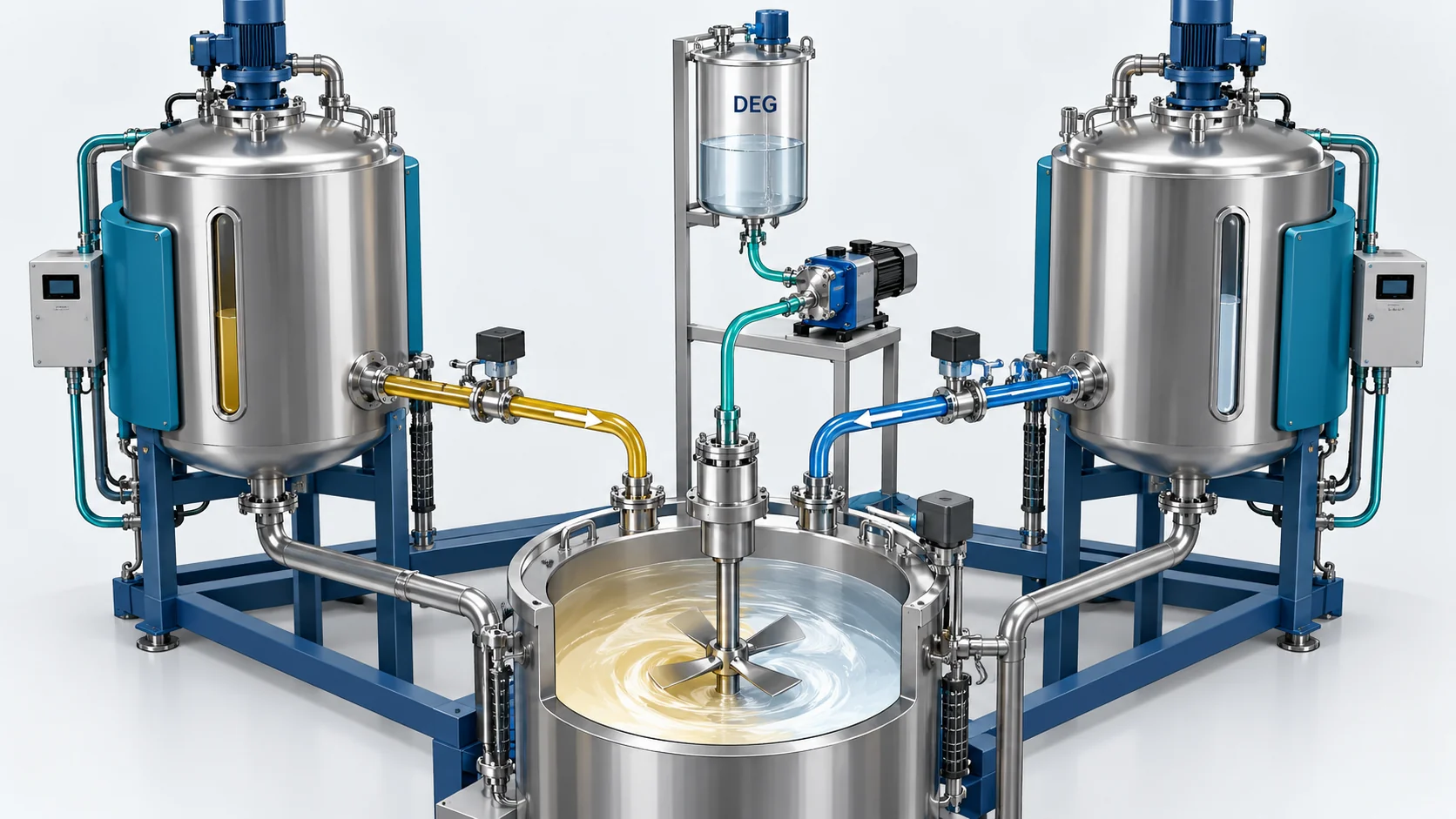
The first equipment concern is metering. DEG has an equivalent weight of 53.06 g/eq, so a small dosing error has an outsized effect on the NCO/OH ratio. On a machine set up for a large-flow polyol stream, the chain extender flow is typically small. A pump that holds ±1% on a 10 kg/min polyol stream may not hold the same practical precision on a 0.3 kg/min extender stream. The control strategy therefore matters more than the nominal pump size.
DEG is a liquid at room temperature, so it does not require the heated tank and melting hardware needed for a solid curative. That simplifies the B-side arrangement. But DEG is hygroscopic and should still be protected from atmospheric moisture. Water contamination is a concentration problem: the extender is added in small amounts, so a little absorbed water becomes a large share of the extender stream.
That water changes the reaction in a predictable way. One mole of water consumes two equivalents of isocyanate, releases carbon dioxide, and forms a urea linkage [4]. The gas creates bubbles or voids in a solid part, and the consumed NCO pulls the index lower than the formulation intended. The stable formulation the lab approved may not be the formulation the machine is actually pouring if the drum has been left open.
Because DEG is added in small percentages on the B-side, a metering error that is acceptable in a crude system may not be acceptable here. How To Calculate Shot Weight In Polyurethane covers how ratio and shot weight are calculated from the same formulation data.
Practical Dosing and NCO Balance
For a prepolymer system, the diol demand can be calculated from the NCO content and the desired isocyanate index:
grams extender per 100 g prepolymer = (NCO % × 53.06) / (42.02 × index)
The 53.06 is the equivalent weight of DEG, and 42.02 is the equivalent weight of the NCO group. The index is expressed as a decimal, such as 1.05 for 105 index. For a 6.0% NCO prepolymer at 105 index, the calculation gives about 7.2 g of DEG per 100 g of prepolymer. At 95 index, the same prepolymer needs about 8.0 g. The difference is small in weight terms but large in hard-segment terms [2][3].
The useful rule is to treat DEG as a precision additive, not a bulk component. Log the extender weight to the same resolution as the isocyanate and polyol streams, and verify the hydroxyl number of each new lot if the supplier has not provided a certificate. A drift of a few tenths of a percent in the extender stream may not be visible on the main flow meter but will show up in hardness and compression set.
Equipment Check When DEG Is on the B-Side
Before committing a DEG-based formula to a line, confirm that the extender stream can be metered at the required accuracy, the B-side day tank can be kept dry or blanketed, and the mixing head can handle the lower-viscosity side without bypassing. If the metering range is too coarse for the extender dose, contact a polyurethane machine engineer before the first production run.
Email: Info@chinahaifeng.com
WhatsApp: +86 13566296633
Use the end-of-article checklist to structure the inquiry so the engineer can compare the formulation, target hardness, shot size, and cycle time against the existing machine.
Handling, Storage, and Moisture Control
DEG is a high-boiling diol, with a boiling point around 245 °C, and it remains liquid over a wide process range [5]. The higher boiling point reduces the volatility problems seen with lighter glycols, but it does not reduce moisture sensitivity. Store DEG in sealed drums, avoid leaving partially emptied containers open to ambient air, and use dry air or nitrogen purging on the day tank when the line will run continuously.
The moisture target should be set from the part requirement, not copied from the polyol specification. A clear elastomer or a high-gloss coating will show water damage earlier than a soft foam. If bubbles appear only in DEG-containing batches, the first check is the extender drum and the B-side pickup, not the isocyanate quality.
Water that finds its way into a hygroscopic chain extender seldom shows up on the weigh ticket. It shows up as foam collapse, bubbles, or dimensional drift. Causes Of Shrinkage In Polyurethane Foam How To Control It covers how uncontrolled water and off-ratio conditions drive foam defects.
DEG Formulation and Machine Checklist
- Confirm whether DEG is being used as a free chain extender or as a polyol monomer, because the process risk is different.
- Recalculate the extender amount using the 53.06 equivalent weight and the actual NCO content.
- Verify the hydroxyl number of incoming DEG against the certificate of analysis.
- Protect the extender drum and day tank from moisture.
- Check that the small extender flow stays inside the metering accuracy range of the machine.
- Expect lower hardness and modulus than a BDO-hardened system at the same index, and set the specification accordingly.
- Run a short cure-profile check after any change in DEG grade or drum handling.
Talk to a Polyurethane Machine Engineer
If the formulation is changing, the machine may need to change with it. Send the proposed DEG content, target Shore hardness or tensile properties, shot size, mold temperature, cycle time, and the current defect or drift. A polyurethane machine engineer can then evaluate whether the metering, B-side handling, degassing, and mixing head configuration fit the system.
Haifeng Polyurethane Machinery specializes in bespoke polyurethane equipment and turnkey production lines, with experience across footwear, automotive, rail transit, and elastomer casting.
Email: Info@chinahaifeng.com
WhatsApp: +86 13566296633
Frequently Asked Questions About DEG in Polyurethane
Is DEG a chain extender or a crosslinker?
DEG is a difunctional chain extender. It has two hydroxyl groups and forms two urethane links, but it does not introduce a branch point by itself. Crosslinking in the finished part comes from higher-functionality polyols, excess isocyanate side reactions, or separately added crosslinkers [4].
Can DEG replace BDO one-to-one?
Not by weight. The equivalent weights and hard-segment structures are different. The stoichiometric amount can be recalculated, but the resulting hardness, modulus, flexibility, and water resistance will not be identical. DEG is usually selected for a specific property balance rather than as a universal substitute for BDO.
Why do DEG-based parts sometimes show bubbles?
The most common cause is water absorbed by the extender. Water consumes isocyanate and releases carbon dioxide, which appears as bubbles or voids in a solid part. Keep DEG drums sealed and purge or dry the B-side day tank when bubble defects appear only after a DEG-related change [4].
What isocyanate index should be used with DEG?
There is no single correct index for DEG. The index depends on the part hardness, the polyol system, the prepolymer NCO content, and the desired degree of over-indexing. Calculate the DEG demand from the actual NCO content and confirm the final properties with a small trial, just as you would with BDO or ethylene glycol.
Does DEG affect machine metering?
Yes. Because DEG is usually added in small amounts and has a low equivalent weight, small dosing errors shift the NCO/OH ratio. The extender stream needs a pump and flow range that remain accurate at the actual addition rate, and the B-side tank must keep the material dry.
References
[1] PubChem, “Diethylene glycol,” Compound Summary, National Center for Biotechnology Information. [Online]. Available: https://pubchem.ncbi.nlm.nih.gov/compound/8117
[2] ISO 14900-1:2019, Plastics — Polyols for use in the production of polyurethanes — Determination of hydroxyl number — Part 1: Manual method, International Organization for Standardization, Geneva, Switzerland, 2019.
[3] ASTM D4274-21, Standard Test Methods for Testing Polyurethane Raw Materials: Determination of Hydroxyl Numbers of Polyols, ASTM International, West Conshohocken, PA, 2021.
[4] M. Ionescu, Chemistry and Technology of Polyols for Polyurethanes, 2nd ed. Shawbury, U.K.: Rapra Technology, 2005.
[5] European Chemicals Agency, “Diethylene glycol — Substance Information.” [Online]. Available: https://echa.europa.eu/substance-information/-/substanceinfo/100.003.573
If you’re interested, check out these related articles:
How Polyurethane Rollers Are Made From Casting To Cure
The Role Of Rise Time In Polyurethane Foaming
Causes Of Shrinkage In Polyurethane Foam How To Control It





