

Haifeng PU foaming convention: A = polyol blend; B = isocyanate. Other suppliers may use different letters; verify actual tank labels and material documentation. CPU prepolymer and curative streams are identified by material name.
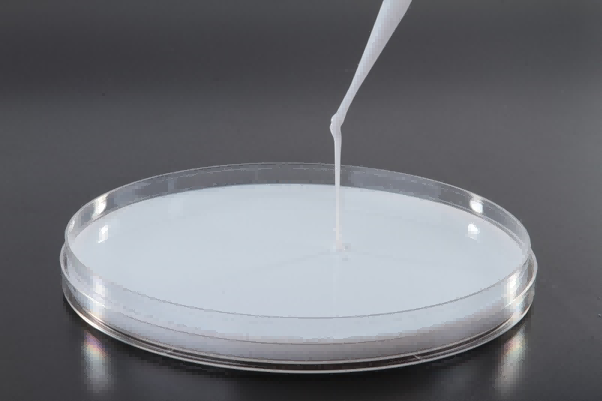
A common failure on the pouring line shows up before the mold closes. The operator dispenses the mixed material, sees the puddle turn murky white, and realizes the reaction has already started — too early. The part comes out with flow marks, uneven cell structure, or incomplete fill. Cream time is the parameter that defines how long that dispense window stays open, and it quietly controls more of the part quality than many line setups account for.
What Cream Time Actually Means
Cream time is the interval between the moment the B-side isocyanate and the A-side polyol blend are brought together and the moment the mixture shows its first visible change — a milky or creamy surface that begins to scatter light. That change is not cosmetic. It marks the start of the blowing reaction, in which isocyanate reacts with water to release carbon dioxide, alongside the gelling reaction that builds urethane linkages [1].
For most polyurethane systems, cream time ranges from a few seconds to roughly a minute depending on the formulation [1]. The standard procedure for recording it is the cup test described in ASTM D7487 [2]. The number is relative to a specific formulation, temperature, and mixing condition — it is not a universal machine setting.
Why Cream Time Matters in Production
Cream time sets the practical window for getting material into place. Before cream, the mixture is still liquid enough to flow, wet out mold surfaces, and level itself. After cream, viscosity builds quickly and the foam begins to expand where it sits. Every operation between the mixing head and the material’s final resting position — dispense, transfer, and even mold rotation — has to be completed inside that window.
When cream time is shorter than the machine’s pour cycle, the symptoms are consistent:
- flow marks where material advanced after reaction had begun
- density gradients from uneven expansion, measured as apparent density per ISO 845 [3]
- voids near gates where early reaction trapped air
- short shots when rising foam closed off flow paths before fill completed
When cream time is much longer than needed, the trade-off is productivity. Mold cycle time extends, material can drain or shift in multi-axis tooling before it firms up, and demold timing drifts later [1].

The window does not operate alone. Cream time starts the clock; rise time describes how quickly the foam then expands to full volume. The Role Of Rise Time In Polyurethane Foaming covers the rise profile that follows and how to read it on the line.
What Controls Cream Time
Four formulation and process variables move cream time more than anything else: the catalyst package, temperature, water content, and the isocyanate index.
Catalyst package. Tertiary amine catalysts primarily promote the water–isocyanate blowing reaction, while organotin catalysts such as dibutyltin dilaurate drive gelling [1]. A few tenths of a percent by weight in the A-side can shift cream time by several seconds [1]. Blowing-selective amines shorten cream time faster than they shorten gel; gelling catalysts do the reverse. This balance is how formulators set the cream point without derailing the later cure profile.
Temperature. Reaction rate rises with temperature. A common rule of thumb in polyurethane processing is that reactivity roughly doubles for every 10 °C increase, following the general Arrhenius behavior of the reaction [1]. This is why cream time measured in a 20 °C drum differs from cream time on a 35 °C line after circulation heat. It also means raw material preheating and day-tank temperature are not convenience settings — they are direct controls on the dispense window. In practice, the cheapest fix for a drifting cream point is often closed-loop temperature control on the component tanks, but the root cause should be confirmed with measurement first.
Water content. Water is the blowing agent in water-blown systems. More water means faster carbon dioxide generation and an earlier visible onset. The same logic explains why moisture contamination in a supposedly dry system can shorten cream time unexpectedly — it adds reactive water no one planned for.
Isocyanate index. A higher index generally pushes the system toward faster reaction [1]. Changes to the A/B ratio therefore move cream time even when the catalyst package stays the same, and metering drift often shows up first as inconsistent cream time before it appears as hardness or density failure.
How to Measure Cream Time
The working method on the bench is the cup test. A fixed mass of A-side is charged into a cup, the B-side is added, a timer starts at the moment of addition, and the mixture is stirred with consistent energy. Cream time is read when the liquid surface turns milky and begins to expand [2]. ASTM D7487 describes the polyurethane foam cup test procedure, including observation of cream, gel, and rise characteristics under laboratory conditions [2].
Two things decide whether the measured number is useful. First, mixing energy must stay constant — the same stir speed, stir time, and cup geometry. The reaction onset depends on how completely the components are dispersed; careless hand mixing gives a number that means little on a high-shear machine. Second, the test temperature and the line temperature must match. A cup test at 23 °C does not predict cream time on a 40 °C pouring line.
On the production floor, cream time is rarely measured with a stopwatch on every shot. Operators learn to read the puddle: when the surface changes from glossy to milky, the cream point has passed. The more useful practice is to record the time for any formulation change and tie it to the machine cycle.

Cream Time vs. Gel Time and Rise Time
These three timings are often confused because they occur close together.
- Cream time is the visible start of reaction — the liquid turns milky and begins to grow.
- Gel time is the point where the reacting mass first forms a continuous network and starts to resist pulling; strings form when a rod is lifted. It usually arrives seconds after cream.
- Rise time is the time for the foam to reach its full expansion height for that shot.
In a normally reacting water-blown flexible foam, cream time may be 5 to 15 seconds while rise time is 60 to 120 seconds or longer [1]. In some rigid foam formulations, all three compress into a short sequence. The order — cream first, then gel, with rise finishing last — holds in the standard reaction sequence [1].
For process control, rise time gets the most attention because it is the most visible end point. Cream time is the leading indicator. It tells you whether the shot will stay where it is placed, and it usually shifts before the other timings when something changes upstream.
What Cream Time Means for Equipment Setups
Equipment does not set cream time directly; the formulation does. But the machine has to be sized around it.
Dispense window. The pour program must finish dispensing before the cream point. If a large shot takes longer to pour than cream time allows, early material reacts before later material arrives and the part can separate into layers. Shot weight, pouring rate, and cream time have to be checked together.
The dispense math runs in reverse from the chemistry. Once cream time fixes the window, shot size and flow rate decide whether the program fits inside it. How To Calculate Shot Weight In Polyurethane covers the calculation that keeps every cavity filled before the reaction closes the window.
A quick protocol for process engineers: if cream time moves shot to shot while the formulation is unchanged, record ten consecutive shots with tank temperature, A/B ratio deviation, mixing head speed, and measured cream point before adjusting chemistry. If the drift follows the machine rather than the material, send the formulation sheet and those ten readings to info@chinahaifeng.com — the data that pins the root cause is the same data needed for the next conversation.
Mixing head speed and pressure. High-pressure impingement mixing shortens the practical cream time because better dispersion brings more reactive groups into contact sooner. That is generally desirable — it means a tighter window, and a tighter window supports a more uniform part, provided the dispense system is fast enough to use it.
Temperature control on tanks and lines. Because temperature moves cream time, a consistent cream point requires closed-loop temperature control on both component tanks. If the B-side and A-side arrive at the head at different temperatures from shift to shift, cream time drifts and the appearance of the part changes with it.
Multi-station and rotary lines. On molding carousels, cream time must be long enough to cover the pour plus any index, clamp, or rotation movement before the reaction builds too far. If the machine indexes slowly, cream time becomes a floor on the minimum cycle time for that station count.
When cream time conflicts with throughput, there are two practical paths: adjust the formulation through the catalyst package, or change the process mechanics — faster shot, shorter transfer paths, better temperature control. A faster machine rarely helps if the material has already started reacting before the pour finishes.
Reaction speed also follows the part out of the mold. If cream time is moved with the wrong catalyst, dimensional stability after demold can shift as B side effect. Causes Of Shrinkage In Polyurethane Foam How To Control It covers how reaction and cure conditions drive shrinkage.
Technical Inquiry About Cream Time and Pour Windows
If you are ready to discuss a specific process problem, include the following with your inquiry:
- Measured cream time and how you record it
- System type, water content, and catalyst package (if available)
- Shot weight and pour rate
- Tank and line temperature settings
Contact us at info@chinahaifeng.com or WhatsApp 86 13566296633.
Frequently Asked Questions
What is a typical cream time for shoe-sole foam?
For many water-blown microcellular sole systems, cream time is typically in the range of 5 to 20 seconds, but the exact number depends on the catalyst level, water content, and processing temperature [1]. Verify the value on your formulation rather than copying a catalog figure.
Does higher temperature always shorten cream time?
Higher temperature generally shortens cream time because it accelerates the underlying reactions [1]. The effect is strong enough that a move from 20 °C to 35 °C can shift the process noticeably. The practical concern is not only the shorter window but also the reduced repeatability of the window if tank temperatures are not controlled.
Can cream time be too long?
Yes. A cream time that is too long extends cycle time and lets the mixture drain or shift before it firms up, which is a problem in multi-axis tooling and complex molds [1]. The target is rarely the longest possible window; it is the shortest window the machine can reliably handle.
How is cream time different from gel time?
Cream time is the first visible milkiness and the beginning of expansion. Gel time is the later point where the reacting mass forms a continuous network and resists pulling when probed [1], [2]. Cream comes first, then gel, with rise finishing the sequence [1].
What should I check when cream time starts fluctuating?
Check temperature first, then metering ratio, then possible moisture contamination. Temperature moves reactivity directly; A/B ratio drift changes the isocyanate index; and unexpected water — from humid air or contaminated drums — accelerates the blowing reaction [1].
References
[1] G. Oertel, Polyurethane Handbook, 2nd ed., Munich, Germany: Hanser Publishers, 1994.
[2] ASTM D7487-18, Standard Practice for Polyurethane Raw Materials: Polyurethane Foam Cup Test, West Conshohocken, PA, USA: ASTM International, 2018.
[3] ISO 845, Cellular Plastics and Rubbers — Determination of Apparent Density, Geneva, Switzerland: International Organization for Standardization, 2006.
If you’re interested, check out these related articles:
SRIM Explained Structural Reaction Injection Molding Basics
RRIM Vs RIM Which Process Suits Your Structural Part





