

A polyurethane seal that passes incoming hardness checks can still lose sealing force after six months inside a housing. The reason is usually not durometer; it is compression set. For gaskets, rollers, suspension buffer blocks, rail pads, and molded shoe components, compression set determines whether a part keeps its thickness after years of clamping, cycling, and heat. It is a practical property and one that is frequently misread at the specification stage.
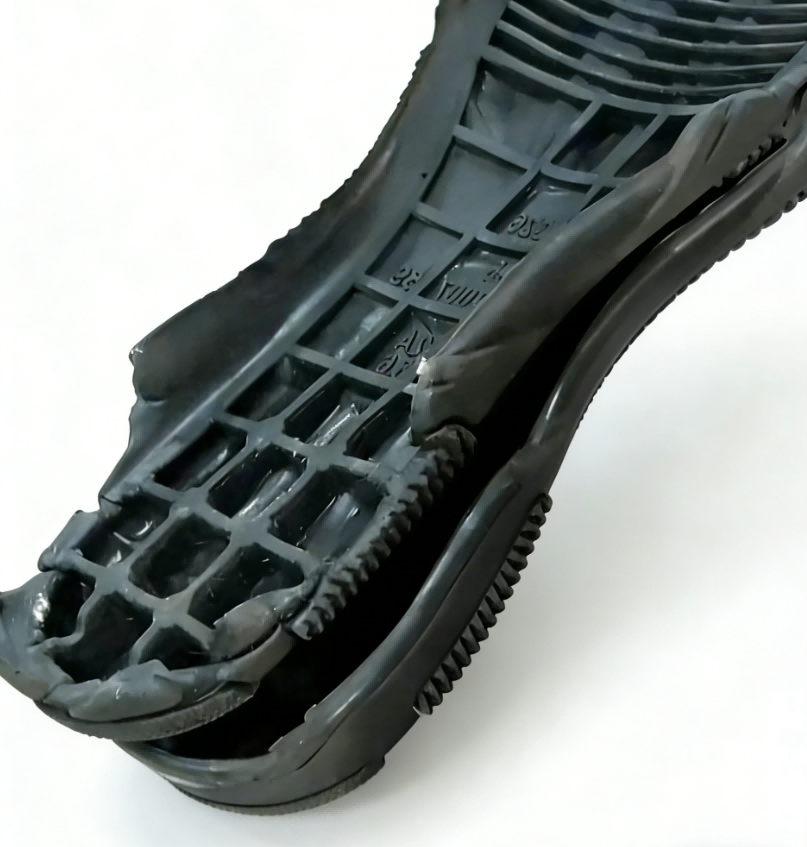
What Is Compression Set in Polyurethane?
Compression set is the permanent deformation a specimen retains after being compressed under defined conditions and allowed to recover. It is reported as a percentage of the original compression. Lower values mean the material returns closer to its original thickness.
For solid elastomers tested under constant deflection, the calculation is usually:
Compression set (%) = [(t0 − ti) / (t0 − tn)] × 100
Where:
- t0 is the original specimen thickness
- ti is the thickness after recovery
- tn is the thickness during the compression period, typically set by a spacer
If a 10 mm specimen is compressed to 7.5 mm and recovers to 9.6 mm, the compression set is 16%. The lost 0.4 mm represents the material’s failure to fully recover after load.
Compression set is not the same as resilience. Resilience describes fast rebound after impact. Compression set describes slow, time-dependent recovery after a sustained compressive load. A part can have good rebound and still develop unacceptable compression set after hours of clamping at elevated temperature.
Why Compression Set Decides Part Life
For a seal, lost thickness translates directly into lost contact pressure. For a roller cover, a measured set can create a flat spot that produces vibration and uneven transfer. For a rail pad, compression set reduces preload and changes the fastening system’s stiffness. For an automotive suspension buffer block, the part becomes shorter and no longer absorbs impact energy as designed.
Roller covers are a classic case because they operate under continuous, localized compression. A set roller does not need to crack or tear to fail; the geometry change alone is enough to reject the part.
Roller covers live and die by compression resistance. How Polyurethane Rollers Are Made From Casting To Cure covers the casting steps that determine finished roller properties.

How Compression Set Is Measured
The two standards most often referenced for solid polyurethane are ASTM D395 [1] and ISO 815 [2]. ASTM D395 Method B uses constant deflection: the specimen is compressed to a fixed strain, commonly 25%, with metal spacers. Time, temperature, and recovery period are set by the part specification. A common quality-control condition is 22 hours at 70°C, but 23°C and 100°C variations appear depending on the application. After release, the specimen rests before the final thickness measurement.
ISO 815-1 [2] covers ambient and elevated temperatures. ISO 815-2 [3] covers low-temperature work. For flexible polyurethane foam, ISO 1856 [5] and ASTM D3574 [4] are the reference methods; cell collapse adds an extra recovery variable.
The main method split looks like this:
- Solid elastomer, constant deflection: ASTM D395 Method B [1] or ISO 815-1 [2]
- Low-temperature sealing applications: ISO 815-2 [3]
- Flexible cellular polyurethane: ASTM D3574 [4] or ISO 1856 [5]
One common source of bad data is measuring too early. Recovery is time-dependent, and if the final thickness is taken before the specified recovery period, the results look worse than they are. Specimen temperature at measurement matters just as much, because a warm specimen recovers more quickly than a cold one.
Compression set is only half the recovery picture. Measuring Polyurethane Foam Resilience A Practical Test Guide covers the rebound side of elastic recovery and how it is tested.

Four Factors That Drive Compression Set
Compression set is rarely controlled by one variable. In practice, four factors interact:
Crosslink density and hard segment content. Higher crosslink density generally restricts chain slippage and reduces permanent set. A tightly crosslinked elastomer has less freedom to reorganize under sustained load.
Curative type and stoichiometry. MOCA-cured systems are often selected for better heat and compression resistance, while BDO-cured systems tend to favor resilience and processability. If the isocyanate-curative ratio drifts away from the formulation target, chain extension becomes incomplete and compression set rises.
State of cure. An under-cured part may pass a quick hardness check but fail compression set after heat aging. Post-curing completes the reaction and removes residual stress.
Service temperature and media. Elevated temperature accelerates chain relaxation, and oils or plasticizers can soften the surface. A material that performs well at room temperature can behave very differently at 80°C.
Hardness alone does not predict compression set. Two compounds at the same durometer can separate by several percentage points under identical test conditions.
Hardness alone does not tell you what you need to know. Shore A Vs Shore D Hardness In Polyurethane covers how durometer selection connects to compound design and part performance.
Equipment-Level Levers That Control Compression Set
On the production floor, compression set failures often trace back to equipment variables rather than the raw material itself.
Ratio control comes first. A small deviation in the A/B ratio changes the stoichiometry and leaves unreacted chain ends. On elastomer casting systems, dynamic metering accuracy around ±0.3% is a realistic process target, but the accuracy must hold at your actual viscosity and temperature, not only at calibration conditions.
Temperature control is second. If the material or mold temperature drifts, gel time, viscosity, and fill behavior change. A cold mold can trap surface porosity; an overheated mold can accelerate cure before full packing, leaving internal stress that later appears as set.
Vacuum degassing matters. Air bubbles in a molded elastomer create voids that collapse under compression, so apparent compression set increases even when the polymer matrix is sound.
Mixing uniformity cannot be assumed. A poorly mixed curative creates soft, under-reacted zones. High-shear mixing heads and consistent mixing-chamber maintenance keep the curative distribution even.
Packing and shot weight close the loop. Underfilling produces lower density and more internal free volume, making permanent deformation more likely. Consistent shot weight keeps every cavity at the same compression-set baseline.
If you already have a compression set test result and you are trying to find whether the problem is material, mold, or machine, send the standard and target to Info@chinahaifeng.com or WhatsApp +86 13566296633. A Haifeng process engineer can help separate formulation issues from metering and cure-line issues.

Need a Compression Set Target? Start With These Details
To review your process, send the following to Info@chinahaifeng.com or WhatsApp +86 13566296633:
- Part type, size, and hardness range
- Target compression set, test standard, temperature, and time
- Material system: polyester or polyether prepolymer, MDI/TDI, MOCA/BDO, additive package
- Current metering equipment, mixing head type, and mold temperature
- Monthly volume and shot weight
Haifeng Polyurethane Machinery designs foaming and elastomer casting lines with closed-loop metering, temperature control, and vacuum degassing to help you hold repeatable compression set results. As the sole drafter of China’s PU pouring machine industry standard, the engineering team works from process data rather than brochure assumptions.
Common Questions About Compression Set in Polyurethane
What is a good compression set value for polyurethane?
There is no single good value. A dynamic seal operating at 80°C may need a compression set below 20%, while a decorative soft foam part may tolerate a much higher value. The target should come from the part drawing, test standard, and service condition, not from a generic material chart.
Is compression set the same as permanent deformation?
It is a standardized measure of permanent deformation under compression. Permanent deformation is the broader term. Compression set applies a defined load or deflection, time, temperature, and recovery period so results can be compared between batches and suppliers.
Does higher hardness guarantee lower compression set?
Higher hardness does not guarantee lower set. A hard but poorly cured or under-crosslinked compound can still take a measurable set. Hardness is an indicator, not a substitute for compression set testing.
Can post-curing improve compression set?
If the part was under-cured, post-curing can improve compression set meaningfully by driving the reaction closer to completion and relieving internal stress. If the part was already fully cured and has a weak network structure, post-curing alone will not fix the problem.
How does heat affect compression set?
Heat accelerates chain relaxation and makes permanent deformation more likely. That is why elevated-temperature compression set tests are stricter than room-temperature tests and why sealing applications must be tested at the actual service temperature.
References
[1] ASTM D395-18, Standard Test Methods for Rubber Property—Compression Set, ASTM International, West Conshohocken, PA, USA, 2018.
[2] ISO 815-1:2019, Rubber, vulcanized or thermoplastic — Determination of compression set — Part 1: At ambient or elevated temperatures, ISO, Geneva, Switzerland, 2019.
[3] ISO 815-2:2019, Rubber, vulcanized or thermoplastic — Determination of compression set — Part 2: At low temperatures, ISO, Geneva, Switzerland, 2019.
[4] ASTM D3574-17, Standard Test Methods for Flexible Cellular Materials—Slab, Bonded, and Molded Urethane Foams, ASTM International, West Conshohocken, PA, USA, 2017.
[5] ISO 1856:2018, Flexible cellular polymeric materials — Determination of compression set, ISO, Geneva, Switzerland, 2018.
If you’re interested, check out these related articles:
Shore A Vs Shore D Hardness In Polyurethane
Causes Of Shrinkage In Polyurethane Foam How To Control It





