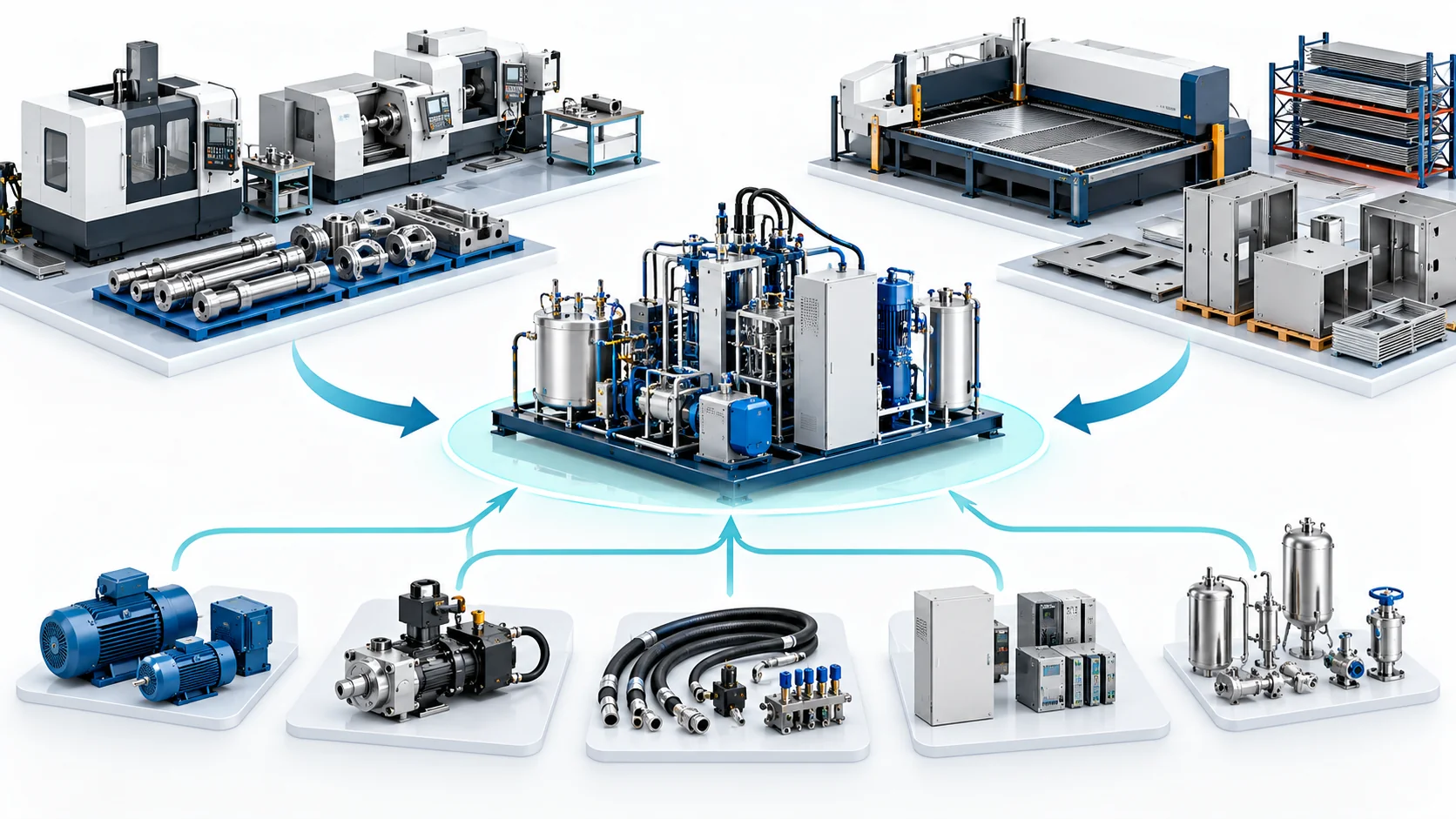
Haifeng Polyurethane Machinery manufactures core equipment primarily at its headquarters in Wenzhou, China, while integrating supply-chain resources through a coordinated manufacturing network. The headquarters are at No. 1 Jucheng Road, Juguangyuan, Lucheng District, Wenzhou, Zhejiang. Its 15,076 m² manufacturing base includes fully equipped precision machining and sheet-metal workshops and a gantry vertical machining center.
Different product lines may use different coordinated manufacturing resources. Core precision components are machined in-house at the Wenzhou headquarters, while some standardized parts are sourced through an approved supplier network. Final machine assembly and commissioning are then completed in Wenzhou.
| Stage | Scope |
| Solution design | Technical solution customized to the customer’s process requirements |
| Machining / component procurement | Core components machined in-house; standardized components sourced through coordinated suppliers |
| Assembly | Complete mechanical assembly at the Wenzhou headquarters |
| Electrical control integration | Integration of the intelligent PLC control system |
| Piping and metering system commissioning | Calibration of the high-precision metering system, with accuracy up to ±0.3% |
Before shipment, equipment undergoes strict factory inspection, including load testing under simulated production conditions. A product certificate is issued only after all factory inspection items pass. Any nonconformities are recorded and corrected through rework or repair until every specification meets the required standard and the equipment is approved for shipment.
Detailed test items
· Appearance and identification inspection: Checks the equipment’s condition and the completeness of its nameplate, including product name and model, key technical parameters, serial number and manufacture date, applicable standard and manufacturer name.
· Mechanical and assembly quality inspection:
1. Inspects assembly quality, including critical assembly parameters such as the parallelism of the platens in the clamping mechanism.
2. Runs the equipment without load to check operating condition, including whether oil temperature is excessive (typically no more than 55°C), hydraulic cylinders move smoothly without creeping, and seals are free from oil leaks.
· Electrical control system testing: Verifies the microcomputer control system, HMI and remote monitoring functions. Electrical-system safety and reliability are also checked against standards such as GB 5226.1.
· Core performance testing:
1. Metering accuracy test: Verifies that the core metering system meets the ±0.3% proportioning accuracy standard.
2. Mixing uniformity test: Checks how the casting head mixes components such as polyol and isocyanate to ensure uniform foaming.
3. Complete-machine stability test: Simulates actual operating conditions in a continuous run to verify overall performance and stability.
4. Safety device inspection: Checks the reliability and responsiveness of all safety devices, such as emergency-stop buttons and safety light curtains.
Secure packaging and shipment
Haifeng follows strict packaging standards to protect equipment during long-distance transportation.
· Packaging standards: Packaging follows applicable standards, including China’s “General Specifications for Packaging of Machinery, Electrical, Instrumentation and Metering Products.”
· Protective measures: Depending on the equipment, protection against moisture, mold, rust, corrosion and vibration is applied as needed.
· Packaging method: Sturdy wooden crates are commonly used, with moisture-treated lumber suitable for long-distance ocean freight and multiple transshipments. Crates are clearly marked with handling symbols such as “Center of Gravity,” “Lifting Point,” “Handle with Care” and “This Way Up” to support safe handling.
Additional support for overseas customers
In addition to standard factory tests, Haifeng generally offers overseas customers more extensive customized services:
· Customer-witnessed testing: Before shipment, customers or their representatives may visit the factory to witness the full test process and jointly inspect the equipment.
· Performance validation: Trial production can be conducted using a customer-supplied formulation or mold to verify equipment performance directly.