
Vacuum Infusion Composite Production Solution
Plan vacuum infusion molding with dry reinforcement, a sealed bag arrangement and controlled resin delivery.
Build the Process Around Your Product
Plan vacuum infusion molding with dry reinforcement, a sealed bag arrangement and controlled resin delivery.
Product and material first
Start with the finished-product drawing, material system and acceptance requirements. The process route and equipment configuration are assessed together.
Compare related routes: Closed-Tool RTM · VBO Prepreg Processing.
Capacity across the whole process
Define output with preparation, forming/reaction, curing, handling and inspection included. The slowest stage and product changes determine practical line capacity.
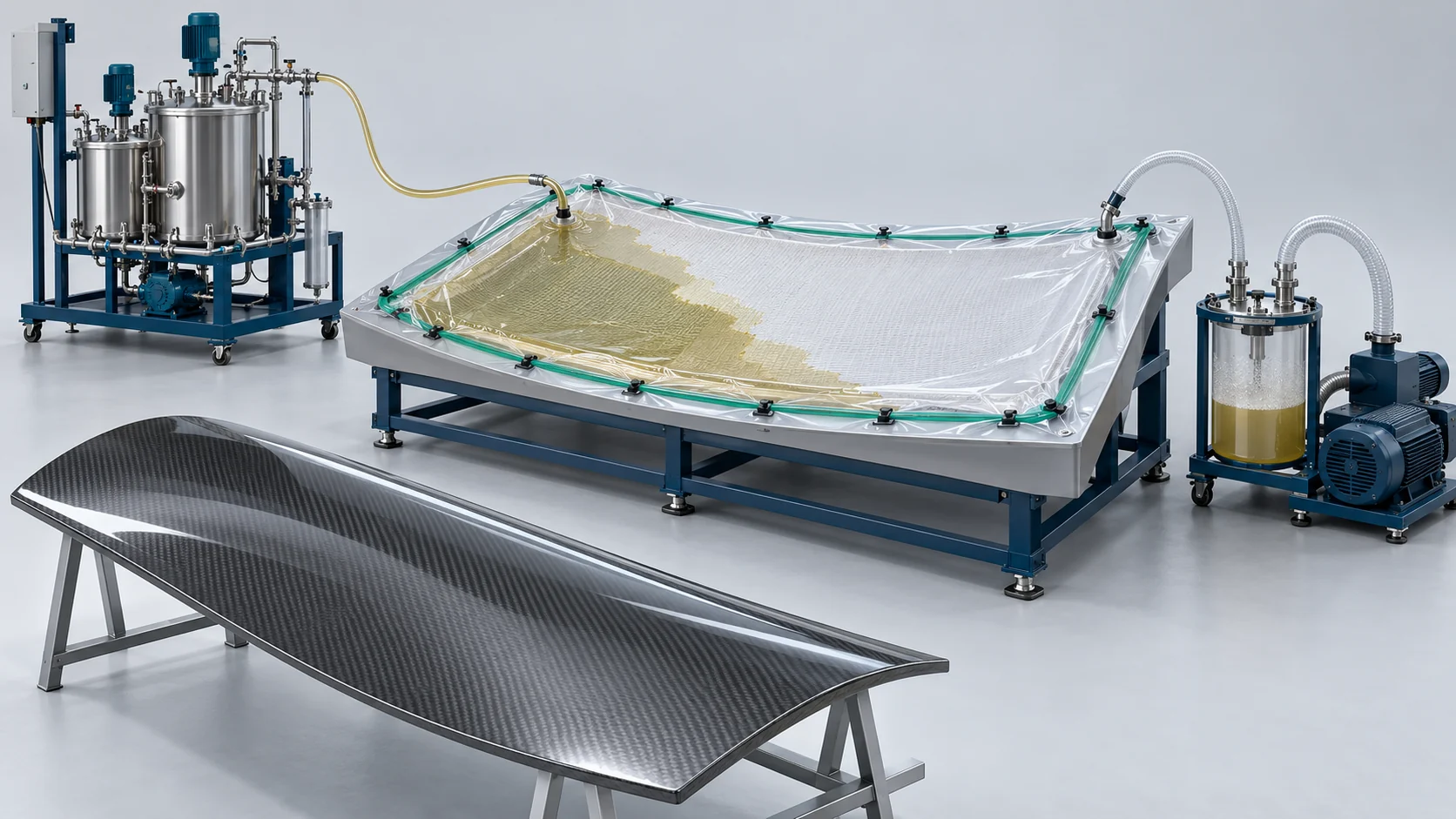
Plan resin inlets, vacuum outlets, flow media, capture and measuring points from the reinforcement and geometry. Leak checks and fill time must fit the resin working window; a good pump reading alone does not prove bag integrity or complete impregnation.
From Preparation to Qualified Product
A planning sequence for the specified route. Final settings and acceptance conditions are established through material and part review.
Plan infusion
Review laminate, permeability, flow media and resin inlet/vacuum layout.
Lay up and bag
Position dry fibers and inserts, apply bagging materials and check leaks.
Prepare resin
Condition and mix the approved resin while controlling usable process time.
Information Needed to Configure the Line
Provide these inputs so the equipment range, interfaces and validation plan can be defined.
| Design input | Information required |
|---|---|
| Part and reinforcement | Geometry, ply arrangement, permeability, inserts and target laminate quality |
| Infusion layout | Bagging materials, flow media, resin inlets, vacuum outlets, leak criteria and flow-front monitoring |
| Resin and filling window | Viscosity at process temperature, mixing instructions, working time and planned filling duration |
| Vacuum system | Pump and connection layout, resin trap capacity and vacuum measurement locations |
| Cure and acceptance | Material-approved thermal profile, temperature/exotherm monitoring, handling and part-inspection requirements |
Coordinate the Equipment With the Process
Evaluate repeatability, handling and acceptance across the full workflow.
Infusion-specific configuration
Resin conditioning, mixing, bag integrity, inlet and vacuum layout, and cure control are configured for the selected laminate.
Vacuum protection
Verify bag leaks, measurement points and resin-trap capacity.
Working-window control
Complete filling and cure with the selected resin and recorded thermal conditions.
Frequently Asked Questions
Review resin flow, filling time and vacuum-system interfaces.
How does vacuum infusion differ from VBO prepreg curing?
How are resin inlets and vacuum outlets planned?
How is filling completed within the resin working window?
What prevents resin reaching the vacuum pump?
What inputs are needed for this configuration?
How should the resin trap and flow monitoring be sized?
Submit Your Production Goals
Share the following for this application: Part/layup, permeability, resin working time, bag/flow layout, vacuum connections, trap and thermal/cure requirements. Our team will reply within one business day. Once requirements are clear, we provide a preliminary proposal within two business days.


