
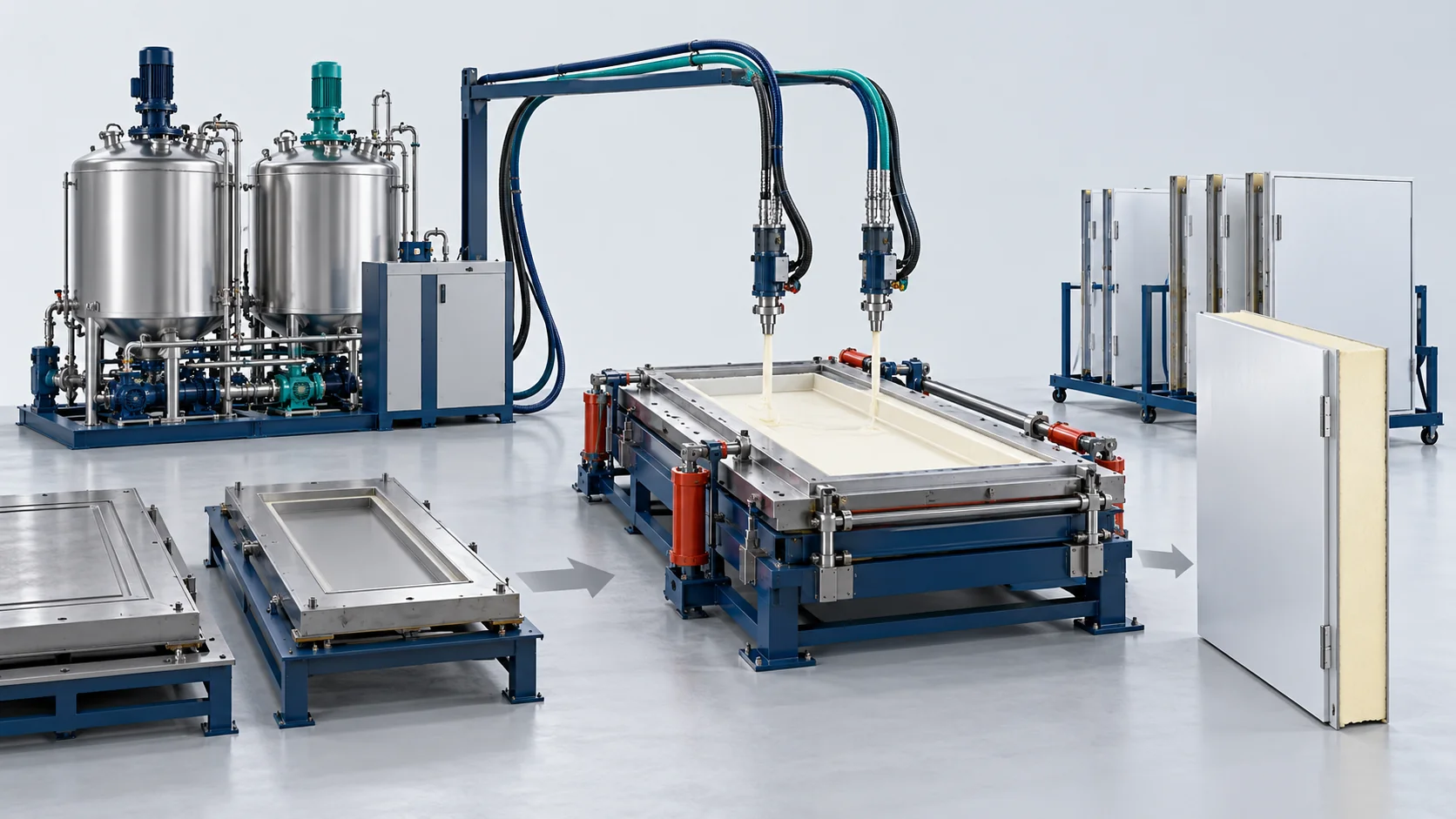
Thick Cold Room Door PU Foaming Solution
Configure synchronized multi-head PU injection and heated fixtures for thick cold-room doors.
Heavy Structural Insulation for Controlled-Atmosphere Cold Storage Envelopes
Thick insulated doors require controlled material delivery, filling, reaction heat, fixture restraint and cure. Multi-head injection is a configurable process, not proof of a scorch-free core or zero bowing. Closed-cell content is a material quantity and does not alone establish the complete door vapor or sealing performance.
Defined supply scope
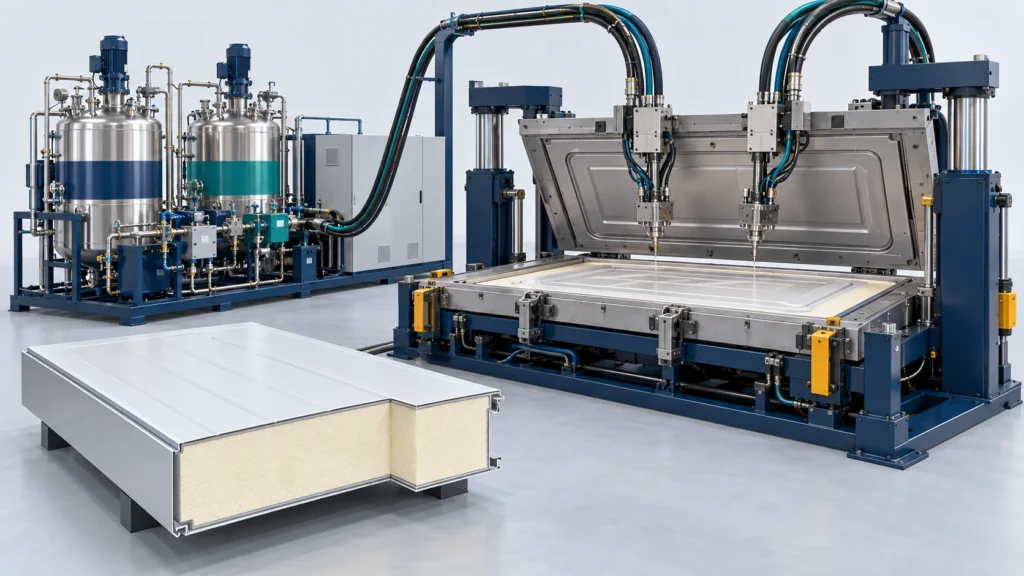
Specify the complete multi-head metering system, fixture, tooling, locks and thermal controls. Door-core tests and finished-door cold-cycle behavior have separate acceptance requirements.
Inputs for process selection
Door dimensions/thickness, skin/frame and locks, formulation, total shot, head routing, fixture and cold-cycle tests.
Equipment scope, retained factory interfaces and acceptance are agreed for the selected material and part. Specify the complete multi-head metering system, fixture, tooling, locks and thermal controls. Door-core tests and finished-door cold-cycle behavior have separate acceptance requirements.
Thick Cold Room Door PU Foaming Workflow
Prepare the door assembly → Clamp and condition → Coordinate the injection heads → Cure and inspect. Define preparation, filling, cure and output timing separately for the selected configuration.
Prepare the door assembly
Locate skins, frame, embedded locks and injection/vent interfaces.
Clamp and condition
Establish fixture closure and thermal conditions for the selected door.
Coordinate the injection heads
Validate total shot, sequence and flow-front interaction.
Reference Solution Engineering Envelope
Existing configuration and test references. Equipment settings, material results and finished-assembly results are separate; apply each value only to its documented configuration and conditions.
| Parameter | Value / Unit | Applicable Configuration / Conditions |
|---|---|---|
| Maximum Panel Core Thickness | Up to 250 mm | Motorized adjustable platen daylight on 200-ton press |
| Combined Chemical Injection Rate | 200–300 kg/min | Multi-head synchronized servo axial piston proportioner |
| Foam Closed-Cell Percentage | Greater than 95.0% | ASTM D6226 testing on rigid polyurethane core |
| Low-Temperature Dimensional Drift | Less than 0.5% | Tested at -30°C for 48 hours under GB/T 8811 |
| Hydraulic Mold Clamping Tonnage | 200 Tons (2,000 kN) | Rigid welded structural steel platens with water heating |
| Maximum Door Dimensions | 4,500 mm length x 2,200 mm width | Accommodates heavy sliding warehouse and CA doors |
Core Equipment for This Solution
Equipment references are selected by their documented process. Main metering, auxiliary supply and alternative routes are not a single standard package.
Process controls and application checks
Evaluate these functions with the selected material, tooling and production brief. Finished-part results require their own acceptance evidence.
System-total delivery
Treat the stated multi-head rate as a system reference rather than multiplying it by each head.
Thick-core process review
Validate exotherm, fill and cure with the actual thickness and formulation.
Door-level inspection
Assess bow, seals and embedded locks separately from foam-cell measurements.
Related Projects
These are related application references. Compare the actual material, process and delivered modules; reported project figures are not acceptance results for another line.
Frequently Asked Questions
Does staggered multi-head injection guarantee no scorch or knit lines?
Is mold cure time the output interval?
What information is needed for a preliminary configuration?
Discuss Your Production Goals
Share the following with your production brief: Door dimensions/thickness, skin/frame and locks, formulation, total shot, head routing, fixture and cold-cycle tests. Our team will reply within one business day. Once requirements are clear, we provide a preliminary proposal within two business days.


