
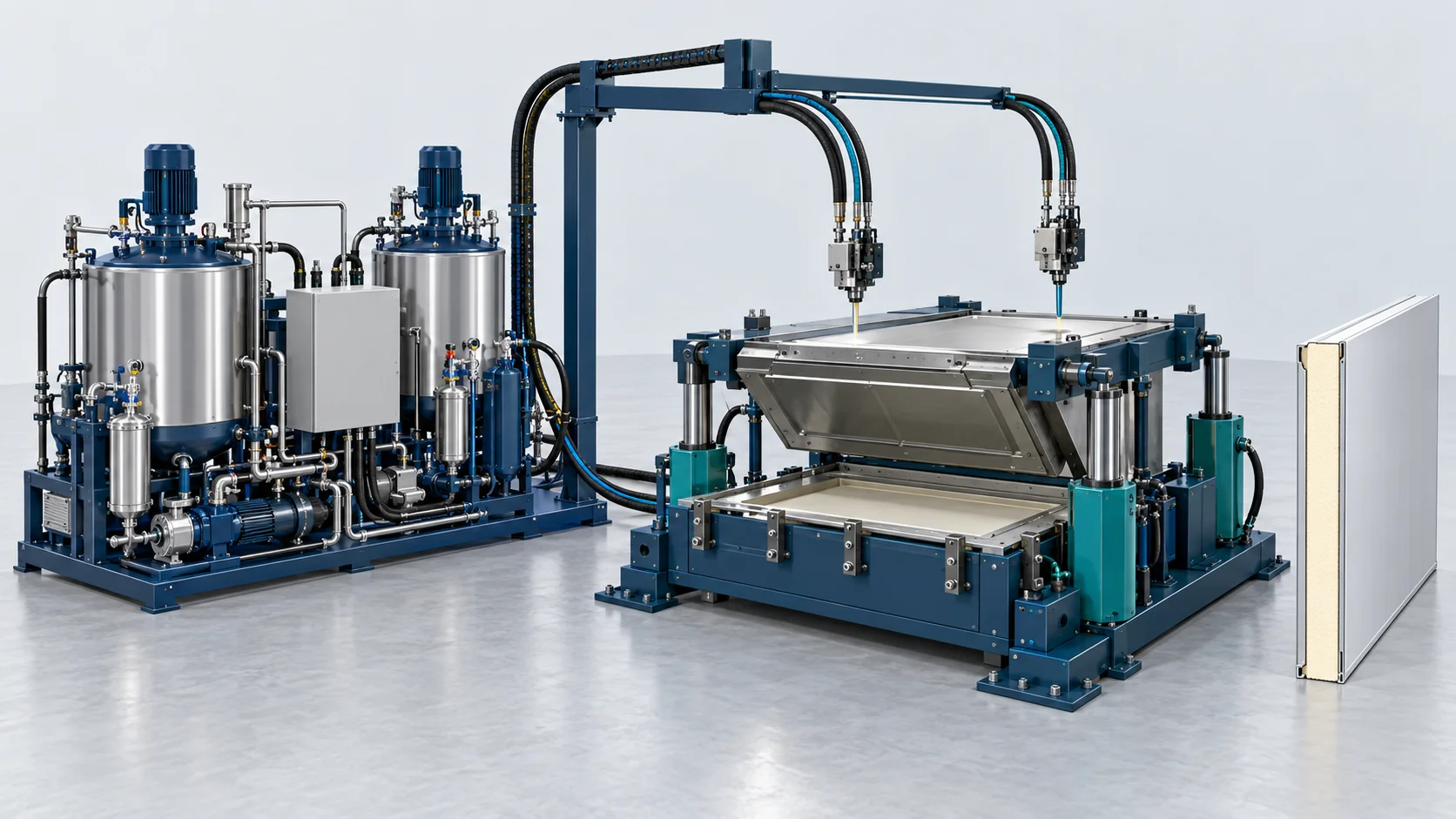
High-Pressure PU Foaming Line | Cold Room Doors
Metering and synchronized multi-head injection for thick cold-room doors, coordinated with heated hydraulic fixtures and mold filling.
Precision Staggered Foaming for Extra-Thick Cold Storage Doors
Metering and synchronized multi-head injection for thick cold-room doors, coordinated with heated hydraulic fixtures and mold filling.
Metering and synchronized multi-head injection for thick cold-room doors, coordinated with heated hydraulic fixtures and mold filling.
Material conditioning, metering, mixing heads, the specified press fixture and coordinated controls. Door hardware, tooling details, chemicals and site utilities are confirmed separately.
The model suffix LP does not identify its pressure class: the supplied circuit is 15–17.5 MPa high-pressure impingement. A 75 kg shot in 18.2 s implies 247.3 kg/min, exceeding the stated combined 180 kg/min maximum; reconcile shot mass, time and head aggregation. Injection time differs from mold dwell and full cure.
Concept illustration: Generated concept illustration for process discussion; not a photograph of the specified machine, a customer facility or a delivered project.
Material Flow and Working Principle
Door Metal Shell Pre-Assembly & Gasket Alignment
Upper and lower pre-painted steel or stainless skins with integrated thermal break profiles and heavy hinge reinforcements are loaded into the preheated hydraulic press platen.
High-Pressure Chemical Conditioning
Polyol blend and polymeric isocyanates are conditioned in 300 L stainless vessels under thermal oil jacket circulation at 22°C ± 0.5°C to stabilize reaction kinetics.
Multi-Head Staggered High-Pressure Injection
Axial piston metering pumps displace components at 16.0 MPa into twin or quad mixing heads, executing programmed delay sequences to fill the 250 mm thick cavity in 18 seconds without flow lines.
Pressurized Hydraulic Cure & Dwell
The 200-ton hydraulic press maintains 1.5 bar counter-pressure across the expanding door shell; platens heated to 45°C ensure uniform closed-cell density without core scorch.
Hydraulic De-Clamping & Dimensional Audit
Following a 25-minute cure dwell, hydraulic cylinders unlock the press platens; pneumatic kickers eject the finished 250 mm door onto an inspection handling table.
Model and Technical Parameters
Supplied HF-CRD250-LP configuration references, pending original calibration and acceptance documents. Material, finished-part and project outcomes are separate from equipment ratings. The model suffix LP does not identify its pressure class: the supplied circuit is 15–17.5 MPa high-pressure impingement. A 75 kg shot in 18.2 s implies 247.3 kg/min, exceeding the stated combined 180 kg/min maximum; reconcile shot mass, time and head aggregation. Injection time differs from mold dwell and full cure.
| Technical Parameter | HF-CRD250-LP |
|---|---|
| Components | 2 Components (A: Polyol blend + Blowing agent, B: Polymeric MDI) |
| Output Range (g/s) | 50.0 to 180.0 kg/min (Combined output across multi-heads) |
| Mixing Ratio Range | 100:100 to 100:150 (By weight) |
| Ratio Accuracy | ±0.3% (Under continuous Coriolis mass flow tracking) |
| Power Supply | 380V, 3-Phase, 50Hz (Custom 440V/480V 60Hz optional) |
| Working Pressure | 15.0 to 17.5 MPa (High-pressure metering and impingement) |
| Tank Capacity (L) | Day tanks: 2 x 300 L (Stainless steel with thermal jackets) |
| Weight | 16,500 kg (Combined press bed, hydraulic power unit, and metering skid) |
| Dimensions (L×W×H) | 7200 mm x 3400 mm x 3200 mm |
| Maximum Panel Thickness | Up to 250 mm (Continuously adjustable platen gap); Heavy-duty cold room door; supplied reference pending original configuration or test records |
| Closed-Cell Content | > 95% (ASTM D6226 gas pycnometer); Core foam test coupon; supplied reference pending original configuration or test records |
| Low-Temperature Dimensional Drift | < 0.5% (-30°C testing for 48 hours); GB/T 8811 thermal stability test; supplied reference pending original configuration or test records |
| Single Shot Weight Capacity | Up to 80 kg per single door cycle; Multi-head sequential shot; supplied reference pending original configuration or test records |
Key Equipment Features
Material conditioning, metering, mixing heads, the specified press fixture and coordinated controls. Door hardware, tooling details, chemicals and site utilities are confirmed separately.
250 mm Extra-Thick Section Capability
Supplied configuration reference: Engineered to pour large-volume panels with core thicknesses up to 250 mm without center core scorching. Actual capability requires material and tooling validation.
Multi-Head Staggered Injection
Supplied configuration reference: PLC-coordinated injection across multiple nozzles prevents resin pre-cure and eliminating flow knit lines. Actual capability requires material and tooling validation.
95% Closed-Cell Cryogenic Stability
Supplied configuration reference: Fine microcellular matrix limits low-temperature (-30°C) dimensional shrinkage to under 0.5%. Actual capability requires material and tooling validation.
200-Ton Anti-Bowing Press Bed
Supplied configuration reference: Rigid welded press platens withstand 1.5 bar foaming pressures, locking door flatness within ±0.5 mm. Actual capability requires material and tooling validation.


