
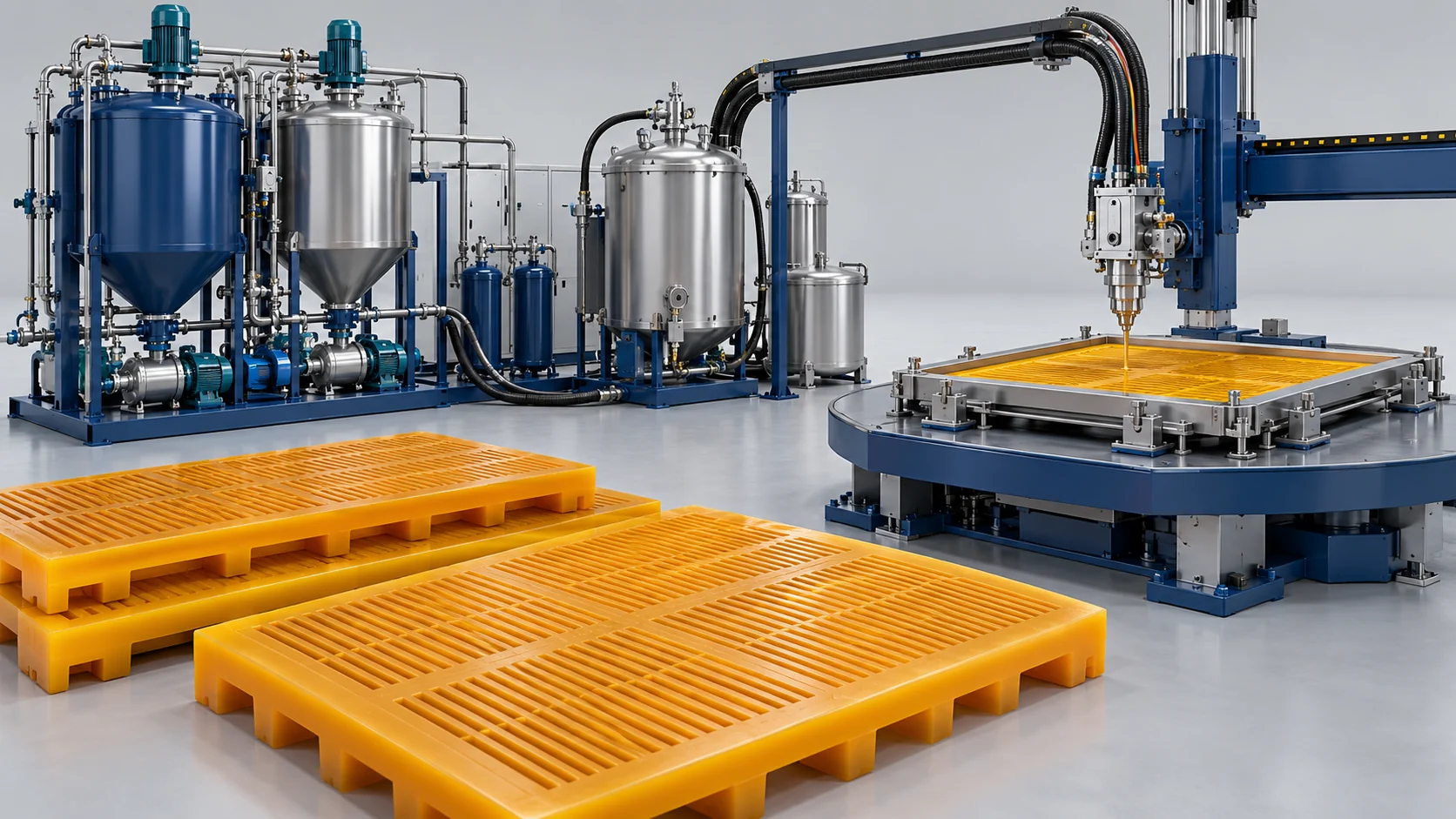
Mining Polyurethane Screen Casting Solution
Vacuum-assisted low-pressure CPU metering and dynamic mixing for fine-aperture screen panels, with stepped flow and configured mold-indexing interfaces.
Void-Free Infiltration for Severe Mineral Processing Media
Vacuum-assisted low-pressure CPU metering and dynamic mixing for fine-aperture screen panels, with stepped flow and configured mold-indexing interfaces. The package covers three primary feed streams, an auxiliary micro-catalyst stream, vacuum preparation, the sealed dispensing/tool interface, a heated rotary mold line and controls. Reinforcement loading robots and hydraulic mold handling are optional. Chemicals are supplied separately; compressed air and factory-floor interfaces are customer provisions.
Stepped-Flow Control
Programmed output profiles are matched to the screen runners, aperture geometry and cavity pressure.
Vacuum Tool Interface
A sealed dispensing interface supports configured mold evacuation; the stated mold vacuum uses gauge pressure.
The equipment package is selected against finished-part geometry, material, output target and factory interfaces. Material properties, life comparisons and inspection results require project-specific test records.
End-to-End Vacuum Screen Casting Workflow
A synchronized, automated manufacturing sequence from raw monomer degassing to demolded elastomeric screen panels.
Thermal Oil Degassing & Chemical Conditioning
PTMEG prepolymers and extenders undergo continuous thin-film vacuum degassing below 0.08 kPa at 90–110°C to extract residual air and moisture before dispensing.
Tool Loading & Negative-Pressure Evacuation
Steel tooling carrying pre-installed wire grids is indexed into the pouring station on an automated turntable; pneumatic valves seal the cavity and pull vacuum down to -0.09 MPa.
Stepped-Rate Dynamic Mixing & Injection
Servo-driven gear pumps meter components into a high-shear dynamic head, ramping discharge from 18 kg/min down to 3 kg/min matching mold fill backpressure.
Reference Solution Engineering Envelope
Supplied configuration references. Values depend on the stated formulation, tool and operating conditions; component qualification and reported project outcomes require separate records.
| Parameter | Value / Unit | Applicable Configuration / Conditions |
|---|---|---|
| Continuous Pouring Capacity | 3.0 to 18.0 kg/min | Stepped-rate variable servo-gear displacement |
| Tool Evacuation Pressure | Down to -0.09 MPa (Gauge) | High-speed multi-channel tool vacuum station |
| Dynamic Mixing Rotor Speed | 2,000 to 5,000 RPM | Multi-stage dynamic rotor with inverter control |
| Stoichiometric Mix Precision | Ratio tolerance within ±0.3% | Closed-loop Coriolis feedback across laminar flows |
| Supported Aperture Dimensions | Down to 0.5 mm slot widths | Fine-mesh dewatering and classification geometries |
| In-Mold Demolding Cycle | 8 to 10 minutes | Auxiliary tertiary catalyst micro-dosing system |
Core Equipment for This Solution
The package covers three primary feed streams, an auxiliary micro-catalyst stream, vacuum preparation, the sealed dispensing/tool interface, a heated rotary mold line and controls. Reinforcement loading robots and hydraulic mold handling are optional. Chemicals are supplied separately; compressed air and factory-floor interfaces are customer provisions.
Core Advantages of Haifeng Screen Casting Systems
Configured process controls and engineering interfaces for the selected equipment package.
Stepped-Flow Control
Programmed output profiles are matched to the screen runners, aperture geometry and cavity pressure.
Vacuum Tool Interface
A sealed dispensing interface supports configured mold evacuation; the stated mold vacuum uses gauge pressure.
Auxiliary Catalyst Feed
A separate micro-feed is configured for the selected recipe; stream identity, accuracy and cure window require calibration.
Thermal Conditioning
Jacketed feed circuits and mold-temperature interfaces are configured separately for the chemical system.
Related Project Draft
Review the project configuration described in the supplied brief. Project records and reported results require verification before public use.
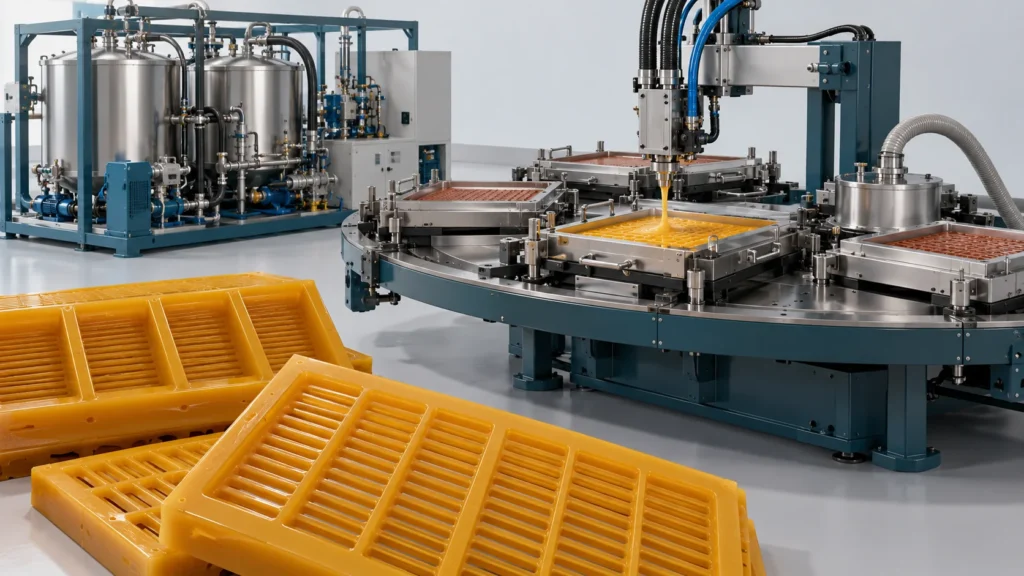
Frequently Asked Questions
Find answers about Mining Polyurethane Screen Casting Solution, including material selection, equipment configuration and the information needed to plan a production line.
How are stepped flow profiles selected for screen molds?
What is the pressure basis for the mold vacuum reference?
How are auxiliary dosing and head cleaning configured?
Can the package be integrated with a rotary mold line?
Request a Mining Screen Casting Equipment Proposal
Share the finished part or drawing, material system, target capacity, automation requirements and factory utilities so the equipment and tooling interfaces can be discussed.


