
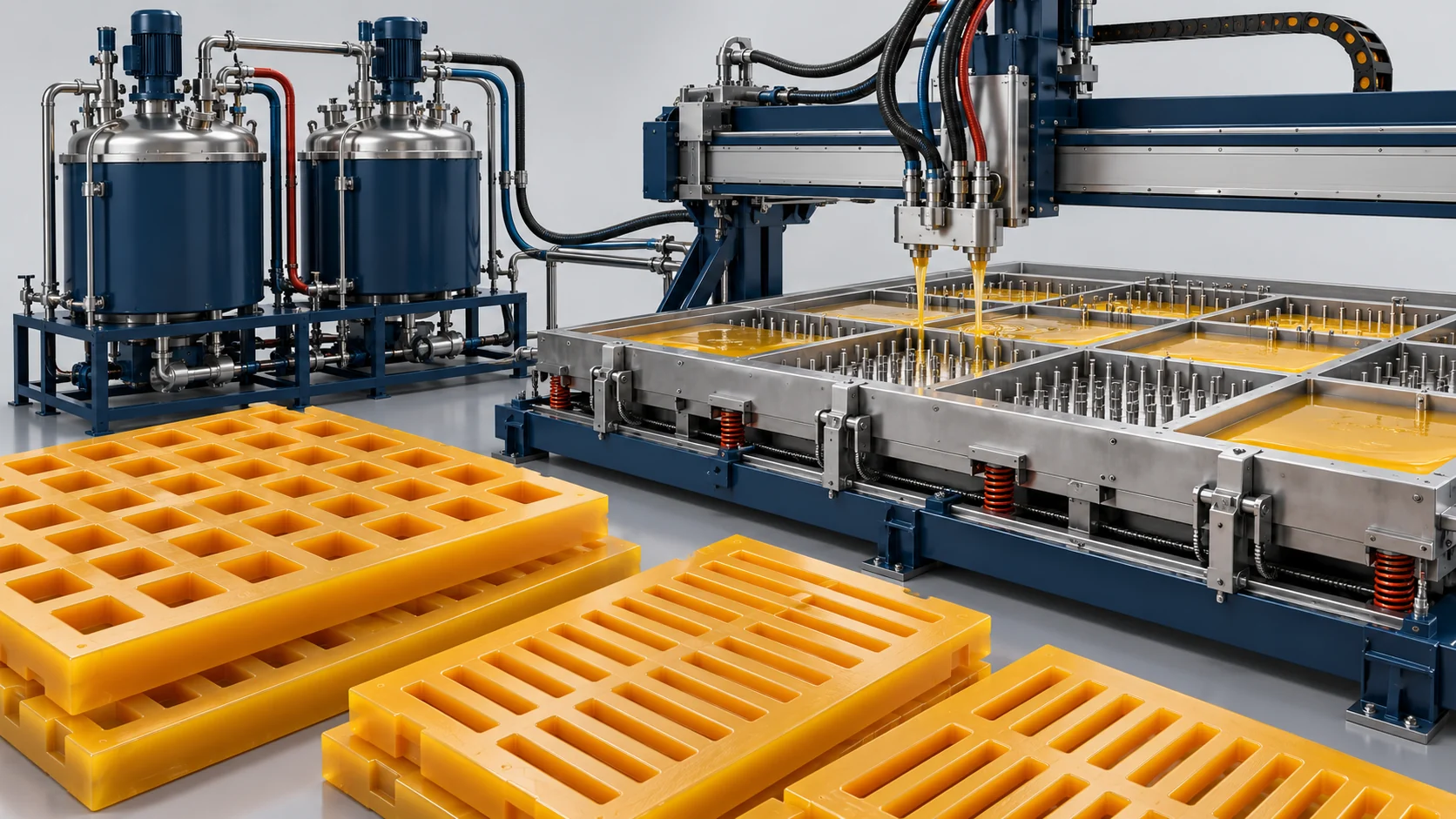
Polyurethane Screen Plate Casting Production Solution
Coordinate cast elastomer processing with screen aperture tooling, inserts and the required screening duty.
Build the Process Around Your Product
Coordinate cast elastomer processing with screen aperture tooling, inserts and the required screening duty.
Product and material first
Start with the finished-product drawing, material system and acceptance requirements. The process route and equipment configuration are assessed together.
Capacity across the whole process
Define output with preparation, forming/reaction, curing, handling and inspection included. The slowest stage and product changes determine practical line capacity.
Define aperture geometry, panel reinforcement and mounting before selecting casting and mold handling. Shot, mold population and cure determine the output sequence; aperture accuracy and insert retention need their own inspection.
From Preparation to Qualified Product
A planning sequence for the specified route. Final settings and acceptance conditions are established through material and part review.
Specify the screen
Review overall dimensions, aperture pattern, mounting details and wear environment.
Prepare molds and inserts
Confirm aperture-forming features, reinforcing elements, release system and venting.
Condition materials
Stabilize the selected wear-resistant formulation and prepare metering recipes.
Information Needed to Configure the Line
Provide these inputs so the equipment range, interfaces and validation plan can be defined.
| Design input | Information required |
|---|---|
| Screen drawing | Aperture dimensions, panel size, reinforcement and mounting pattern |
| Material selection | Hardness, abrasion duty and chemical exposure |
| Process plan | Shot mass, cure time, mold population and part handling |
| Quality checks | Aperture tolerance, flatness, insert retention and wear test method |
Core Equipment and Integrated Interfaces
The screen-casting unit is the metering core. Reinforcement preparation, molds and cure handling are selected interfaces; vacuum fine-screen equipment is not mandatory for every screen.
Coordinate the Equipment With the Process
Evaluate repeatability, handling and acceptance across the full workflow.
Aperture-specific tooling
Review runners, release and reinforcement around the actual screening openings.
Mold-cycle balance
Coordinate filling, cure, demolding and available molds with the order mix.
Panel inspection
Check aperture, flatness, mounts and the specified wear test.
Related Projects
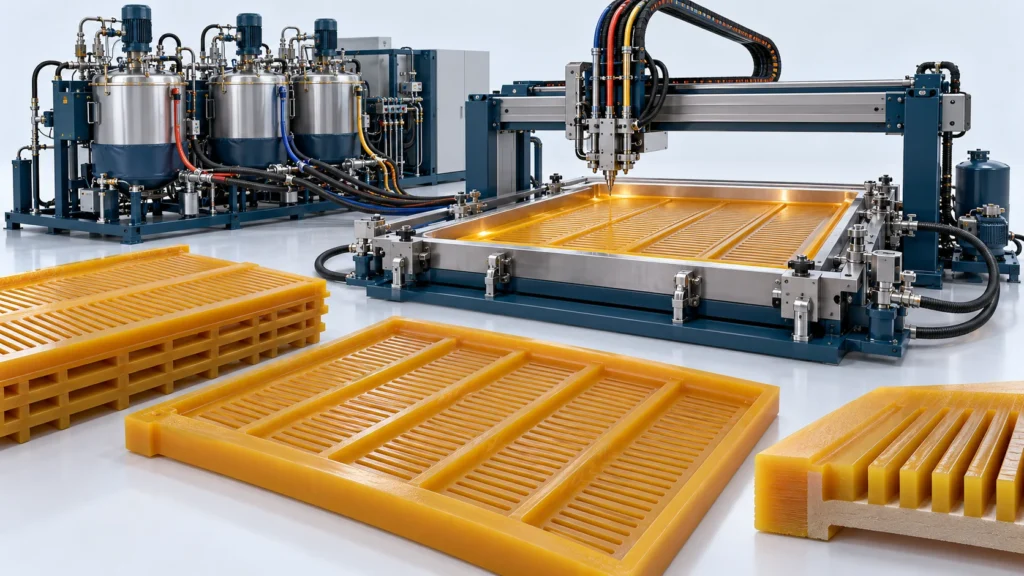
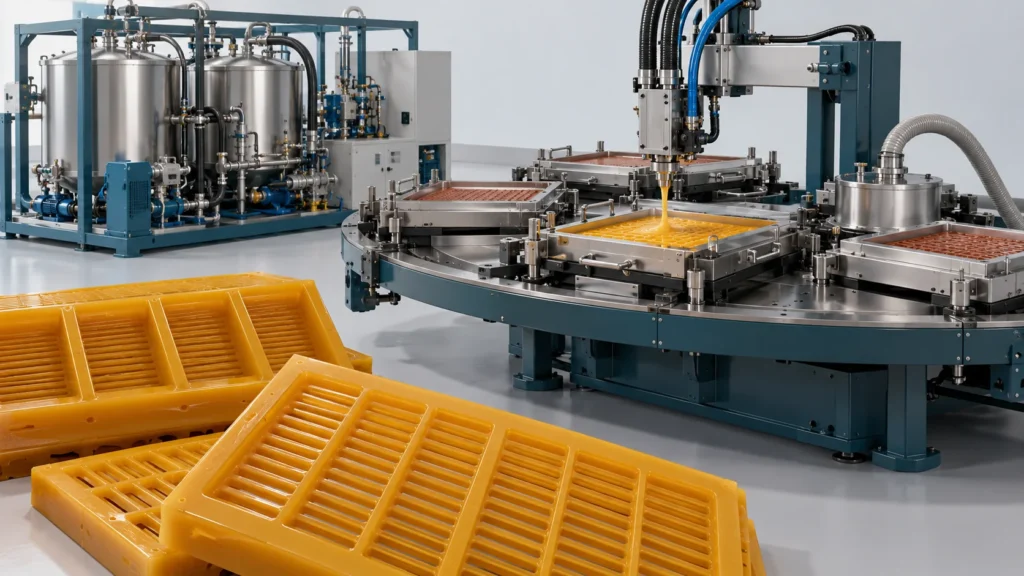
The linked upgrades concern their actual screen types and supplied modules, not every aperture or wear condition.
Frequently Asked Questions
Clarify the production route before selecting a machine.
What determines line capacity?
What information is needed to size the production line?
What is included in the equipment package?
Are cycle time and finished-product performance fixed?
How should screen tooling and production capacity be reviewed together?
Submit Your Production Goals
Share the following for this application: Screen/aperture drawing, panel size, reinforcement and mounts, wear/impact duty, material, shot and mold population. Our team will reply within one business day. Once requirements are clear, we provide a preliminary proposal within two business days.


