
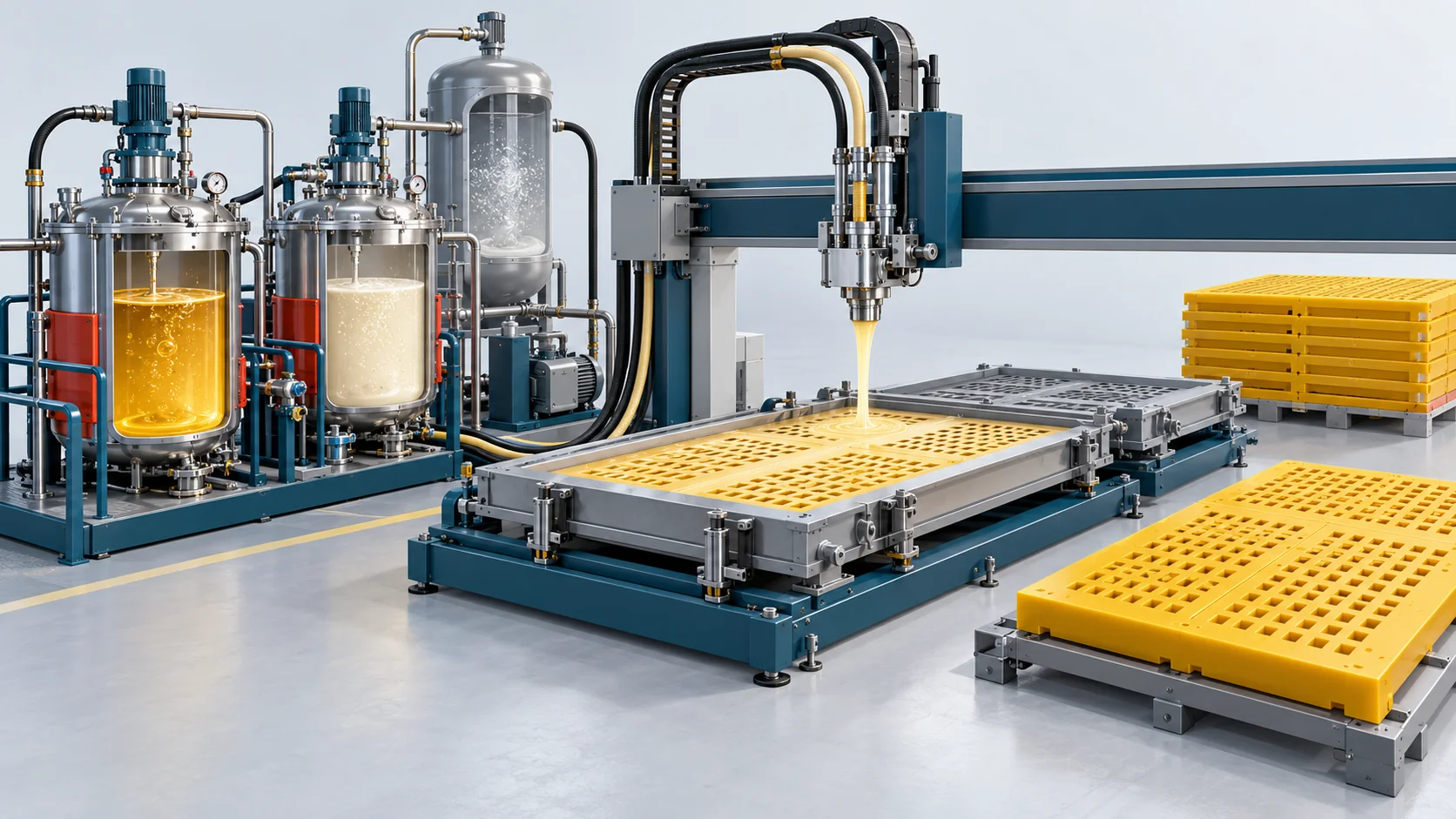
Vacuum PU Casting Machine | Mining Screen Panels
Vacuum-assisted low-pressure CPU metering and dynamic mixing for fine-aperture screen panels, with stepped flow and configured mold-indexing interfaces.
Stepped-Flow Vacuum Dispensing for Mineral Screen Panels
Vacuum-assisted low-pressure CPU metering and dynamic mixing for fine-aperture screen panels, with stepped flow and configured mold-indexing interfaces.
Vacuum-assisted low-pressure CPU metering and dynamic mixing for fine-aperture screen panels, with stepped flow and configured mold-indexing interfaces.
The package covers three primary feed streams, an auxiliary micro-catalyst stream, vacuum preparation, the sealed dispensing/tool interface, a heated rotary mold line and controls. Reinforcement loading robots and hydraulic mold handling are optional. Chemicals are supplied separately; compressed air and factory-floor interfaces are customer provisions.
Material Flow and Working Principle
Thermal Oil Conditioning & Prepolymer Degassing
The primary streams are conditioned in the configured heated vessels before metering. Tank capacities follow the model table; vacuum, temperature and drying requirements are confirmed for each stream.
Mold Evacuation & Sealing Docking
The multi-cavity screen mold clamped on the rotary turntable is evacuated to -0.09 MPa via vacuum valves, while the automated dispensing nozzle locks onto the mold sprue cup.
Stepped-Rate Dynamic Mixing
Servo-driven gear pumps meter components into a high-shear dynamic mixing head; output automatically transitions from 18 kg/min down to 3 kg/min as mold backpressure increases.
Vacuum Assisted Mold Infiltration
The reactive mixture is drawn through the vacuum-assisted mold runners, completely encapsulating internal structural steel wire frames and filling deep aperture rib geometries without voiding.
Fast Curing & Mechanical Demolding
Auxiliary catalyst dosing accelerates gelation within 8–10 minutes inside 100°C heated molds, followed by automated pneumatic pin ejection onto the curing conveyor.
Model and Technical Parameters
Configuration values from the supplied HF-CPU200-VS brief. Final performance is confirmed for the chemical formulation, tool, operating conditions and original calibration records. Casting-circuit pressure is distinct from finished-component service or qualification pressure.
| Technical Parameter | HF-CPU200-VS |
|---|---|
| Components | 3 Primary Streams + 1 Micro-Catalyst Stream |
| Output Range (g/s) | 3.0 to 18.0 kg/min (Continuous stepped adjustable) |
| Mixing Ratio Range | 100:8 to 100:45 (Prepolymer to Curative, by weight) |
| Ratio Accuracy | ±0.3% (Measured with steady Coriolis feedback) |
| Power Supply | 380V, 3-Phase, 50Hz (Custom 440V/480V 60Hz optional) |
| Working Pressure | 0.3 to 0.6 MPa (Metering lines and mixing head) |
| Tank Capacity (L) | Tank A: 150 L, Tank B: 80 L, Tank C: 40 L (Stainless steel) |
| Weight | 2,400 kg (Empty configuration on main skid) |
| Dimensions (L×W×H) | 2800 mm x 1900 mm x 2350 mm |
| Tool Evacuation Vacuum Level | Down to -0.09 MPa (Gauge pressure); Vacuum clamping station |
| Dynamic Stirring Speed | 2,000 to 5,000 RPM (Variable inverter drive); Mixing Chamber Rotor |
| Process Heating Limit | Up to 125°C (Circulating thermal oil jacket); Tanks, pumps, and delivery lines |
| Catalyst Dosing Accuracy | ±0.5 g/min (Micro servo injection valve); Auxiliary catalyst stream |
Key Equipment Features
The package covers three primary feed streams, an auxiliary micro-catalyst stream, vacuum preparation, the sealed dispensing/tool interface, a heated rotary mold line and controls. Reinforcement loading robots and hydraulic mold handling are optional. Chemicals are supplied separately; compressed air and factory-floor interfaces are customer provisions.
Stepped-Flow Control
Programmed output profiles are matched to the screen runners, aperture geometry and cavity pressure.
Vacuum Tool Interface
A sealed dispensing interface supports configured mold evacuation; the stated mold vacuum uses gauge pressure.
Auxiliary Catalyst Feed
A separate micro-feed is configured for the selected recipe; stream identity, accuracy and cure window require calibration.
Thermal Conditioning
Jacketed feed circuits and mold-temperature interfaces are configured separately for the chemical system.


