
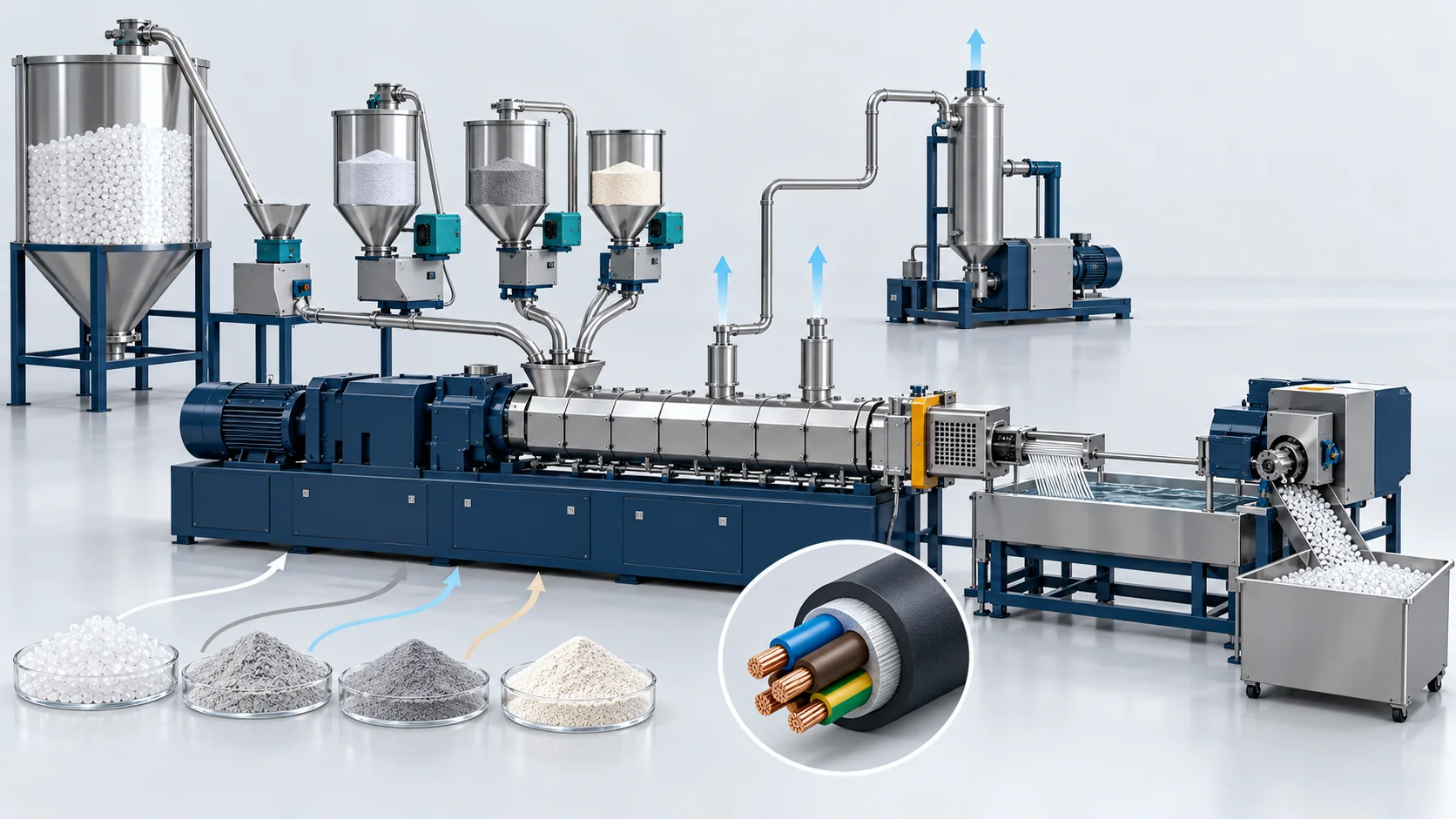
HFFR Flame Retardant TPU Solution
Configure TPU/mineral compounding and pelletizing for a defined halogen-free flame-retardant cable-grade formulation.
High-Filler Compounding Without Sacrificing Cable Flexibility
This route compounds a selected base TPU with mineral/additive feeds. Feeding, dispersion, venting and pelletizing must suit the powder and thermal window. Flame rating, elongation and cable surface quality are material or finished-cable results; they are not automatically provided by the line.
Defined supply scope
Define gravimetric feeds, side feeding, screw arrangement, venting and selected pelletizing. Base-TPU synthesis and final cable qualification are separate scope items.
Inputs for process selection
Base TPU, filler/additive data, loading, powder behavior, output, pelletizing choice and material/cable tests.
Equipment scope, retained factory interfaces and acceptance are agreed for the selected material and part. Define gravimetric feeds, side feeding, screw arrangement, venting and selected pelletizing. Base-TPU synthesis and final cable qualification are separate scope items.
HFFR Flame Retardant TPU Workflow
Characterize and feed → Melt and compound → Vent and pelletize → Test compound and cable samples. Define preparation, filling, cure and output timing separately for the selected configuration.
Characterize and feed
Confirm TPU, mineral/additives, dosing and powder handling.
Melt and compound
Validate temperature, side feeding and dispersion for the formulation.
Vent and pelletize
Establish devolatilization and the selected pelletizing/drying sequence.
Reference Solution Engineering Envelope
Existing configuration and test references. Equipment settings, material results and finished-assembly results are separate; apply each value only to its documented configuration and conditions.
| Parameter | Value / Unit | Applicable Configuration / Conditions |
|---|---|---|
| Continuous Production Output | 300.0 to 800.0 kg/hour | High-torque co-rotating twin-screw compounding line |
| Mineral Filler Loading Capacity | 40% to 60% by weight | Dual-stage forced side stuffers with powder de-aeration |
| Finished Material Flame Rating | UL94 V-0 (At 0.8 mm thickness) | Vertical burn test compliant with zero burning drips |
| Retained Tensile Elongation | Greater than or equal to 400% | ASTM D412 testing on compounded cable jacket matrix |
| Limiting Oxygen Index (LOI) | Greater than or equal to 35% | ASTM D2863 oxygen index measurement on compound |
| Pelletizing Mechanism Type | Die-face water-ring cutting | Tungsten-titanium carbide die plate with water ring |
Core Equipment for This Solution
Equipment references are selected by their documented process. Main metering, auxiliary supply and alternative routes are not a single standard package.
Process controls and application checks
Evaluate these functions with the selected material, tooling and production brief. Finished-part results require their own acceptance evidence.
Powder-specific supply
Evaluate bridging, aeration and addition rather than promising unrestricted filler handling.
Thermal-window control
Develop screw/temperature conditions around the selected polymer and filler.
Separate fire and cable tests
Keep specimen thickness, burn method and cable qualification explicit.
Related Projects
These are related application references. Compare the actual material, process and delivered modules; reported project figures are not acceptance results for another line.
Production Planning FAQ
Selection, supply scope and validation for this production route.
Does the compounding line guarantee V-0 or a robotic-cable grade?
Can every powder use the maximum filler reference?
What information is needed for a preliminary configuration?
Discuss Your Production Goals
Share the following with your production brief: Base TPU, filler/additive data, loading, powder behavior, output, pelletizing choice and material/cable tests. Our team will reply within one business day. Once requirements are clear, we provide a preliminary proposal within two business days.


