
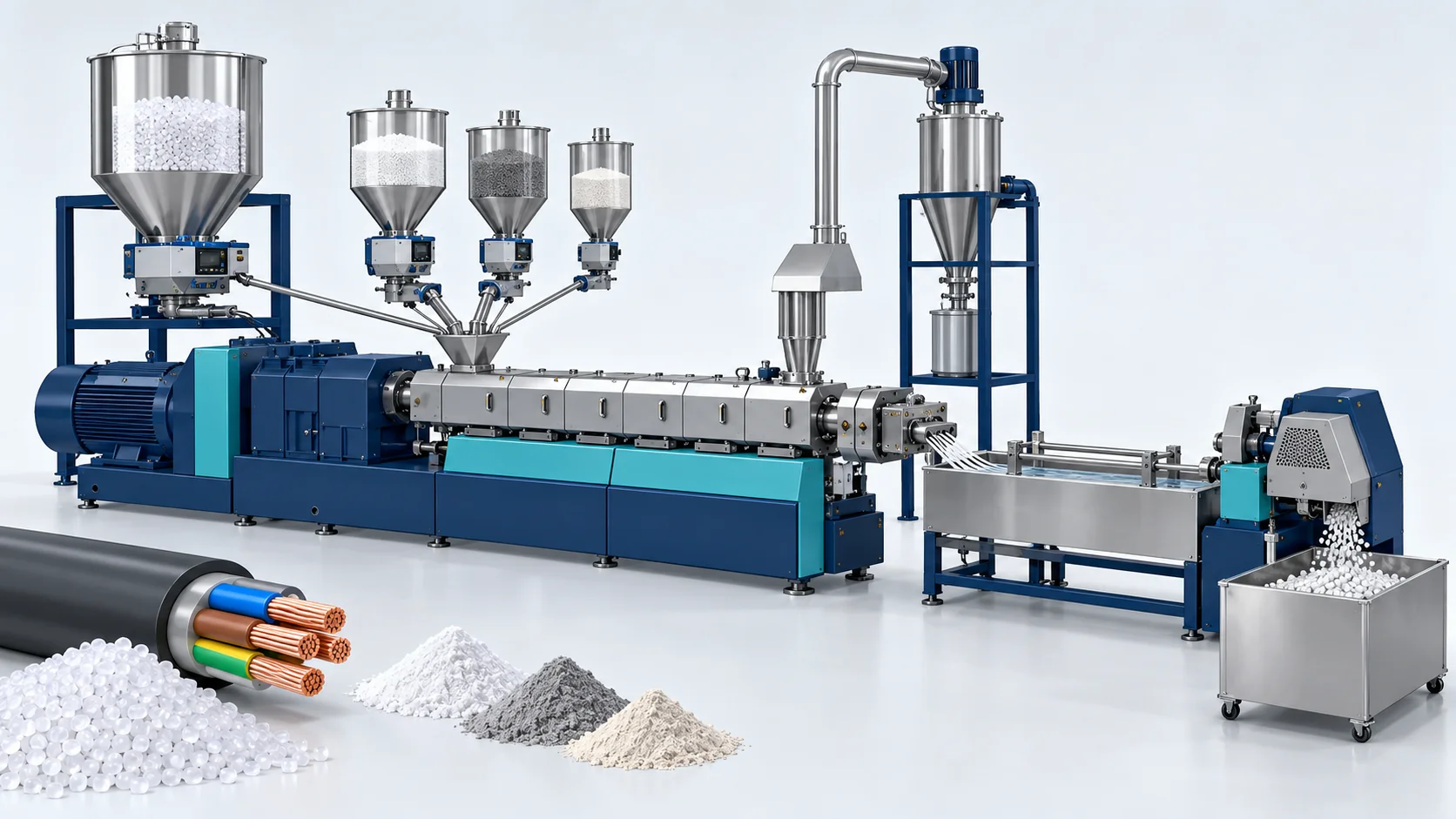
TPU Compounding Line | HFFR Cable Grades
Gravimetric TPU and mineral-additive feeding with configured compounding, venting and pelletizing for cable-grade development.
High-Filler Low-Shear Compounding for Flame-Retardant Cable TPU
Gravimetric TPU and mineral-additive feeding with configured compounding, venting and pelletizing for cable-grade development.
Gravimetric TPU and mineral-additive feeding with configured compounding, venting and pelletizing for cable-grade development.
Pellet feed, staged powder side feeds, liquid additives, compounding extruder and pelletizing stages; cable extrusion, final formulation and finished-cable qualification are separate.
This is pellet/additive compounding rather than a primary liquid reactive-polymerization route. UL 94 V-0 at 0.8 mm and oxygen index concern the tested compound/specimen; they do not establish cable qualification or machine certification. Feeder accuracy and final dispersion are different measures.
Concept illustration: Generated concept illustration for process discussion; not a photograph of the specified machine, a customer facility or a delivered project.
Material Flow and Working Principle
Gravimetric Loss-in-Weight Base Polymer Feeding
TPU base resin pellets and functional processing aids are metered into the main extruder throat via twin-screw gravimetric loss-in-weight feeders under digital mass-flow control.
Polymer Plasticization & Melt Homogenization
The base resin is gently melted across the initial five barrel zones through forward-conveying elements, establishing a sealed, molten polymer pool before filler entry.
Twin-Stage High-Volume Powder Side-Stuffing
Dense mineral flame-retardant powders (ATH/MCA) are de-aerated and rammed into the molten TPU pool via twin-screw co-rotating side feeders at up to 60% loading ratios.
Low-Shear Distributive Blending & Vacuum De-Watering
Specially profiled distributive mixing gears disperse powder aggregates into the matrix, while dual high-vacuum ports (0.05 kPa) strip mineral hydration moisture and trapped air.
Die-Face Water-Ring Pelletizing & Classification
The filled melt is extruded through wear-resistant carbide die plates, sliced by high-speed rotary cutters into water rings, centrifugally spin-dried, and classified by vibrating screens.
Model and Technical Parameters
Supplied HF-TPU75-HFFR configuration references, pending original calibration and acceptance documents. Material, finished-part and project outcomes are separate from equipment ratings. This is pellet/additive compounding rather than a primary liquid reactive-polymerization route. UL 94 V-0 at 0.8 mm and oxygen index concern the tested compound/specimen; they do not establish cable qualification or machine certification. Feeder accuracy and final dispersion are different measures.
| Technical Parameter | HF-TPU75-HFFR |
|---|---|
| Components | Solid Feeding (TPU Pellets + 2 Powder Streams + Liquid Additive) |
| Output Range (g/s) | 300.0 to 800.0 kg/h (Continuous compound output) |
| Mixing Ratio Range | 40% to 60% Mineral Filler by weight |
| Ratio Accuracy | ±0.3% (Gravimetric loss-in-weight feeders) |
| Power Supply | 380V, 3-Phase, 50Hz (Custom 440V/480V 60Hz optional) |
| Working Pressure | 8.0 to 14.0 MPa (Extruder die discharge and pelletizer head) |
| Tank Capacity (L) | Day hoppers: 1 x 500 L (Pellet), 2 x 300 L (Powder de-aerated) |
| Weight | 16,200 kg (Extruder, side feeders, and water-ring pelletizer) |
| Dimensions (L×W×H) | 20,500 mm x 3,600 mm x 3,100 mm |
| Flame Retardancy Classification | UL94 V-0 (At 0.8 mm specimen thickness); Standard vertical burning test; supplied reference pending original configuration or test records |
| Tensile Elongation at Break | ≥ 400% (ASTM D412 test on compounded cable core); Compound tensile test coupon; supplied reference pending original configuration or test records |
| Side Feeder Processing Capacity | Up to 500 kg/h (De-aerated powder compaction); Dual-stage co-rotating stuffer; supplied reference pending original configuration or test records |
| Limiting Oxygen Index (LOI) | ≥ 35% (ASTM D2863 oxygen index test); Finished HFFR TPU pellets; supplied reference pending original configuration or test records |
Key Equipment Features
Pellet feed, staged powder side feeds, liquid additives, compounding extruder and pelletizing stages; cable extrusion, final formulation and finished-cable qualification are separate.
UL94 V-0 at 0.8 mm Compliance
Supplied configuration reference: Optimized filler dispersion achieves self-extinguishing flame resistance compliant with UL94 V-0 and zero dripping. Actual capability requires material and tooling validation.
Dual-Stage Side-Feeding (Up to 60%)
Supplied configuration reference: High-capacity side stuffers ram bulky flame-retardant powders without hopper bridging or back-venting. Actual capability requires material and tooling validation.
Retained Elongation at Break > 400%
Supplied configuration reference: Low-shear distributive mixing prevents polymer chain degradation, preserving high cable flexibility. Actual capability requires material and tooling validation.
Water-Ring Die-Face Cutting
Supplied configuration reference: Eliminates frequent strand-break shutdowns common to water-cooled strand pelletizers on highly filled compounds. Actual capability requires material and tooling validation.


