
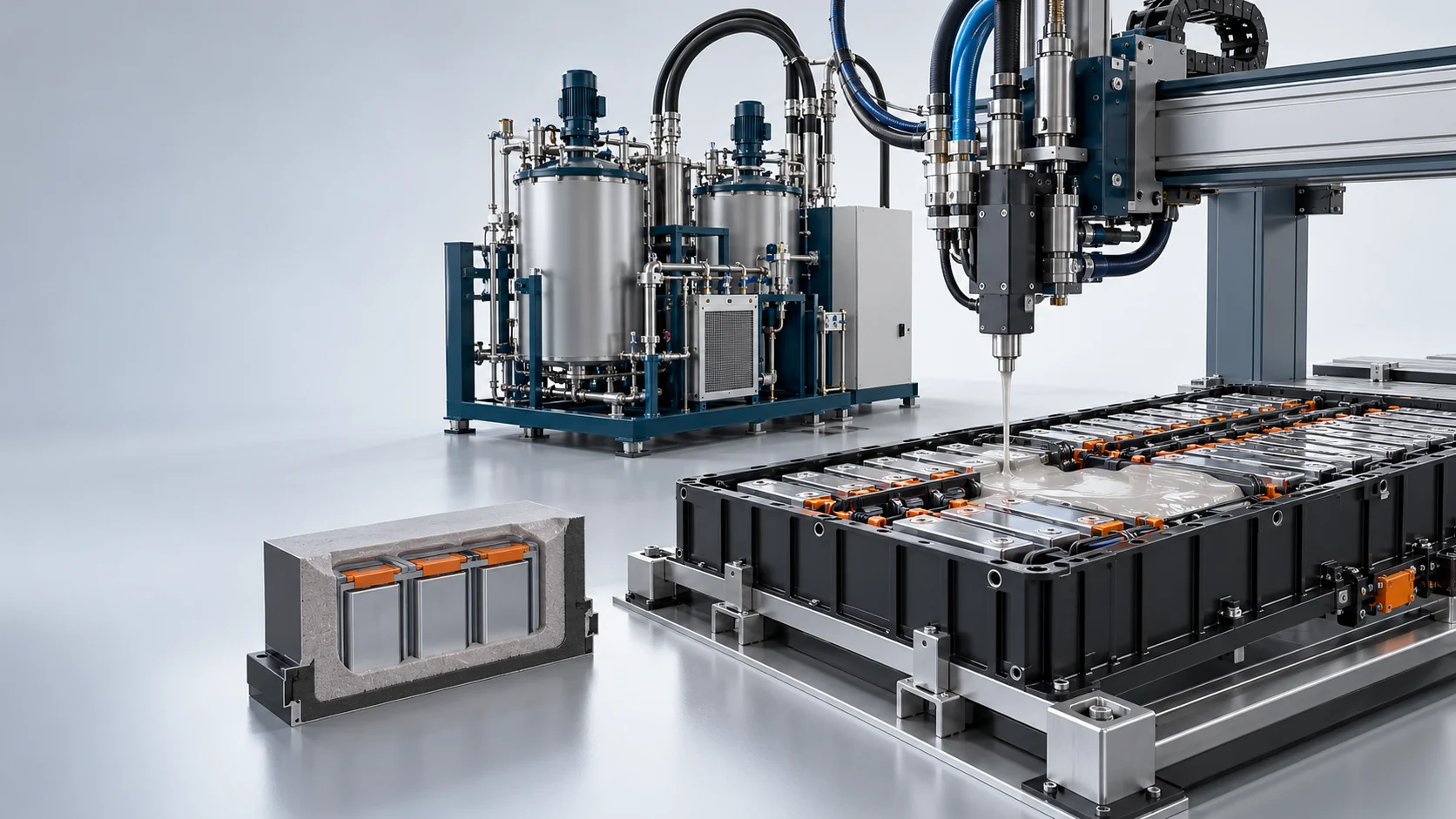
EV Battery Cell PU Potting Solution
Configured PU dispensing and module encapsulation processes. Finished battery safety requires pack-level design and testing under the applicable requirements.
Precision High-Pressure PU Potting for EV Cell Safety
Plan EV battery-cell encapsulation around the selected PU formulation, cell geometry, thermal-management design and inspection criteria. GB 38031-2025 specifies safety requirements and test methods for traction batteries; supplying dispensing equipment or selecting a flame-retardant material does not establish battery-pack compliance. Thermal-propagation performance, electrical insulation and void content require defined tests on the intended assembly.
Battery-System Safety Validation
Define the applicable battery-system safety requirements with the pack designer. Thermal-propagation results require representative assembly tests and source reports.
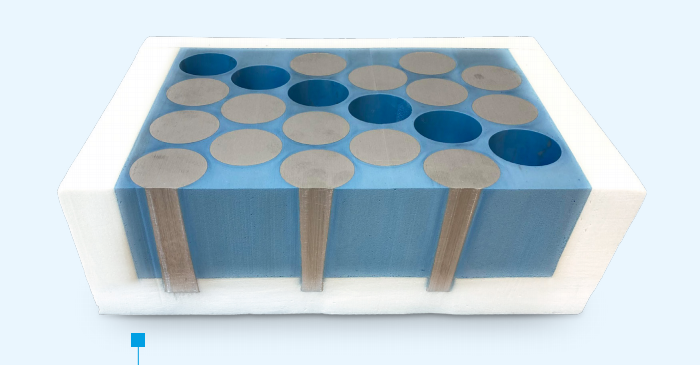
Filling and Void Inspection
Select mixing and dispensing arrangements through formulation and gap-filling trials. Validate void content using the agreed inspection method.
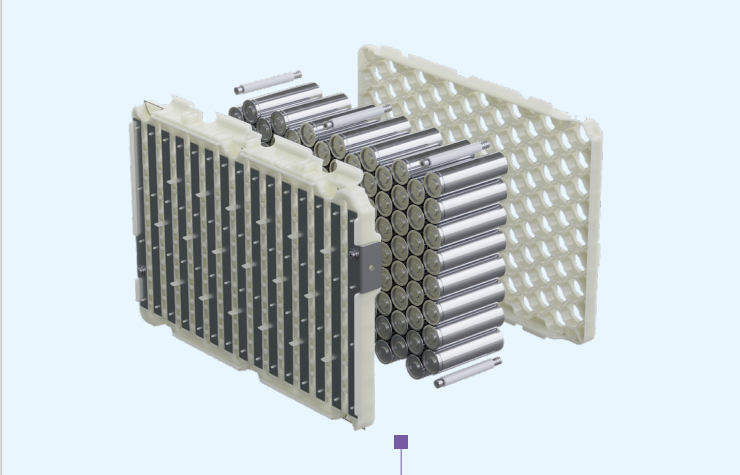
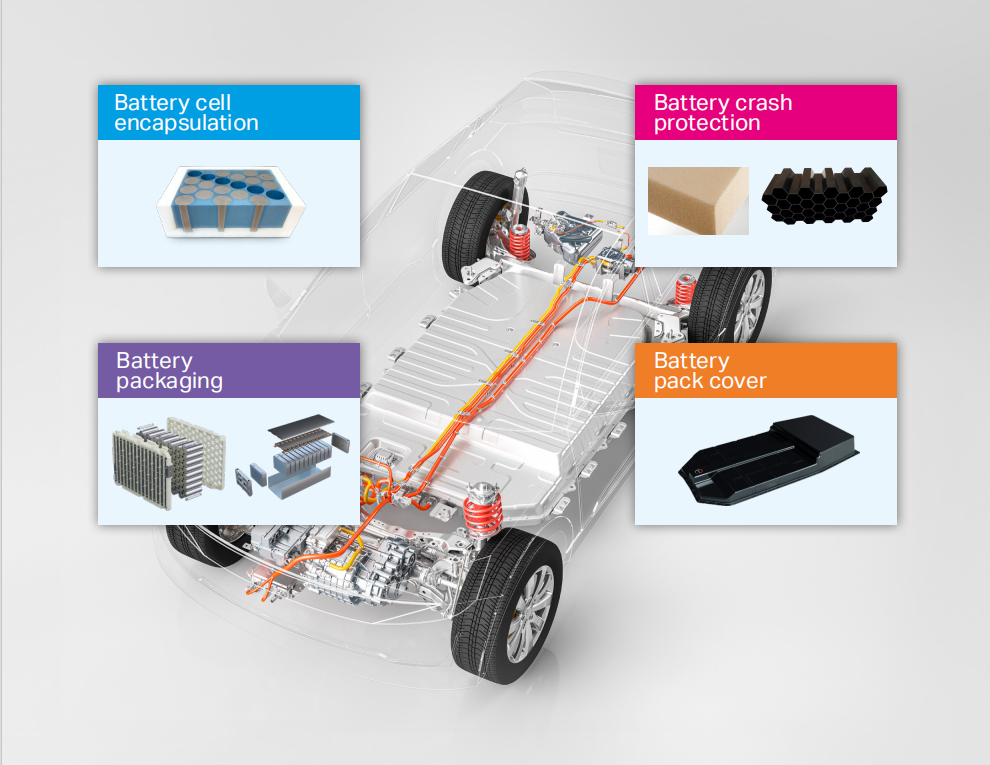
Haifeng delivers complete encapsulation systems—from closed-loop high-pressure metering units and multi-axis Cartesian dispensing gantries to optional curing lines and MES database synchronization—engineered for high-cadence gigafactory battery module assembly.
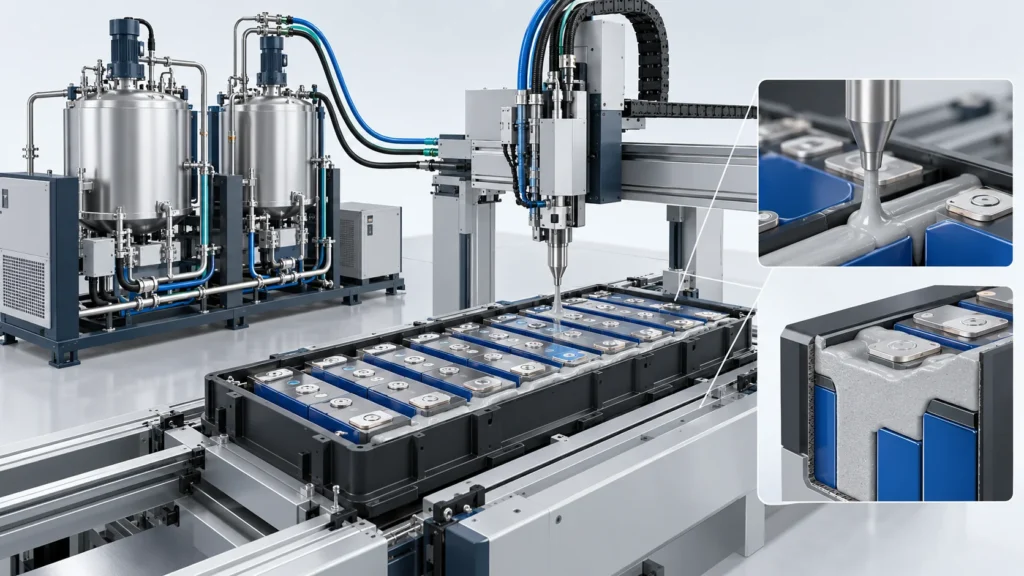
High-Pressure Battery Cell Potting Workflow
A synchronized four-stage workflow delivering high-cadence, bubble-free potting with 100% telemetry traceability per battery module.
Precise Fluid Temperature Management
Polyol and isocyanate precursors are conditioned in stainless steel jacketed tanks. Dual heat exchangers stabilize chemical temperatures within ±0.5°C to control reaction exotherm.
High-Pressure Impingement Dispensing
Servo-driven displacement pumps meter precursors into an L-shaped high-pressure mixing head mounted on a 3-axis CNC gantry, dispensing exact shot weights into battery module crevices.
Capillary Expansion & Void-Free Filling
The injected reaction mass flows freely into ultra-narrow cell interspaces, expanding into low-density microcellular foam that locks cells in place without generating excessive internal stress.
Engineering Specifications & Technical Parameters
Operational parameters for the Haifeng EV battery cell polyurethane potting system.
| Technical Parameter | Standard Specification / Value | Engineering Context & Verification |
|---|---|---|
| Target Application | Cylindrical (21700/4680) & Prismatic Cell Modules | EV battery pack thermal isolation & potting |
| Material Formulation | Dual-Component Flame-Retardant PU Microcellular Foam | Flame rating requires the selected formulation test report |
| Metering Output Capacity | 5 – 30 kg/min (Customizable) | Servo axial piston pumps with Ratio Lock |
| Dispensing Weight Repeatability | ±1.0% | Reference target; confirm the calibration procedure and records |
| Chemical Viscosity Tolerance | Up to 15,000 mPa·s | Dynamic high-pressure circulation |
| Thermal Containment Rating | Project-specific pack test required | Battery-system safety validation; not an equipment certificate |
| Dielectric Insulation Resistance | ≥100 Ω/V (DC Circuit) | Confirm electrical insulation by the agreed assembly test |
| Dispensing Head Shut-Off | 0.3 seconds | Anti-drip hydraulic clean needle cut-off |
| Scope of Supply | Turnkey (Potting Skid, Gantry, TCU + Optional MES/Fixtures) | Complete workcell delivery or cleanroom integration |
Key Engineering Advantages
Why leading power battery and EV manufacturers deploy Haifeng high-pressure potting solutions.
Configured Dispensing
Select material preparation, mixing and dispensing arrangements through representative trials.
Defined Inspection
Agree on void-content, shot-weight and cured-part inspection criteria.
Battery-System Validation
Pack safety and thermal-propagation performance require separate system-level assessment.
Traceability Interfaces
Confirm parameter recording and MES integration in the contracted scope.
Proven Manufacturing Project
Review related encapsulation application references. Project-specific battery safety conclusions require their test records.
Frequently Asked Questions
Engineering and purchasing questions about this polyurethane production route.
How does polyurethane foam potting compare to silicone or epoxy potting for EV cells?
How does this potting line help fulfill the GB 38031-2025 safety regulation?
How is filling quality assessed in narrow cell gaps?
Can this potting line upload real-time parameters directly to our factory MES?
What is the standard on-site installation and validation timeline?
Discuss Your EV Battery Potting Project with Haifeng
Contact our engineering team for module potting layouts, formulation compatibility testing, and turnkey gigafactory quotations.


