
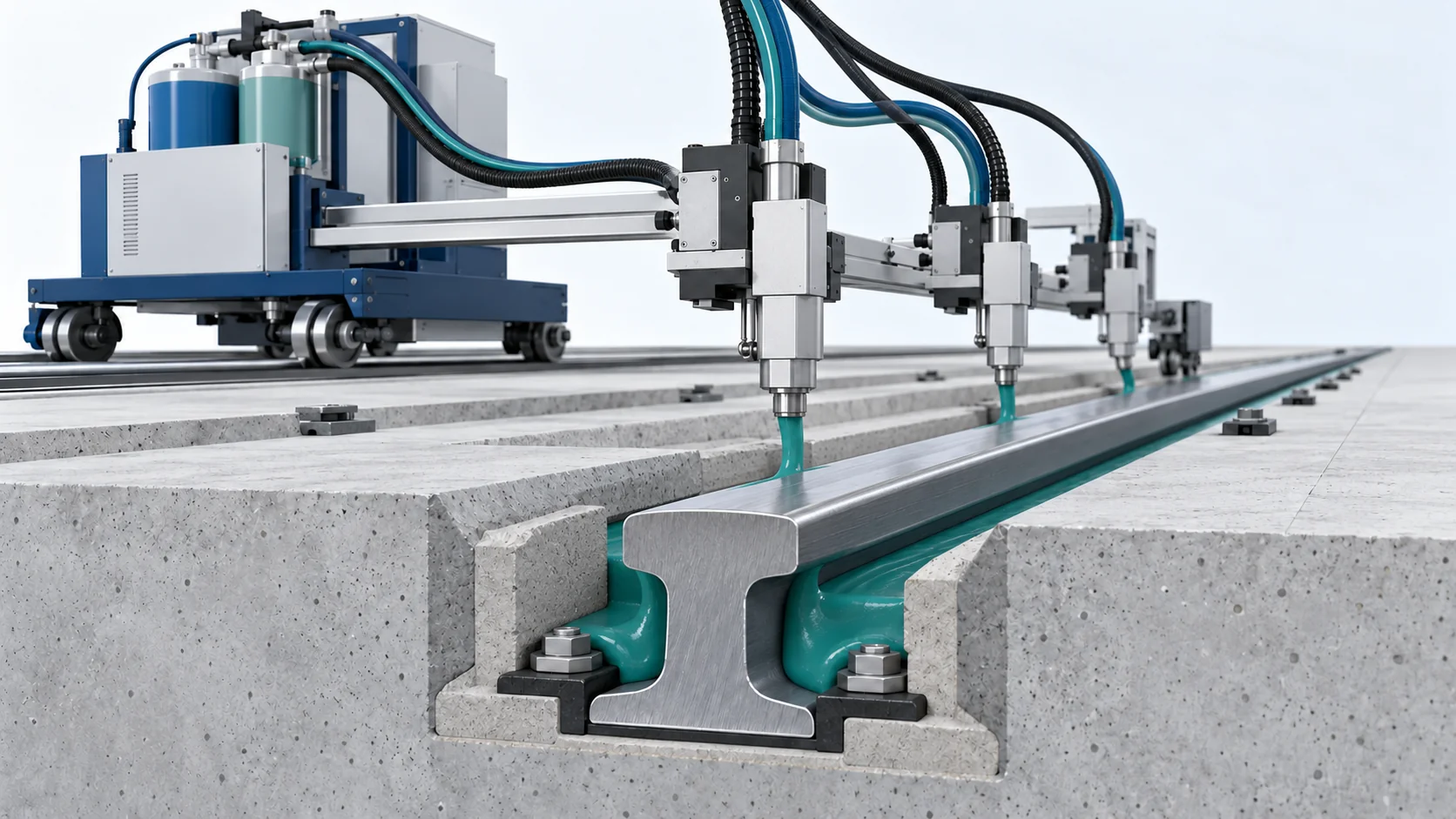
Embedded Rail Channel Damping Solution
Plan continuous two-component polyurethane rail-channel filling with travel-synchronized metering, multiple dispensing heads, surface preparation and controlled curing.
Continuous Elastic Support for Quiet, Low-Maintenance Transit Lines
Plan continuous two-component polyurethane rail-channel filling with travel-synchronized metering, multiple dispensing heads, surface preparation and controlled curing. The configured scope covers mobile material handling, conditioned two-component feed, multi-head metering and mixing, travel encoders and primer interfaces. Carrier geometry, access, ventilation, power, track gauge and structural clearances require a site-specific design; a suspended monorail is not assumed to accept a standard road-rail vehicle.
Product, material and tooling
The configured scope covers mobile material handling, conditioned two-component feed, multi-head metering and mixing, travel encoders and primer interfaces. Carrier geometry, access, ventilation, power, track gauge and structural clearances require a site-specific design; a suspended monorail is not assumed to accept a standard road-rail vehicle.
Capacity and acceptance
Review all preparation, dispensing, curing, handling and inspection stages. Material and component results require separate original test records.
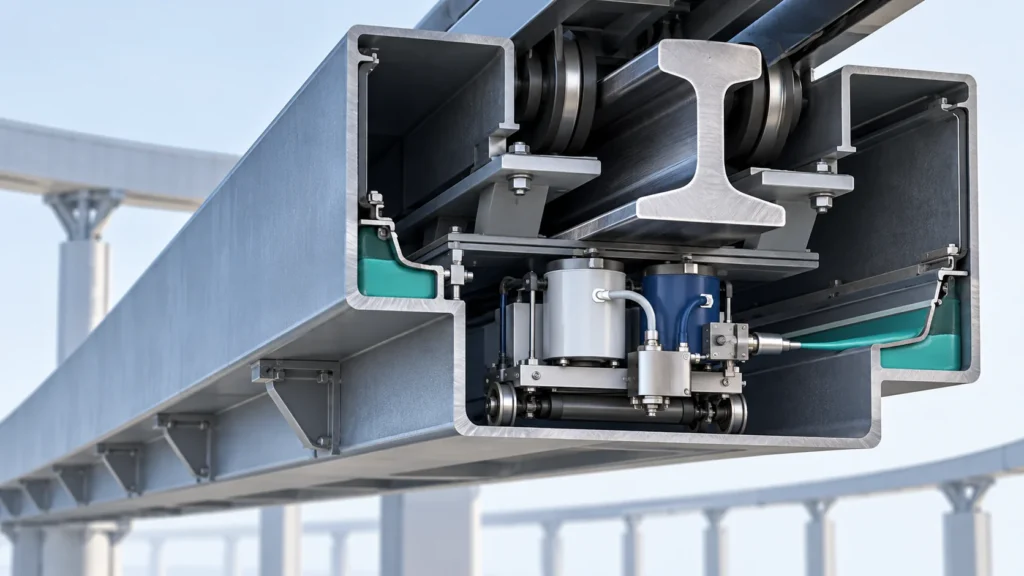
Configuration references are reviewed for the selected material, product geometry and acceptance conditions. The solution describes embedded channels; the case describes a suspended monorail steel girder. Confirm access and carrier architecture separately. Vibration-level dB and sound-pressure dB are not interchangeable; the reference quantity and method must be supplied.
Turnkey Embedded Rail Channel Grouting Process
The supplied process sequence is a configuration reference. Temperature, pressure, output and cure settings are confirmed for the selected material and tooling. The solution describes embedded channels; the case describes a suspended monorail steel girder. Confirm access and carrier architecture separately. Vibration-level dB and sound-pressure dB are not interchangeable; the reference quantity and method must be supplied.
Trough Debris Evacuation & Primer Application
Configured reference: High-velocity air blowers evacuate debris from concrete troughs, followed by automated spray application of moisture-barrier polyurethane primer.
Road-Rail Vehicle Alignment & Track Coupling
Select the carrier, guide wheels, access and power arrangement for the actual track architecture. Standard-gauge road-rail access is not assumed for a suspended monorail.
Optical Speed Slaving & Four-Stream Metering
Configured reference: Optical ground encoders measure vehicle crawling velocity (1–5 m/min), dynamically commanding four servo gear pumps to maintain constant flow.
Reference Solution Engineering Envelope
Values transcribed from the supplied configuration brief. Material properties and finished-product benchmarks are separate validation targets, not general equipment guarantees.
| Parameter | Value / Unit | Applicable Configuration / Conditions |
|---|---|---|
| Combined Dispensing Flow Rate | 10.0 to 50.0 kg/min | Four-channel servo-driven rotary gear pumps; supplied reference requiring configuration or test verification |
| Vehicle Creep Working Speed | 1.0 to 5.0 m/min | Hydraulic stepless crawl drive with encoder slaving; supplied reference requiring configuration or test verification |
| Finished Surface Height Variance | Within ±1.0 mm | Continuous speed-slaved automatic level regulation; supplied reference requiring configuration or test verification |
| Steel-to-Elastomer Bond Strength | Greater than 3.0 MPa | ASTM D4541 pull-off testing on primed steel rails; supplied reference requiring configuration or test verification |
| Roadside Vibration Attenuation | Up to 12 dB drop | Measured against standard rigid fastener trackbeds; supplied reference requiring configuration or test verification |
| Daily Construction Progress | 1.5 to 2.0 km/day | Double-track continuous four-channel dispensing; supplied reference requiring configuration or test verification |
Core Advantages of Haifeng Embedded Rail Systems
Engineering functions and interfaces developed for the specified product and material system.
Travel-Synchronized Feed
Configure and validate travel-synchronized feed for the selected product, formulation, tooling and production conditions.
Multi-Head Dispensing
Configure and validate multi-head dispensing for the selected product, formulation, tooling and production conditions.
Surface Preparation
Configure and validate surface preparation for the selected product, formulation, tooling and production conditions.
Site Access Engineering
Configure and validate site access engineering for the selected product, formulation, tooling and production conditions.
Related Project Draft
Review the project configuration described in the supplied brief. Project records and reported results require verification before public use.
Frequently Asked Questions
Technical questions to establish the equipment scope, material window and validation plan.
How is dispensing synchronized to travel speed?
How are bond durability and electrical properties verified?
When can a treated track be reopened?
How is the carrier configured for different track architectures?
Request an Embedded Rail Channel Grouting Proposal
Share your finished product or drawing, material system, target capacity, automation requirements and factory conditions to discuss the line configuration.


