
Sports Footwear Leather Line Project in China
Review draft: Sports Footwear Leather Line Project. Configuration and reported outcomes require original project records.
Project Overview
Illustration notice. Process illustrations are not verified photographs of this installation.
Project reference basis. Figures and configuration details are reported in the supplied project brief. They are reference values for the stated application, rather than verified acceptance results or a guarantee for another installation. Confirm the source records, material, tooling, operating schedule and test method when assessing a comparable project.
A leading high-performance sports synthetic leather manufacturer in Fujian deployed Haifeng’s precision dry-process release paper transfer coating and lamination line. The project was commissioned to manufacture elite-tier synthetic leather uppers for international professional football boots and alpine running shoes.
Previously, the client operated older knife-over-roll coating machines. Spool tension fluctuations at speeds above 20 m/min frequently caused release paper creasing and tears, halting production up to 12 times per week. Coating thickness variations (±8 µm) created uneven skin modulus; during mandatory laboratory testing, shoes developed visible micro-cracking and whitening along flex lines after only 50,000 to 80,000 cycles at -20°C. Interfacial peel strengths stalled around 40 N/3cm, failing elite athletic brand audits.
Haifeng engineered and commissioned a complete high-precision transfer line centered on the HF-DPC180-TR platform. Incorporating closed-loop servo tension dancers (holding tension within ±2 N) and an enclosed slot die extrusion head, the line produced footwear leather with peel strengths reaching 62.5 N/3cm and surviving 200,000 cold flex cycles at -20°C without cracking.
Review point: Topcoat and adhesive circuits have different chemistry and rates. Dry-process is not synonymous with solvent-free. Flex testing, coating peel strength and VOC performance require substrate, temperature, thickness, conditioning and original reports; finished leather results are not equipment certifications. ISO 5423 is a polyurethane industrial-boot specification; citing it alone does not establish a general synthetic-leather cold-flex method. Identify the applicable annex, material scope and report.
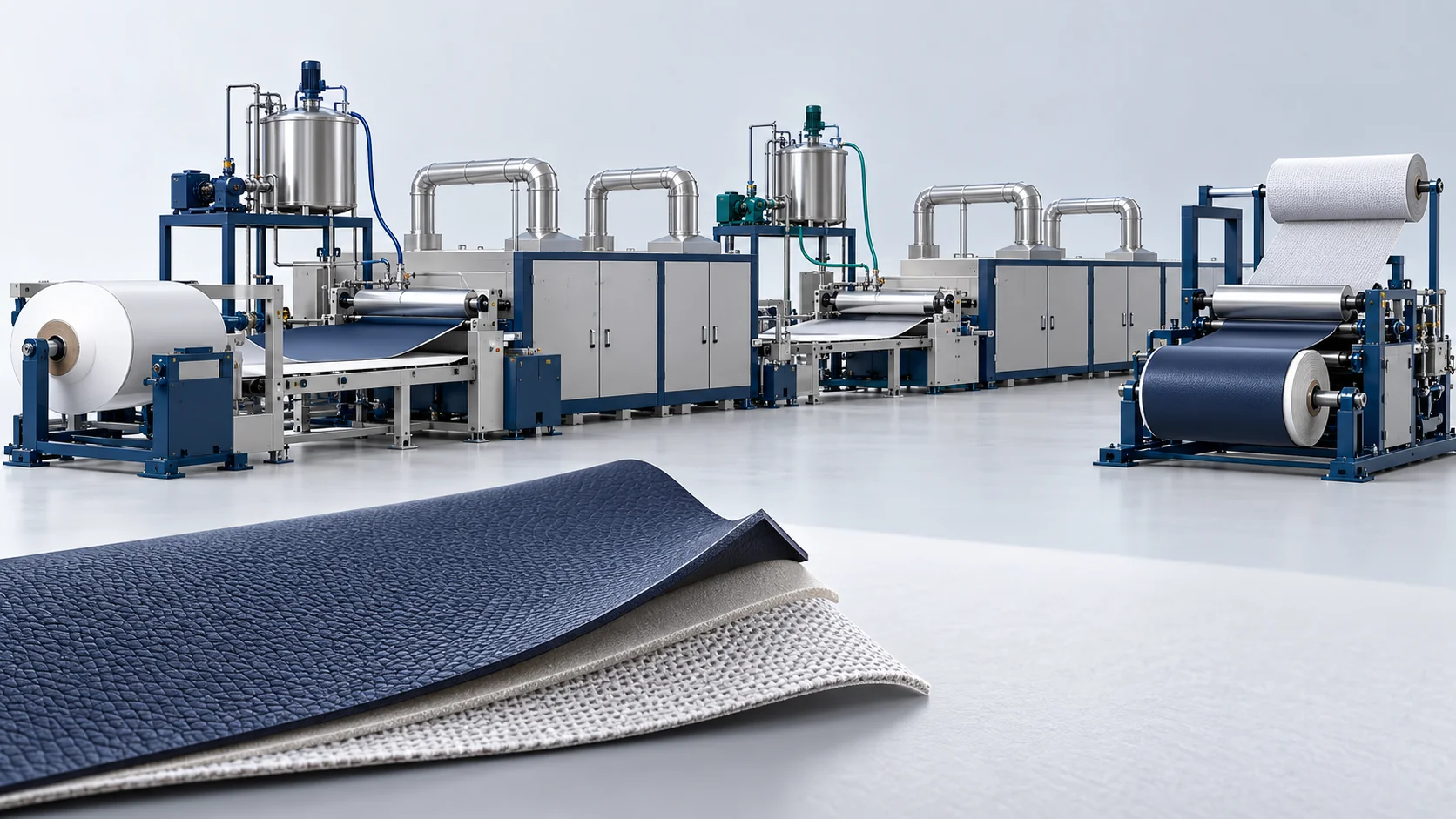
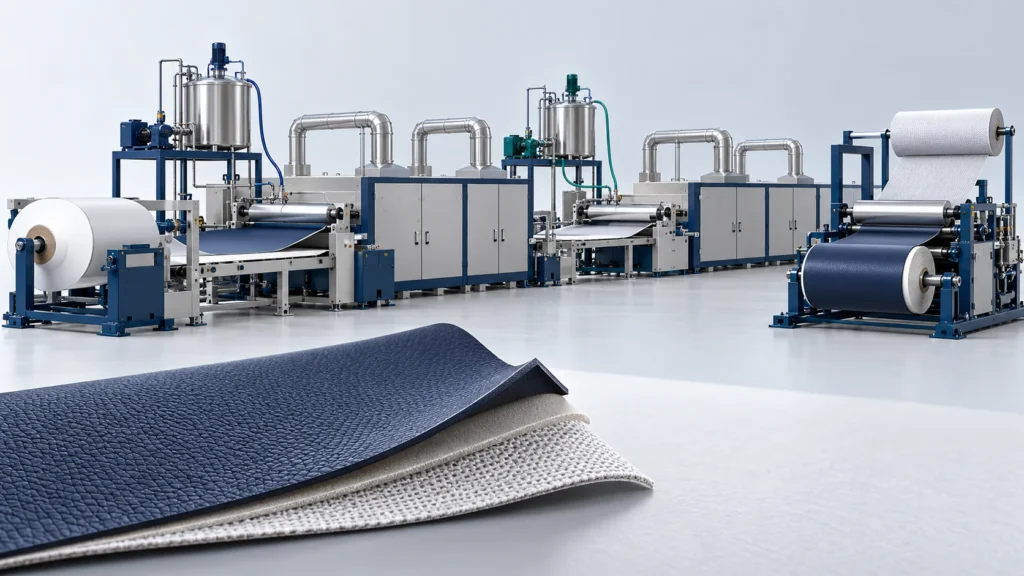
Concept illustration: Generated concept illustration for process discussion; not a photograph of the specified machine, a customer facility or a delivered project.
Solutions Delivery
Configuration reported in the supplied brief.
Haifeng engineered an automated roll-to-roll continuous transfer line spanning 58 meters in process length. Textured silicone release paper is unwound through dual flying-splice turrets, where servo-driven floating dancer arms stabilize web tension within ±2 N at continuous operating speeds of 22 m/min.
High-viscosity polyether polyurethane skin resin is extruded through an enclosed slot die manifold across the 1,420 mm paper width, laying down a uniform 0.08 mm liquid layer with thickness variance under ±1.5 µm. The wet web traverses a 30-meter progressive hot air tunnel (75°C to 125°C), evaporating carrier solvents and crosslinking the polymer without micro-blisters.
At the lamination station, a precision reverse roll coater applies a two-component reactive polyurethane adhesive (0.10 mm), married immediately to high-tenacity microfiber nonwoven base fabrics via pneumatic nip rolls under 0.6 MPa linear pressure. Following a secondary 24-meter cure tunnel, chilling drums, and automatic paper peeling, the finished leather achieves peel strengths of 62.5 N/3cm with zero grain distortion.
Topcoat and adhesive circuits have different chemistry and rates. Dry-process is not synonymous with solvent-free. Flex testing, coating peel strength and VOC performance require substrate, temperature, thickness, conditioning and original reports; finished leather results are not equipment certifications. ISO 5423 is a polyurethane industrial-boot specification; citing it alone does not establish a general synthetic-leather cold-flex method. Identify the applicable annex, material scope and report.
| Equipment | Model | Qty | Function |
|---|---|---|---|
| Precision Dry-Process Transfer Coater | HF-DPC180-TR | 1 complete line | Core ±2 N tension unwinding, slot die coating, and progressive drying. |
| Enclosed Precision Slot Die Head | HF-SDH-1600 | 1 unit | Extrudes topcoat resin uniformly across 1,420 mm paper with ±1.5 µm tolerance. |
| Dual-Spindle Flying-Splice Unwinder | HF-FSU-02 | 2 units | Automated continuous roll unwinding and high-speed splicing without line stops. |
| Two-Component Adhesive Metering Unit | HF-ADU-01 | 1 set | Continuous servo metering and dynamic mixing of reactive lamination adhesive. |
Reported Results — Original Records Required
Upgrade Your Athletic Footwear Synthetic Leather Line
Connect with Haifeng coating specialists to deploy precision slot die transfer lines engineered for high-peel, cold-flex resistant footwear materials.


