
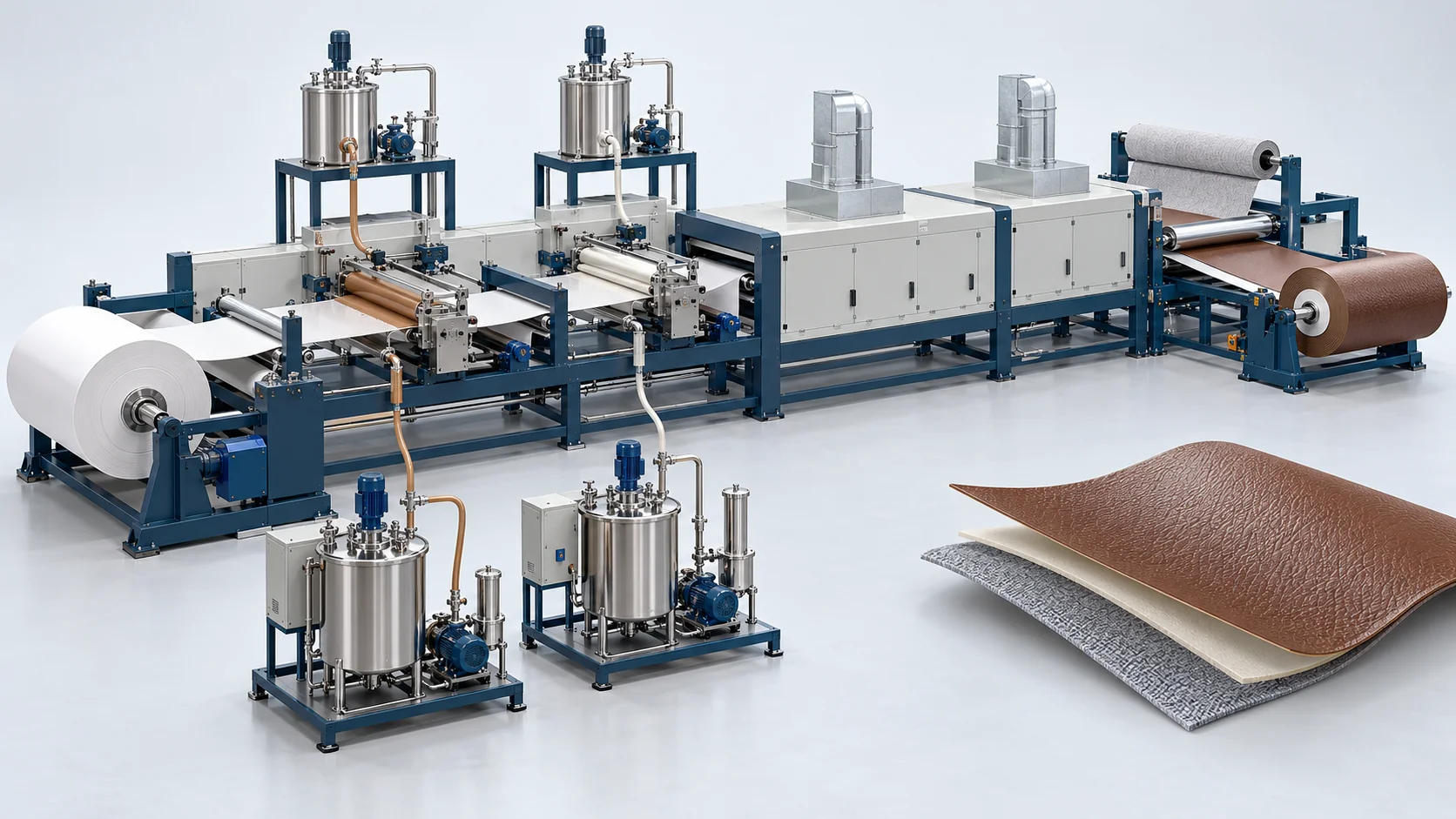
PU Transfer Coating Line | Dry-Process Leather
Release-paper topcoat and adhesive delivery, coordinated drying and lamination for dry-process PU synthetic leather.
Precision Dry-Process Transfer Coating for Performance Footwear
Release-paper topcoat and adhesive delivery, coordinated drying and lamination for dry-process PU synthetic leather.
Release-paper topcoat and adhesive delivery, coordinated drying and lamination for dry-process PU synthetic leather.
Topcoat supply, proportioned adhesive stream, coating dies, ovens, laminator and winding interfaces; release paper, fabric, resin chemistry and solvent recovery are specified separately.
Topcoat and adhesive circuits have different chemistry and rates. Dry-process is not synonymous with solvent-free. Flex testing, coating peel strength and VOC performance require substrate, temperature, thickness, conditioning and original reports; finished leather results are not equipment certifications. ISO 5423 is a polyurethane industrial-boot specification; citing it alone does not establish a general synthetic-leather cold-flex method. Identify the applicable annex, material scope and report.
Concept illustration: Generated concept illustration for process discussion; not a photograph of the specified machine, a customer facility or a delivered project.
Material Flow and Working Principle
Continuous Tension-Controlled Paper Unwinding & Splicing
Textured silicone release paper is unwound continuously, with servo accumulators executing non-stop flying splices while dancer rolls hold web tension within ±2 N.
Enclosed Slot Die Topcoat Application
High-viscosity polyether polyurethane skin resin is metered through an enclosed slot die head, depositing a uniform 0.05–0.12 mm liquid layer with thickness variance under ±1.5 µm.
Multi-Zone Progressive Evaporation & Skin Crosslinking
The coated paper passes through a 30-meter progressive hot air tunnel (70°C to 130°C), evaporating carrier solvents and crosslinking the polyurethane matrix without blistering.
Adhesive Coating & Textile Lamination Nip
A secondary reverse roll applies a two-component polyurethane bonding adhesive (0.08 mm); pneumatic nip rollers marry the wet adhesive to knitted or microfiber base fabrics.
Final Curing, Paper Stripping & Rewinding
The composite cures through a 24-meter secondary oven, chills over cooling drums, and separates from the release paper, yielding finished leather with peel strength > 60 N/3cm.
Model and Technical Parameters
Supplied HF-DPC180-TR configuration references, pending original calibration and acceptance documents. Material, finished-part and project outcomes are separate from equipment ratings. Topcoat and adhesive circuits have different chemistry and rates. Dry-process is not synonymous with solvent-free. Flex testing, coating peel strength and VOC performance require substrate, temperature, thickness, conditioning and original reports; finished leather results are not equipment certifications. ISO 5423 is a polyurethane industrial-boot specification; citing it alone does not establish a general synthetic-leather cold-flex method. Identify the applicable annex, material scope and report.
| Technical Parameter | HF-DPC180-TR |
|---|---|
| Components | Topcoat 1 Component + Adhesive 2 Components (Base + Crosslinker) |
| Output Range (g/s) | Topcoat: 20–100 kg/h; Adhesive: 30–120 kg/h |
| Mixing Ratio Range | Adhesive 100:3 to 100:10 (By weight) |
| Ratio Accuracy | ±0.3% (Continuous mass flow feedback on adhesive stream) |
| Power Supply | 380V, 3-Phase, 50Hz (Custom 440V/480V 60Hz optional) |
| Working Pressure | 0.3 to 0.5 MPa (Slot die and adhesive line) |
| Tank Capacity (L) | Day tanks: 2 x 200 L (Stainless steel with pneumatic stirrers) |
| Weight | 18,500 kg (Combined coater, ovens, laminator, and rewinder) |
| Dimensions (L×W×H) | 58,000 mm x 3,600 mm x 3,400 mm (Total line footprint) |
| Tension Control Precision | ±2.0 N (Closed-loop servo dancer feedback); Continuous running release paper; supplied reference pending original configuration or test records |
| Coating Thickness Profile | 0.05 to 0.25 mm (Tolerance within ±1.5 µm); Enclosed slot die extrusion; supplied reference pending original configuration or test records |
| Cold-Flex Fatigue Endurance | ≥ 200,000 Cycles (At -20°C cryogenic condition); Bally flexometer testing; supplied reference pending original configuration or test records |
| Interfacial Peel Strength | ≥ 60 N/3cm (Polyurethane to substrate); ISO 2411 peel adhesion test; supplied reference pending original configuration or test records |
Key Equipment Features
Topcoat supply, proportioned adhesive stream, coating dies, ovens, laminator and winding interfaces; release paper, fabric, resin chemistry and solvent recovery are specified separately.
±2 N Web Tension Precision
Supplied configuration reference: Servo-driven accumulators and floating dancer arms stabilize release paper tension within ±2 N at 30 m/min. Actual capability requires material and tooling validation.
±1.5 µm Slot Die Uniformity
Supplied configuration reference: Enclosed slot die manifold eliminates knife streaks, locking cross-web dry film thickness within ±1.5 µm. Actual capability requires material and tooling validation.
-20°C 200,000 Flex Cycles
Supplied configuration reference: Formulated polyether matrix survives 200,000 continuous cold flex cycles without surface micro-cracking. Actual capability requires material and tooling validation.
≥ 60 N/3cm Interfacial Peel
Supplied configuration reference: Precision adhesive metering and hot lamination nips achieve extreme bonding resisting delamination. Actual capability requires material and tooling validation.


