
Heavy Truck Bumper LFI Molding Project in China
Review draft: Heavy Truck Bumper LFI Molding Project. Configuration and reported outcomes require original project records.
Project Overview
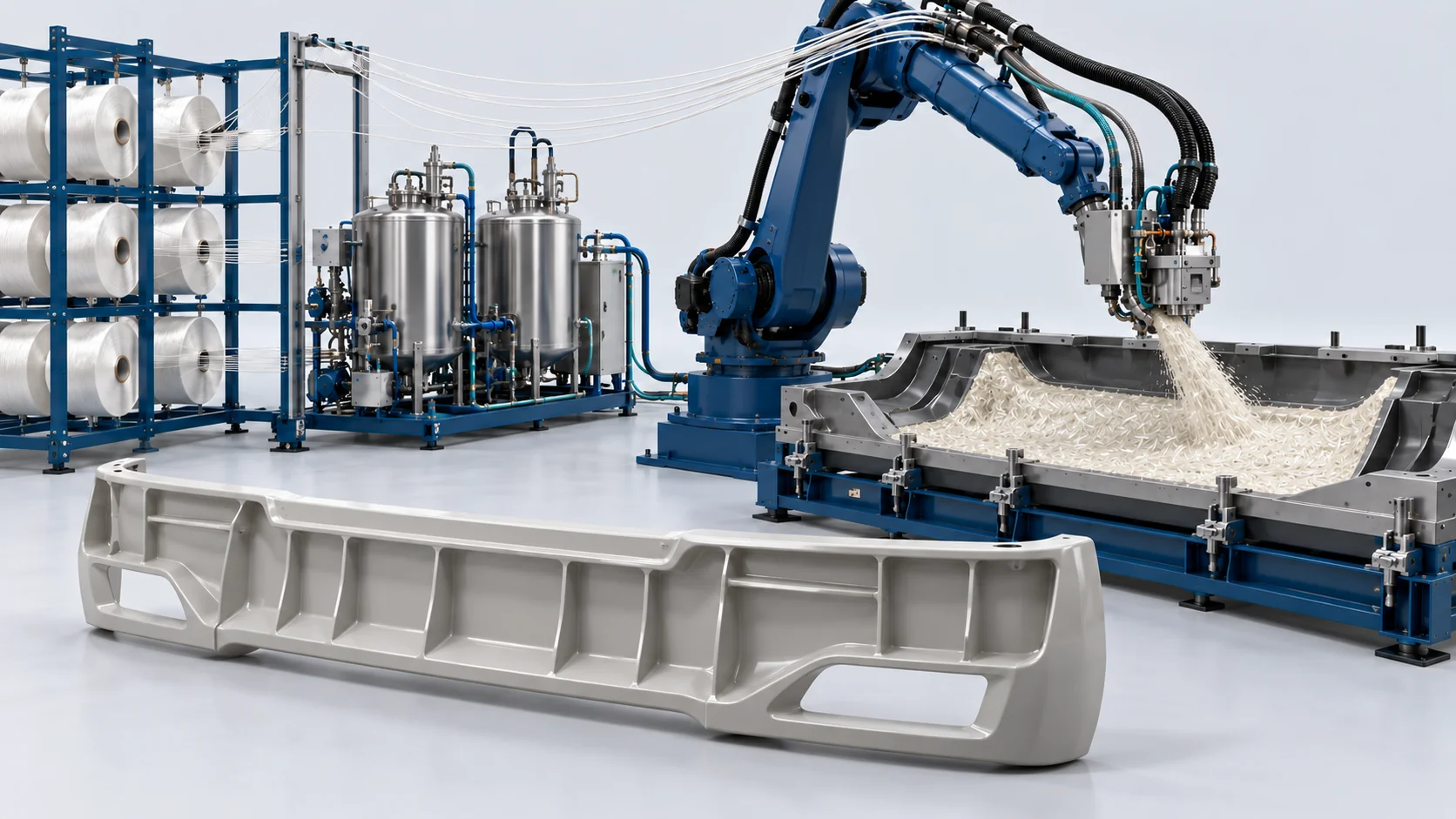
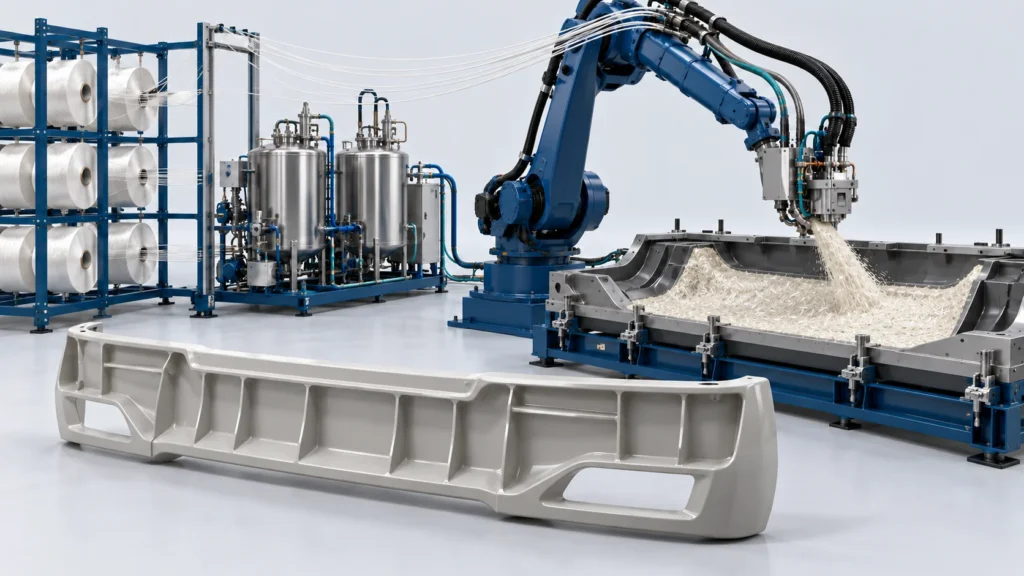
Illustration notice. Process illustrations are not verified photographs of this installation.
Project reference basis. Figures and configuration details are reported in the supplied project brief. They are reference values for the stated application, rather than verified acceptance results or a guarantee for another installation. Confirm the source records, material, tooling, operating schedule and test method when assessing a comparable project.
A leading national heavy-duty truck manufacturer in Northeast China deployed Haifeng’s robotic long fiber injection (LFI) composite molding cell to manufacture high-durability modular front bumpers for a new generation of long-haul heavy tractor trucks.
Prior to this modernization, the OEM utilized compression-molded Sheet Molding Compound (SMC). The legacy process required a 2,500-ton press and massive forged steel molds costing 2.8 million RMB per set. Furthermore, SMC parts were heavy (20.8 kg) and brittle; during cold-weather winter testing in northern regions (-30°C), road gravel impact caused severe cracking and fragmentation. High scrap rates and rigid tooling lead times delayed new bumper styling launches.
Haifeng engineered an agile composite manufacturing cell centered on the HF-LFI120-ROB platform. Utilizing a six-axis robot that chops 25 mm glass rovings into an atomized polyurethane spray in mid-air, the line fills low-pressure cast aluminum tooling under a 300-ton press. The resulting 16.5 kg LFI bumpers delivered impact toughness more than double that of SMC while cutting initial tooling expenses by 62%.
Review point: Open-mold LFI and closed-mold RIM are distinct routes; one configuration does not automatically perform both. PU flow and fiber-chopper capacity constrain achievable fiber content together. The 45% fiber maximum is not assumed at simultaneous maximum PU flow. Impact, mass and tooling savings are part/project comparisons, not general machine guarantees. At the stated minimum PU flow of 100 g/s (360 kg/h) and maximum fiber feed of 60 kg/h, the continuous fiber mass fraction is at most 14.3%; reconcile the stated 15–45% fiber range and instantaneous versus sustained flow basis.
Concept illustration: Generated concept illustration for process discussion; not a photograph of the specified machine, a customer facility or a delivered project.
Solutions Delivery
Configuration reported in the supplied brief.
Haifeng engineered an automated robotic composite cell integrated with a 300-ton fast-acting hydraulic press. The cycle initiates as a six-axis industrial robot applies an automated water-based in-mold coating (IMC) onto the heated cast aluminum mold (75°C) to ensure a Class-A automotive paintable finish.
Next, the robot switches to the LFI multi-process head. High-pressure proportioning pumps meter polyurethane structural chemicals at 16.0 MPa while the integrated rotary chopper slices continuous 2400tex E-glass roving into 25 mm strands at 45 kg/h.
Fibers and liquid polyurethane intersect in mid-air, creating a thoroughly wetted composite veil deposited across the 2,400 mm open lower mold in 42 seconds. The 300-ton press clamps the tool shut at 2.5 MPa cavity pressure. The microcellular structural polyurethane core expands to lock fibers tightly in place, curing in 180 seconds. Automated vacuum grippers remove the finished 16.5 kg bumper with zero surface sink marks.
Open-mold LFI and closed-mold RIM are distinct routes; one configuration does not automatically perform both. PU flow and fiber-chopper capacity constrain achievable fiber content together. The 45% fiber maximum is not assumed at simultaneous maximum PU flow. Impact, mass and tooling savings are part/project comparisons, not general machine guarantees. At the stated minimum PU flow of 100 g/s (360 kg/h) and maximum fiber feed of 60 kg/h, the continuous fiber mass fraction is at most 14.3%; reconcile the stated 15–45% fiber range and instantaneous versus sustained flow basis.
| Equipment | Model | Qty | Function |
|---|---|---|---|
| Robotic Long Fiber Injection Skid | HF-LFI120-ROB | 1 set | Core 16 MPa metering, 60 kg/h fiber chopper, and automated mix head. |
| Heavy 6-Axis Industrial Gantry Robot | HF-IRB-60 | 1 unit | Articulated robot carrying the LFI chopper-head along 3D tool contours. |
| Low-Pressure 300-Ton Hydraulic Press | HF-LPP-300 | 1 unit | Clamps cast aluminum molds under 3.0 MPa cavity counter-pressure. |
| Continuous Dual-Spool Glass Roving Creel | HF-GRC-02 | 1 set | Tension-controlled unspooling of 2400tex roving with non-stop changeover. |
Reported Results — Original Records Required
Modernize Your Commercial Vehicle Exterior Composite Lines
Connect with Haifeng LFI specialists to deploy robotic long fiber injection cells engineered for heavy-duty truck exterior components.


