
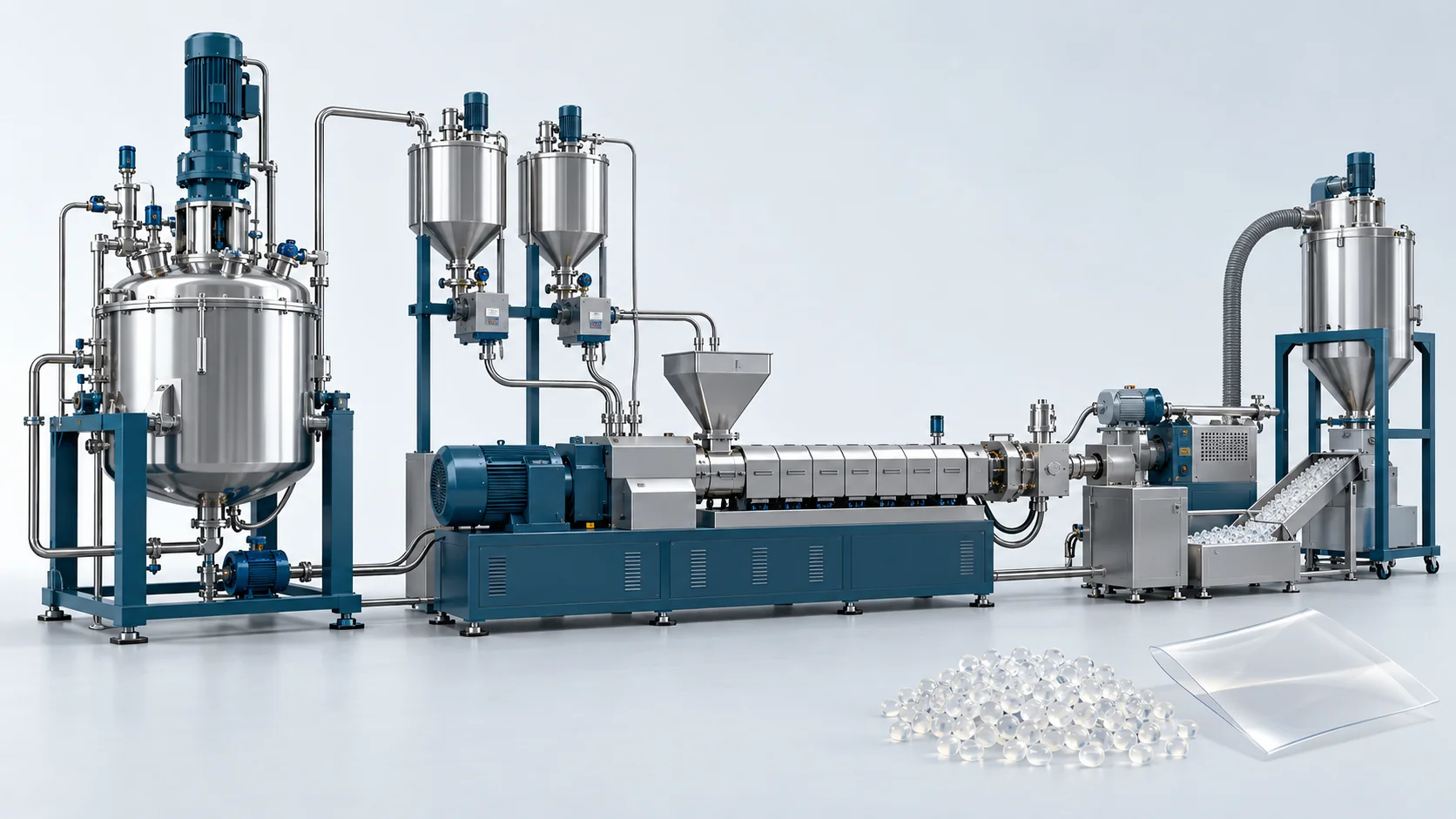
Línea de extrusión reactiva de TPU | Grados de película alifáticos
Un proceso de TPU alifático en dos etapas con preparación del prepolímero, extrusión reactiva, acondicionamiento de la masa fundida y peletización para el desarrollo de grados para película.
Producción
150.0 to 500.0 kg/h (Continuous optical pellet production)
Main Feed Ratio Reference
100:30:6 to 100:60:15 (Precision recipe tracking)
Referencia de precisión
±0.1% (Coriolis mass flow continuous tracking)
Prepolymer Reactor Reference
90°C in the listed prepolymer preparation
Continuous Two-Step Reactive Synthesis for Optical-Grade Aliphatic TPU
Un proceso de TPU alifático en dos etapas con preparación del prepolímero, extrusión reactiva, acondicionamiento de la masa fundida y peletización para el desarrollo de grados para película.
Un proceso de TPU alifático en dos etapas con preparación del prepolímero, extrusión reactiva, acondicionamiento de la masa fundida y peletización para el desarrollo de grados para película.
Selected prepolymer reactor, liquid feed circuits, twin-screw extruder, melt pump, pelletizer and drying interfaces. Film conversion and optical testing are separate downstream processes.
Reactor geometry, residence time and mixing are specified for the selected prepolymer process. Optical defect counts are film-conversion results, and ASTM E313 describes color-index calculations rather than the complete weathering exposure. Define the yellowing method, film thickness, conditioning and sampling for the finished-film acceptance test.
Ilustración conceptual: Ilustración conceptual generada para el análisis del proceso; no es una fotografía de la máquina especificada, de una instalación del cliente ni de un proyecto entregado.
Flujo de material y principio de funcionamiento
Prepolymer Preparation (Step 1)
Dehydrated PCL polyol and molten H12MDI are metered via high-precision Coriolis pumps into the configured jacketed prepolymer reactor, forming a homogeneous prepolymer stream with narrow oligomer distribution at 90°C.
High-Torque Twin-Screw Chain Extension (Step 2)
The prepolymer is injected directly into Zone 1 of the twin-screw extruder (L/D = 60) while chain extender (BDO/IPDA) and non-toxic bismuth catalysts enter via high-pressure micro-nozzles, completing polymer chain growth.
Three-Stage High-Vacuum De-Volatilization
The reacting melt traverses three progressive vacuum de-volatilization ports operating down to 0.02 kPa absolute pressure, removing trace volatile monomers, moisture, and micro-bubbles to achieve optical clarity.
Jacketed Melt Pump Pressure Stabilization
An oil-jacketed melt gear pump maintains continuous discharge pressure fluctuations below 0.03 MPa, passing the melt through a 325-mesh continuous hydraulic screen changer without thermal degradation.
Deionized Water Underwater Pelletizing & Spin Drying
The melt is extruded through micro-hole die plates into a closed cutting chamber flooded with tempered deionized water; multi-knife heads cut uniform spherical pellets that are dried centrifugally within seconds.
¿Necesita una cotización de este equipo?
Solicitar presupuestoModelo y parámetros técnicos
Supplied HF-TPU65-ALI configuration references. Select the material, operating conditions and measurement methods for the quoted package. Finished-material properties and downstream process results are separate acceptance items.
| Parámetro técnico | HF-TPU65-ALI |
|---|---|
| Componentes | 4 Liquid Streams (PCL Polyol, H12MDI, Extender BDO, Catalyst/HALS) |
| Rango de salida | 150.0 to 500.0 kg/h (Continuous optical pellet production) |
| Rango de relación de mezcla | 100:30:6 to 100:60:15 (Precision recipe tracking) |
| Referencia de precisión | ±0.1% (Coriolis mass flow continuous tracking) |
| Alimentación eléctrica | 380 V, trifásica, 50 Hz (opcional personalizada 440 V/480 V, 60 Hz) |
| Presión de trabajo | 10.0 to 16.0 MPa (Extruder die discharge and melt pump) |
| Capacidad de tanque/tolva | Day tanks: 2 x 600 L (Stainless 316L mirror polished) |
| Peso | 14,800 kg (Combined prepolymer reactor, extruder and pelletizer skid) |
| Dimensiones (L×An×Al) | 22,000 mm x 3,200 mm x 2,800 mm |
Características clave del equipo
Selected prepolymer reactor, liquid feed circuits, twin-screw extruder, melt pump, pelletizer and drying interfaces. Film conversion and optical testing are separate downstream processes.
Configured Prepolymer and Extrusion Stages
The selected prepolymer stage conditions the formulation before L/D 60 reactive extrusion. Reactor geometry, residence time and mixing follow the quoted configuration; film gel counts require downstream specimen testing.
Color and Weathering Evaluation
Color-index and weathering results depend on the formulation, film thickness, exposure program and sampling. Assess the supplied yellowing reference against the complete agreed test method.
Three-Stage Vacuum Devolatilization
The configured vacuum ports remove volatiles from the reacting melt. The listed 0.02 kPa reference describes absolute pressure; optical clarity and residual volatile content are tested separately.
Deionized-Water Pelletizing
Tempered deionized-water circulation is configured for pellet cutting and cooling. Water quality, filtration and cleaning are controlled; pellet surface quality is inspected on the selected material.
Hablemos de la configuración de su equipo
Comparta su producto, materiales, utillaje y requisitos de producción para que podamos revisar el equipo y las interfaces para su proyecto.
Preguntas frecuentes
Why does this configured line use a prepolymer stage?
How are optical defects and yellowing assessed?
How are pellet surface contamination and water quality controlled?
What controls gels and black specks during extrusion?
¿Listo para hablar de su proyecto?
Contacte con nuestro equipo


