
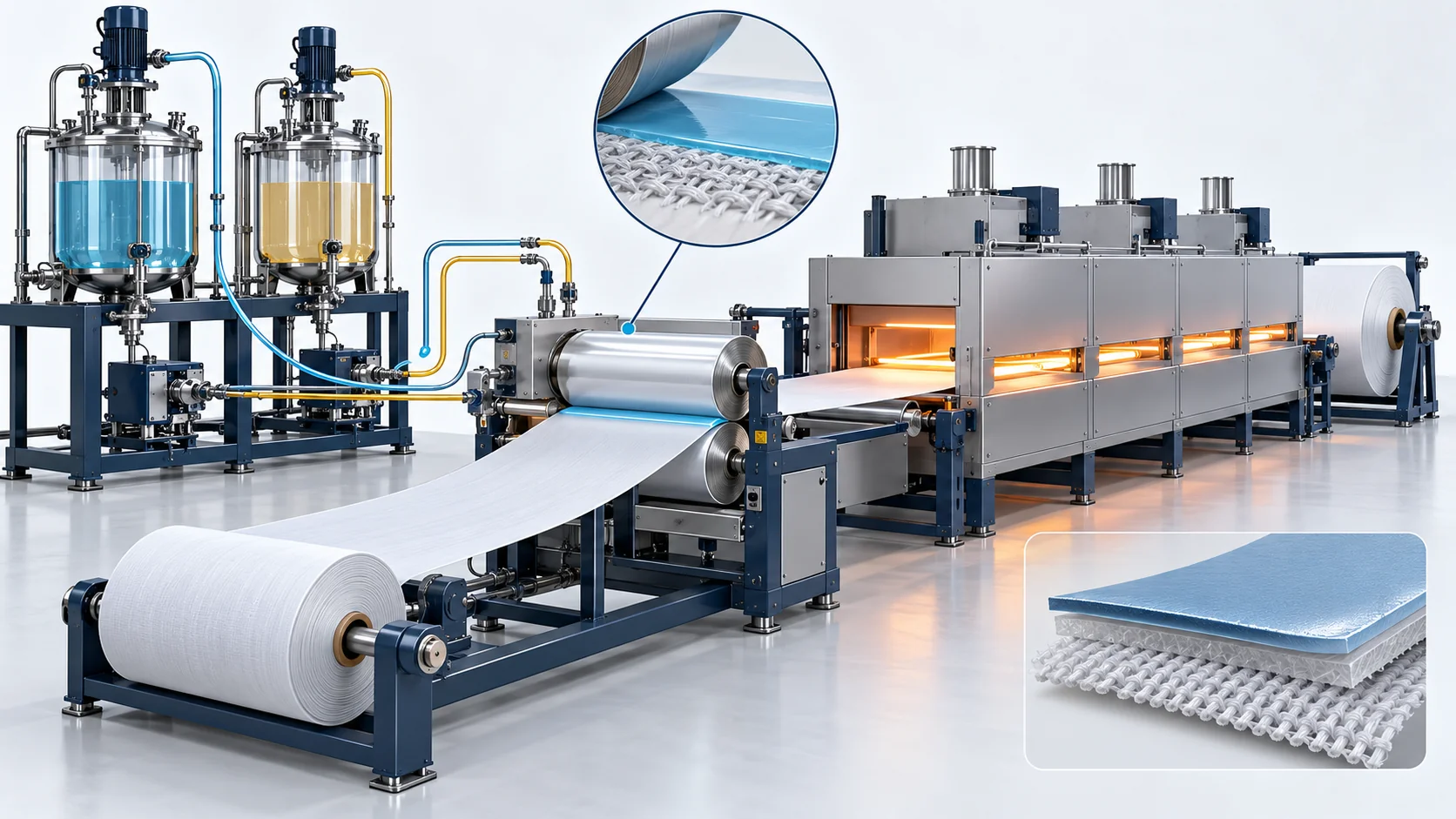
Solvent-Free PU Coating Machine | Synthetic Leather
Two-component solvent-free reaction coating with material degassing, dynamic mixing and reverse-roll application; water-borne modules use a separate process configuration.
Precision Reaction Coating for 100% Solids Solvent-Free Leather
Two-component solvent-free reaction coating with material degassing, dynamic mixing and reverse-roll application; water-borne modules use a separate process configuration.
The HF-SFL180-2K is described in the supplied equipment brief as a two-component solvent-free PU reaction coating and lamination system. Its vacuum-conditioning, dynamic-mixing and reverse-roll stages are configured for the chosen resin and substrate.
The specified web width, coating thickness and line speed are configuration references. Finished-leather VOC, odor, adhesion and durability performance require material-specific testing. A water-borne process uses a separate chemistry and drying configuration.
Concept illustration — not a photograph of delivered equipment or a customer installation.
Material Flow and Working Principle
Vacuum Degassing & Thermal Pre-Conditioning
Component A (Polyol) and Component B (Isocyanate prepolymer) undergo continuous thin-film vacuum degassing below 0.1 kPa to remove entrained air and are heated to 45–60°C to stabilize viscosities.
Synchronized Servo Metering
High-precision servo-driven gear pumps measure the two reactive streams into the mixing head, with Coriolis mass flow meters ensuring mix ratio tolerances remain within ±0.3%.
High-Shear Bubble-Free Dynamic Mixing
The components enter a water-jacketed dynamic mixing chamber equipped with a micro-pin rotor operating at 1,500 to 4,000 RPM, achieving instantaneous homogenization without air entrainment or excessive exotherm.
Micron-Precision Reverse Roll Coating
The mixed resin is metered between precision-ground chrome rollers and transferred onto release paper or base substrate at thicknesses between 0.05 and 0.30 mm, maintaining a cross-web profile variance of less than 2 µm.
Tension-Controlled Lamination & Thermal Curing
The coated film is bonded to the textile base via pneumatic nip rolls and transported through a short infrared/convection curing oven for accelerated crosslinking and final winding.
Model and Technical Parameters
Configuration values from the supplied equipment brief. Final settings and capability are confirmed for the selected material and project conditions.
| Technical Parameter | HF-SFL180-2K |
|---|---|
| Components | 2 Components (A: Polyol resin, B: Isocyanate curative) |
| Output Range (g/s) | 1.5 to 12.0 kg/min (Continuous adjustable) |
| Mixing Ratio Range | 100:80 to 100:120 (By weight) |
| Ratio Accuracy | ±0.3% (Measured with closed-loop mass flow meters) |
| Power Supply | 380V, 3-Phase, 50Hz (Custom 440V/480V 60Hz optional) |
| Working Pressure | 0.4 to 0.8 MPa (Metering lines and dynamic mixing head) |
| Tank Capacity (L) | Day tanks: 2 x 120 L (Stainless steel with vacuum seals) |
| Weight | 6,500 kg (Main coating line skid) |
| Dimensions (L×W×H) | 18,000 mm x 3,200 mm x 2,600 mm |
| Working Web Width | Up to 1,600 mm (Substrate / Release paper); Finished Synthetic Leather |
| Coating Thickness Range | 0.05 to 0.30 mm (Continuous adjustable); Liquid Polyurethane Layer |
| Coating Line Speed | 5.0 to 25.0 m/min (Line-speed synchronized); Steady production run |
| Total Installed Power | 45 kW (Excluding optional thermal oil boiler); Maximum operational load |
Key Equipment Features
The package covers two-component metering and mixing, a reverse-roll coating interface, material conditioning and controls for the solvent-free route. Water-borne mechanical foaming is a separate process module. Conveying and unwinding are optional; chemistry, release paper, water and power are agreed external interfaces.
Solvent-Free Reaction Coating
The selected reactive formulation avoids the conventional solvent carrier; finished-product VOC and odor results require testing.
Precision Reverse-Roll Application
The specified three-roll station controls wet-film thickness across the working web.
Material Degassing
Vacuum conditioning and dynamic mixing control entrained air for the selected resin viscosity.
Process-Specific Curing
The curing section is matched to the reactive coating; comparative energy use depends on the baseline and operating conditions.


