
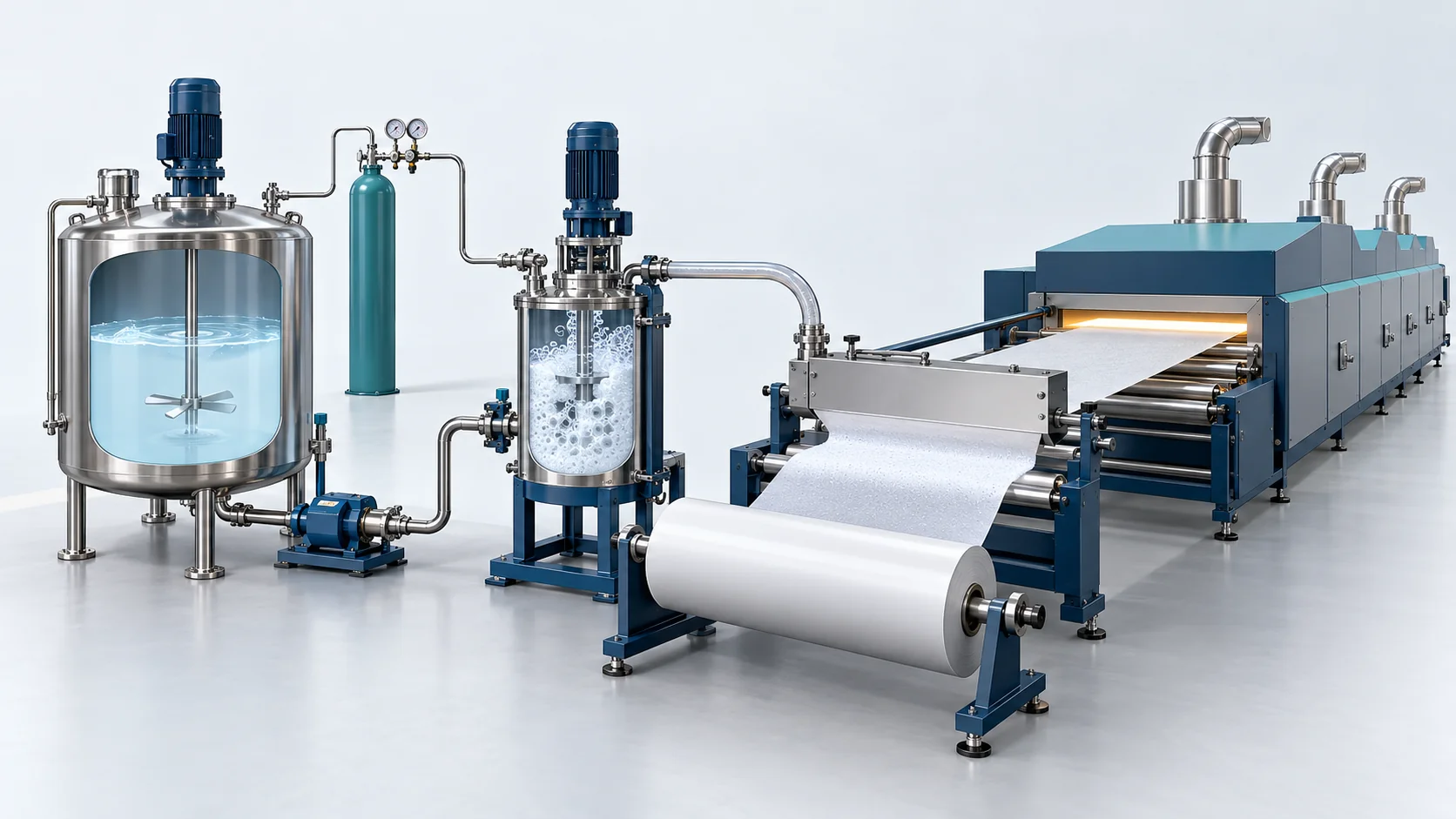
Máquina de espumación mecánica de PU | Cuero en medio acuoso
Dispersión mecánica de gas en PU en medio acuoso, seguida de un recubrimiento y secado configurados para capas de cuero sintético.
Wet Foam Throughput
50.0 to 300.0 kg/h (Continuous wet foam throughput)
Wet Foam Expansion Reference
Wet-foam expansion factor: 2–6x relative to unfoamed liquid volume; gas-flow settings are defined separately at stated pressure and temperature.
Gas Tracking Accuracy
±0.5% (Mass flow controller closed-loop gas tracking)
Foaming Head Backpressure
0.3 to 0.6 MPa (Foaming head backpressure)
Continuous Physical Mechanical Foaming for Water-Borne Leather Bases
Dispersión mecánica de gas en PU en medio acuoso, seguida de un recubrimiento y secado configurados para capas de cuero sintético.
Dispersión mecánica de gas en PU en medio acuoso, seguida de un recubrimiento y secado configurados para capas de cuero sintético.
PUD preparation, controlled gas/liquid feed, foam generator, coating interface and the specified dryer; chemistry, backing web, dryer energy and exhaust are agreed interfaces.
This route mechanically disperses gas in a water-borne dispersion; it differs from reactive chemical blowing. Wet-foam gas ratio and final dry density are distinct. MVTR, odor and steam savings need specimen, method and full-line energy boundaries; water-borne chemistry alone does not establish zero emissions.
Ilustración conceptual: Ilustración conceptual generada para el análisis del proceso; no es una fotografía de la máquina especificada, de una instalación del cliente ni de un proyecto entregado.
Flujo de material y principio de funcionamiento
Dispersed PUD Metering & Gas Pressure Regulation
Water-borne polyurethane dispersion (PUD, 50% solids) and foam stabilizers are displaced by a servo progressive cavity pump while filtered nitrogen/air is metered via a mass flow controller into the mixing chamber.
High-Shear Stator-Rotor Mechanical Foaming
The gas-liquid mixture enters the water-jacketed stator-rotor foaming head, where intermeshing pins running at 300 to 1,200 RPM beat the gas into fine micro-bubbles (10–30 µm) with expansion ratios between 2x and 6x.
Precision Floating-Knife Coating
The dense foam discharges directly onto advancing release paper or textile base fabrics via an automated distribution manifold; a micrometric floating knife coats a level layer from 0.2 to 1.5 mm thickness.
Short-Wave Infrared Surface Gelation
The wet foam layer passes under short-wave infrared lamps, rapidly setting the bubble walls and flash-skinning the surface before bubble collapse can occur.
Step-Down Convection Evaporation & Winding
The material travels through a 24-meter multi-zone hot air convection tunnel (80°C to 140°C), progressively evaporating water to yield a dry, highly breathable microfiber base before automated edge-trimming and rewinding.
¿Necesita una cotización de este equipo?
Solicitar presupuestoModelo y parámetros técnicos
Supplied HF-WPF160-MF configuration references. Select the material, operating conditions and measurement methods for the quoted package. Finished-material properties and downstream process results are separate acceptance items.
| Parámetro técnico | HF-WPF160-MF |
|---|---|
| Componentes | 1 Liquid Stream (PUD Masterbatch) + 1 Gas Stream (Air/N2) |
| Rango de salida | 50.0 to 300.0 kg/h (Continuous wet foam throughput) |
| Rango de relación de mezcla | Wet-foam expansion factor: 2–6x relative to unfoamed liquid volume; gas-flow settings are defined separately at stated pressure and temperature. |
| Referencia de precisión | ±0.5% (Mass flow controller closed-loop gas tracking) |
| Alimentación eléctrica | 380 V, trifásica, 50 Hz (opcional personalizada 440 V/480 V, 60 Hz) |
| Presión de trabajo | 0.3 to 0.6 MPa (Foaming head backpressure) |
| Capacidad de tanque/tolva | Day tank: 1 x 500 L (Stainless steel with slow anchor agitator) |
| Peso | 8,200 kg (Foaming generator, coating head, and gantry) |
| Dimensiones (L×An×Al) | 32,000 mm x 3,400 mm x 2,800 mm (Including 24m oven) |
Características clave del equipo
PUD preparation, controlled gas/liquid feed, foam generator, coating interface and the specified dryer; chemistry, backing web, dryer energy and exhaust are agreed interfaces.
2–6x Wet-Foam Expansion Reference
Gas delivery and stator-rotor settings control physical dispersion in the selected PUD formulation. The 2–6x reference describes wet-foam volume expansion; supply-gas volume ratio and final dry density are defined separately.
Mechanical Gas Dispersion
Filtered air or nitrogen is selected for the material system. The specified mechanical route does not rely on azodicarbonamide blowing; finished-material emissions and compliance require separate evaluation.
Finished-Layer Breathability Testing
Pore structure, dry-layer thickness, formulation and drying affect moisture-vapor transmission. Evaluate the supplied 1,500 g/(m²·24h) reference on a defined specimen and test method.
Configured Infrared and Convection Drying
Infrared surface setting and staged convection drying are coordinated with coating thickness, line speed and foam stability. Setting time and resistance to collapse are established through material trials.
Hablemos de la configuración de su equipo
Comparta su producto, materiales, utillaje y requisitos de producción para que podamos revisar el equipo y las interfaces para su proyecto.
Preguntas frecuentes
Which gas is used for mechanical foaming?
Does 2–6x expansion describe the gas-to-liquid supply ratio?
How are foam stability and breathability validated?
Can the unit process other water-borne dispersions?
¿Listo para hablar de su proyecto?
Contacte con nuestro equipo


