
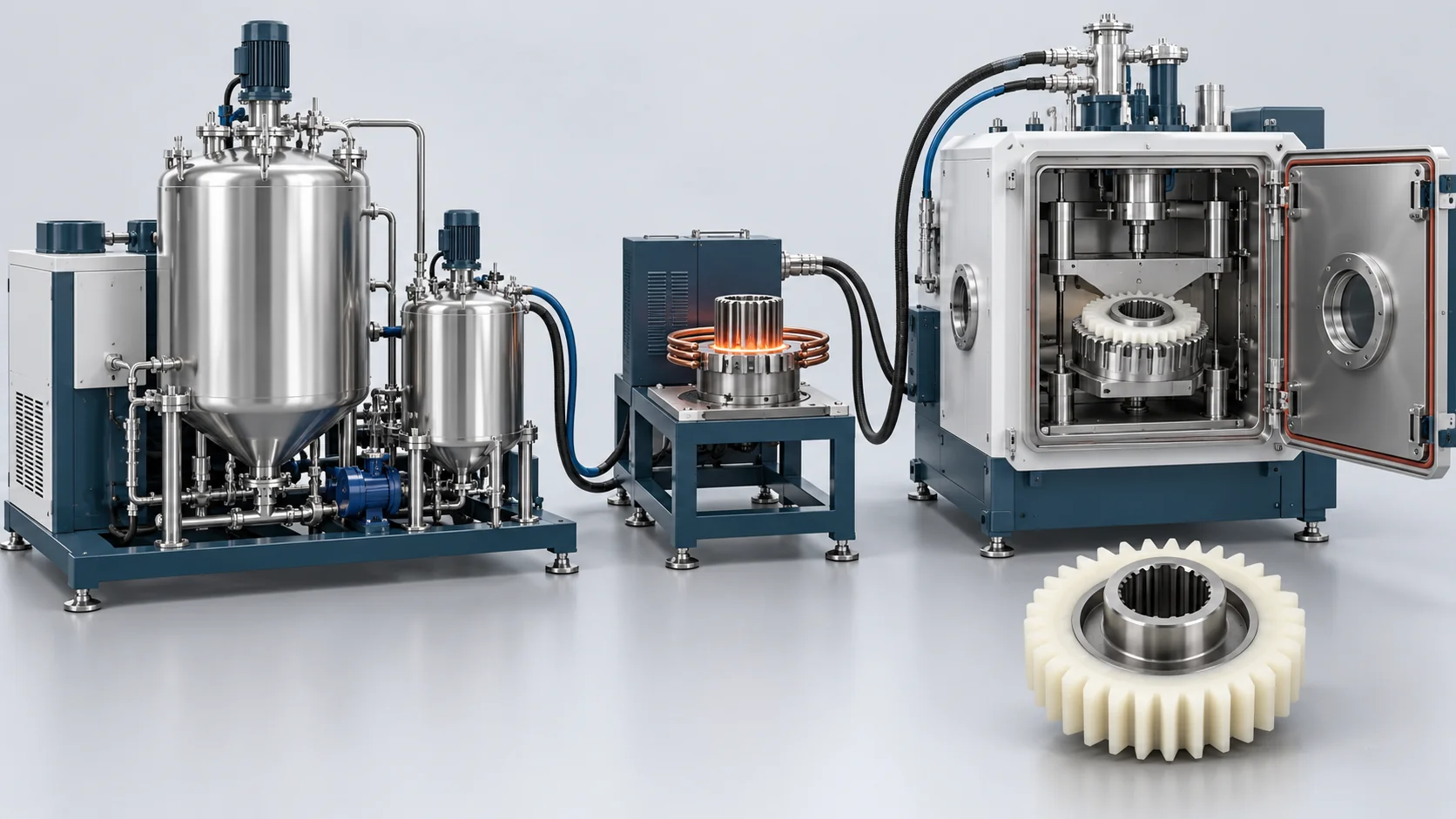
MC Nylon Casting Machine | Metal-Core Gears
Metal-core conditioning and vacuum-assisted MC Nylon casting for hybrid gear tooling and part-development trials.
Discharge Flow Rate
3.0 to 20.0 kg/min (Continuous adjustable)
Feed-Stream Ratio Reference
1:1 fixed (listed feed-stream reference)
Accuracy Reference
±0.2% (Under continuous Coriolis mass flow tracking)
Thermal Control Configuration
2 × 150 L jacketed day tanks; metal-core preheating and mold heating
In-Situ Induction Preheated Casting for Heavy Metal-Core MC Nylon Gears
Metal-core conditioning and vacuum-assisted MC Nylon casting for hybrid gear tooling and part-development trials.
Metal-core preparation and preheating are coordinated with monomer metering, mixing and vacuum-assisted tooling for hybrid MC Nylon gears. The metal hub is an insert, separate from the liquid material circuits.
Specify the hub interlock, gear mold, thermal cycle and post-treatment together. Torque capacity, gear accuracy, noise and service life require separate qualification of the finished gear and assembly.
Concept illustration: Generated illustration for process discussion; not a photograph of the specified machine, a customer facility or a delivered project.
Material Flow and Working Principle
Prepare the Metal Core
Prepare the specified metal hub and surface/interlock arrangement, then condition it for casting.
Set the Gear Tool
Position the hub and configure the mold heating, venting and selected vacuum interface.
Meter and Cast Nylon
Condition, meter and mix the monomer streams and fill the selected gear tool.
Post-Treat and Inspect
Demold and condition the gear, machine where specified and carry out the agreed dimensional and service tests.
Need a quote for this equipment?
Request a QuoteModel and Technical Parameters
Reference data describe monomer delivery, core preheating and the vacuum-tool interface. Core temperature and tool vacuum are process settings; finished torque, acoustic results and dimensional class are separate acceptance items.
| Technical Parameter | HF-MCG120-INS |
|---|---|
| Components | Monomer Streams A & B + Solid Forged Steel Splined Hub |
| Output Range | 3.0 to 20.0 kg/min (Continuous adjustable) |
| Mixing Ratio Range | 1:1 Fixed (Volumetric/weight balanced) |
| Accuracy Reference | ±0.2% (Under continuous Coriolis mass flow tracking) |
| Power Supply | 380V, 3-Phase, 50Hz (Custom 440V/480V 60Hz optional) |
| Working Pressure | 0.3 to 0.5 MPa (Liquid metering and head line) |
| Tank / Hopper Capacity | Day tanks: 2 x 150 L (Stainless steel with thermal jackets) |
| Weight | 5,600 kg (Casting machine, induction heater, and mold bed) |
| Dimensions (L×W×H) | 3800 mm x 2400 mm x 2600 mm |
| Thermal Control Configuration | 2 × 150 L jacketed day tanks; metal-core preheating and mold heating |
Key Equipment Features
Monomer circuits, metering/mixing, induction preheat, vacuum interface and controls. Splined hub, gear mold, post-treatment and final load/noise qualification are separate.
Metal-Core Conditioning
Prepare the specified hub surface and interlock, then select preheating conditions with the nylon formulation and tool.
Hub and Rim Interface Review
Coordinate the metal insert, nylon rim geometry, molding shrinkage and post-treatment for the intended gear duty.
Finished-Gear Qualification
Define dimensional, load and noise checks on the finished gear and operating assembly. Machine settings alone do not establish service performance.
Vacuum-Assisted Tool Filling
Configure mold evacuation and monomer filling for the gear geometry. Inspect the finished casting for the agreed internal and surface requirements.
Discuss Your Equipment Configuration
Share your product, materials, tooling and production requirements so we can review the equipment and interfaces for your project.
Frequently Asked Questions
Is the metal core a third chemical component?
How are preheat and vacuum selected?
Does vacuum establish a finished gear accuracy class?
How are torque, noise and service life accepted?
Ready to discuss your project?
Contact Our Team


