
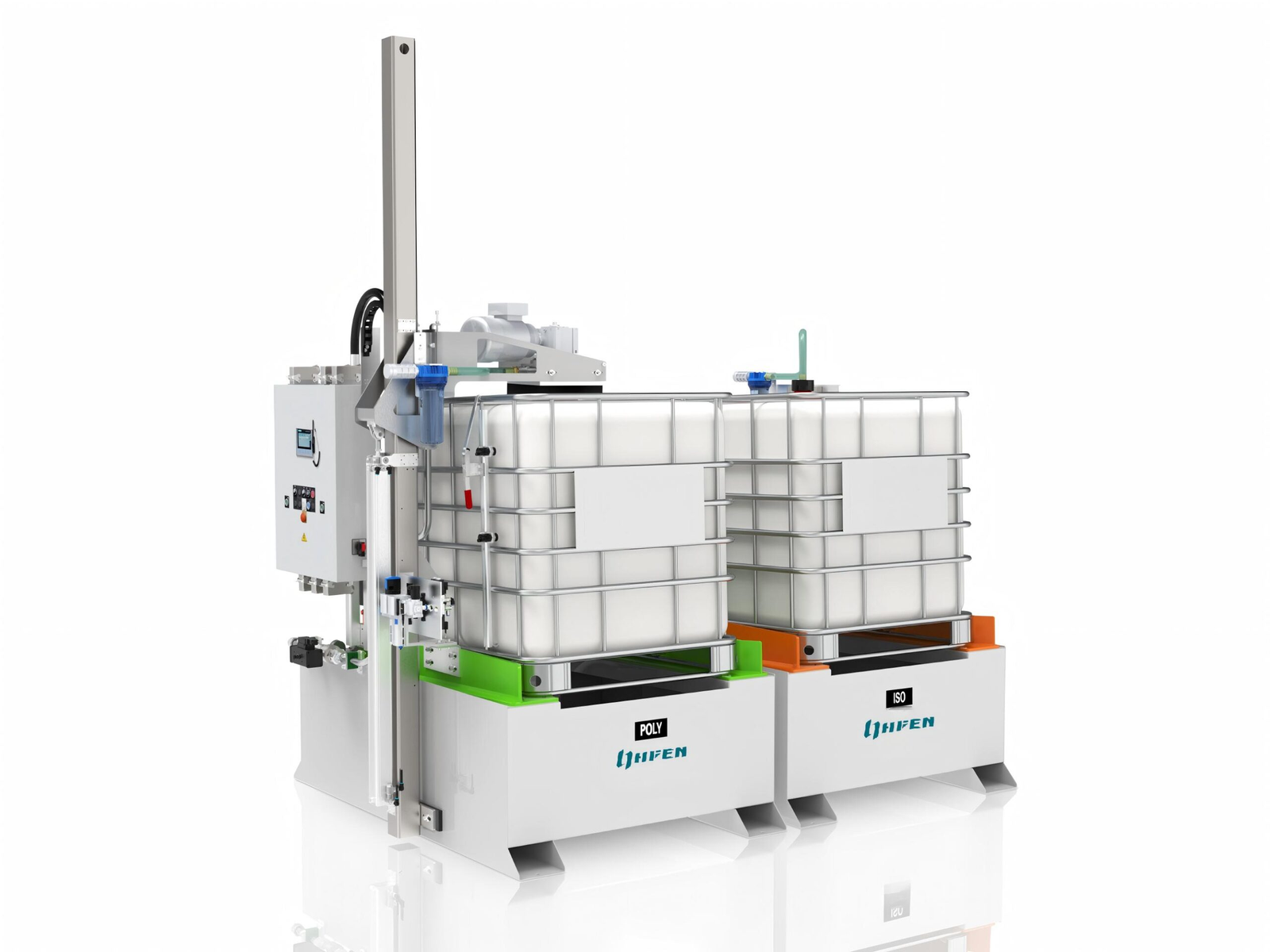
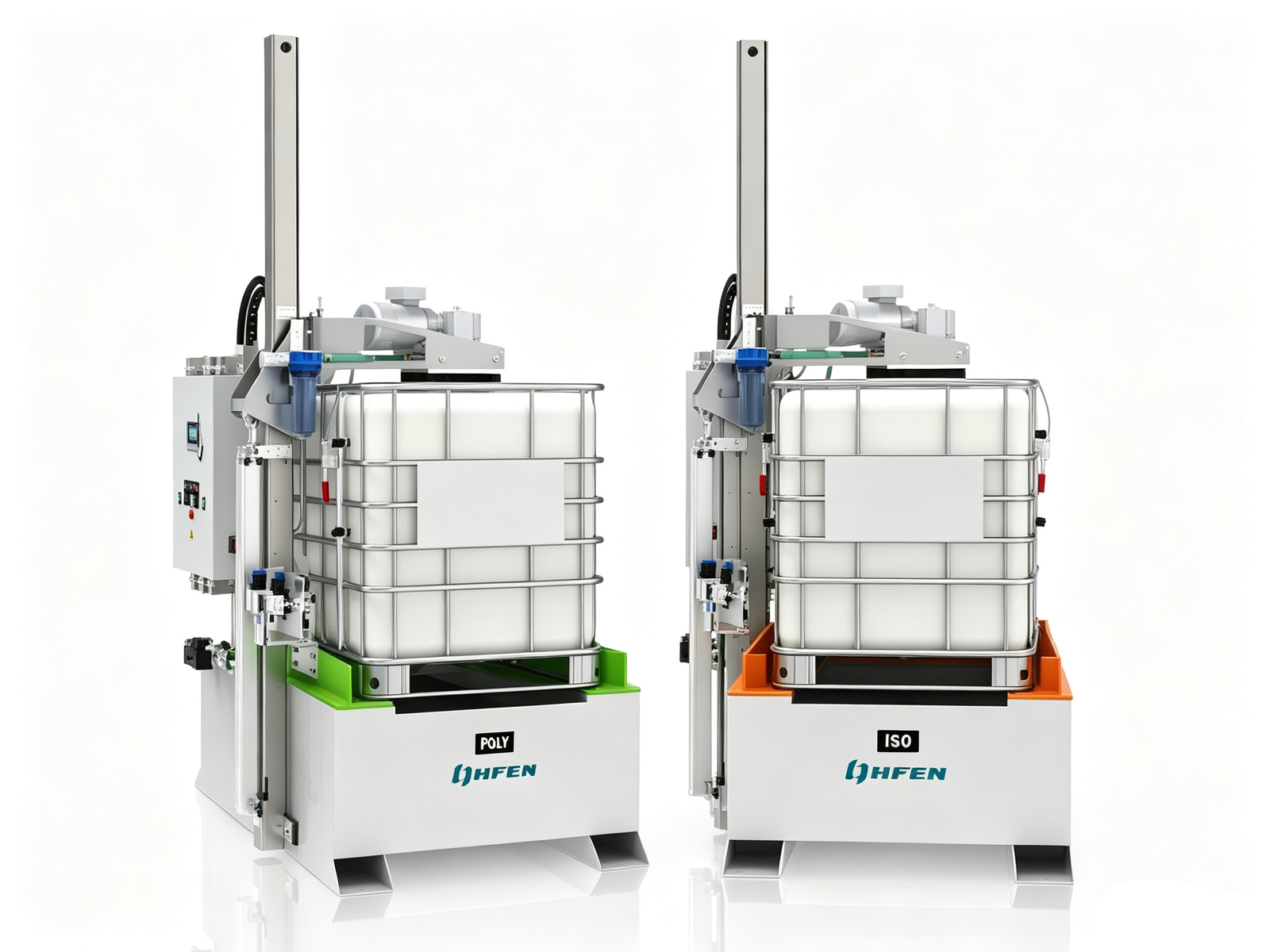
Automatic PU Feeding and Premixing Station | IBC Supply
A raw material conditioning and automatic replenishment system connecting standard IBC containers to downstream polyurethane metering equipment for polyol and isocyanate. Manual drum transfer is labor-intensive and can introduce contamination and temperature variation. Design follows the material TDS, chemical properties, temperature requirements and uninterrupted-changeover needs.
Direct Standard IBC Connection
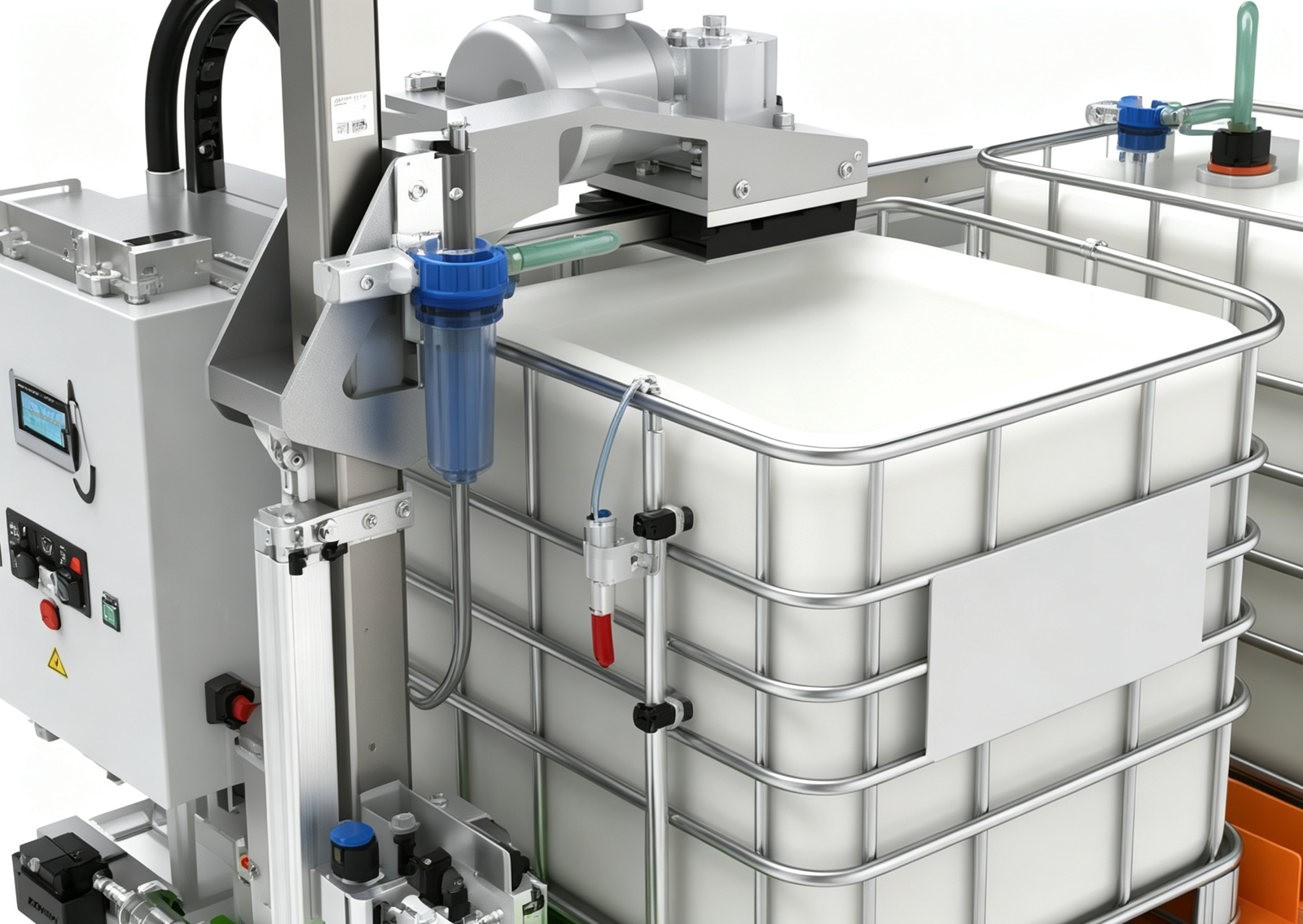
Use standard industrial IBC containers directly. Inlet circuits, seals and transfer configuration are selected for viscosity and chemical compatibility and confirmed in the technical agreement.
PLC + HMI Automatic Replenishment
Monitor downstream day-tank levels and automatically replenish when levels fall. Intermittent recirculation and agitation settings follow the material TDS and technical agreement.
±2°C Material Conditioning
Recirculating heat exchange maintains polyol/isocyanate processing temperature and reduces settling or stratification, stabilizing material delivered to the metering unit.
Optional Back-to-Back Buffer System
Optional back-to-back buffer tanks keep the line supplied while an empty IBC is replaced; configuration follows the production cycle.
Automatic PU Material Feeding & Premixing Station
IBC-connected automatic polyol/isocyanate replenishment with temperature-controlled conditioning and homogenization.
This modular raw material conditioning and feeding system transfers polyol and isocyanate from IBC containers to downstream casting or foaming units, with temperature control and recirculating homogenization. Manual replenishment increases labor, contamination risk and temperature fluctuations that can affect ratio stability. Engineering follows the TDS, chemical properties, temperature window and line-continuity requirements.
Specifications are product-family selection references, not a promise that one configuration maintains identical feeding quality under all conditions. Replenishment flow and recirculation settings are commissioned for actual viscosity and line consumption. Finished-product properties depend on the complete material, feeding, metering and molding system; connected trials are required before production.
Commissioning and Production Start-Up
Confirm Material and Line Boundaries
Confirm IBC size, polyol/isocyanate grade, hourly consumption, downstream unit specifications and the TDS. Determine whether back-to-back buffering is required.
Prepare Materials and Equipment
Set temperature from the TDS and inspect IBC connection seals, circulation pumps, agitators, level sensors, filtration and safety components.
Calibrate Levels and Feeding Flow
Connect the downstream metering unit and calibrate day-tank high/low levels. Check replenishment flow with the actual material and temperature and confirm stable pump operation.
Run and Validate Automatic Feeding
Apply preset conditions and observe automatic replenishment and intermittent recirculation. Check temperature and level-alarm logic, keep operating records and sample downstream material.
Technical Specifications
The values describe optional product-family configuration ranges. Final equipment configuration, capacity, accuracy, power, material compatibility and acceptance methods are defined in the technical agreement.
| Technical Parameter | HF‑PPS‑2X10‑P&I‑I / HF‑PPS‑2X10‑P&I‑II / HF‑PPS‑2X10‑P&I‑III |
|---|---|
| Components | Polyurethane polyol and isocyanate; highly filled or strongly corrosive materials require prior compatibility confirmation |
| Output Range (g/s) | 0.05‑1 t/h; customized to downstream consumption |
| Mixing Ratio Range | Dosing and operating settings follow the material formulation and technical agreement. |
| Ratio Accuracy | Actual transfer flow is calibrated on site. |
| Tank Capacity (L) | Standard 1000L IBC containers; twin-container configuration with optional back-to-back buffer tanks |
| Series Models | HF‑PPS‑2X10‑P&I‑I / HF‑PPS‑2X10‑P&I‑II / HF‑PPS‑2X10‑P&I‑III |
| Processing Capacity | 0.05‑1 t/h; customized to downstream consumption |
| Feeding Output | 5‑30 kg/min; model-dependent and affected by material viscosity |
| Containers | Standard 1000L IBC containers; twin-container configuration with optional back-to-back buffer tanks |
| Temperature Accuracy | ±2°C; set within the polyol/isocyanate material processing window |
| Operating Mode | Level-triggered automatic replenishment; intermittent recirculation/agitation homogenization; manual/automatic switching |
| Transfer and Circulation | Dedicated transfer pumps and circulation pipework; intermittent operation reduces settling and stratification; wetted materials matched to PU raw materials |
| Connections | Direct standard IBC connections and supply to downstream metering-unit day tanks |
| Buffer System | Back-to-back buffer configuration enables uninterrupted production during IBC replacement |
| Filtration | Inlet filters intercept contamination and protect downstream metering pumps |
| Installed Power | 10‑20 kVA; determined by actual transfer pumps, heat exchange, sensors and auxiliaries |
| Control System | PLC + HMI touchscreen; level logic configuration, operating records and exportable alarm logs |
| Compatible Materials | Polyurethane polyol and isocyanate; highly filled or strongly corrosive materials require prior compatibility confirmation |
| Warranty | Standard 12 months; commencement date, coverage, wear parts and service boundaries are defined in the contract. |
| Compliance and Documentation | CE and accompanying documents are supplied according to the sales region, final configuration and contract. ISO9001 is a company management-system certificate, not certification of an individual machine. |
Core Equipment Capabilities
Engineering for production efficiency, material consistency and operating conditions.
Direct IBC Connection
Standard industrial IBC containers serve directly as material containers, eliminating intermediate transfer and simplifying workshop logistics.
Automatic Level-Based Replenishment
Continuously monitor downstream day-tank levels and start replenishment below the threshold, reducing manual intervention and operator error.
Temperature-Controlled Recirculation
±2°C temperature control and intermittent recirculating agitation reduce polyol settling and stratification for consistent inlet material temperature and condition.
Uninterrupted IBC Changeover Option
Optional back-to-back buffer tanks supply material while empty IBCs are replaced, avoiding line waiting time and improving OEE.
Flexible Modular Configuration
Versions range from simple feeding to comprehensive conditioning, sensing and alarms, matched to budget and operating requirements.
Downstream Metering Protection
Upstream filtration intercepts IBC contamination. Stable temperature and transfer conditions reduce metering-pump wear and ratio drift.
Explore More Polyurethane Equipment
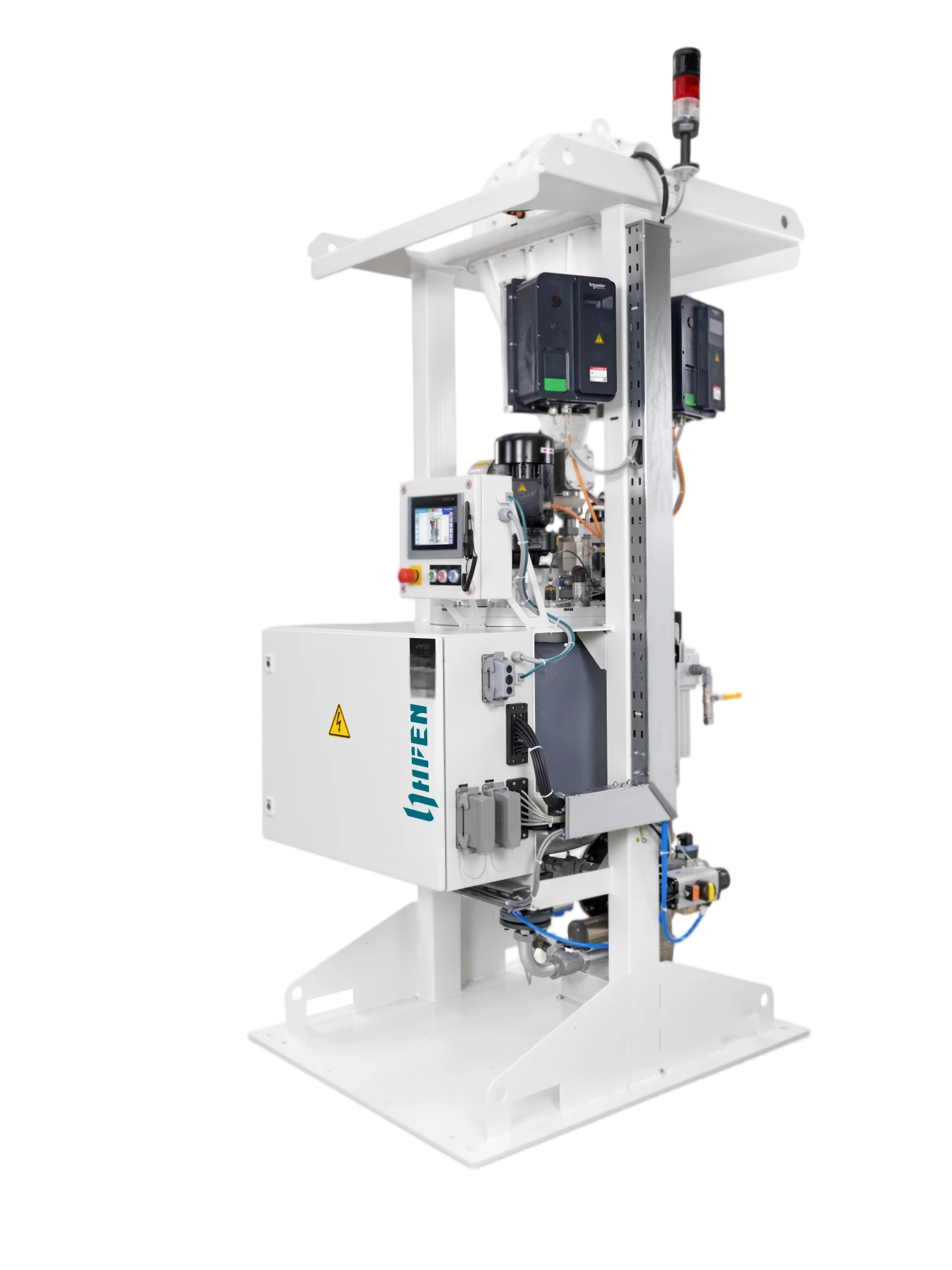
Epoxy Pouring Machine | Printing Rollers
Low Pressure Polyurethane Machine
Low-Pressure PU Foaming Machine | Refrigerator Rigid Foam
Low Pressure Polyurethane Machine


