Building dreams with technology · Exploring new horizons
From April 20 to 26, 2026, a Haifeng delegation traveled to Moscow, Russia, to attend the 17th International Polyurethane Exhibition in Russia (Polyurethanex 2026). Organized by Mir-Expo, it is the only international professional exhibition focused on polyurethane in the Russian-speaking region.
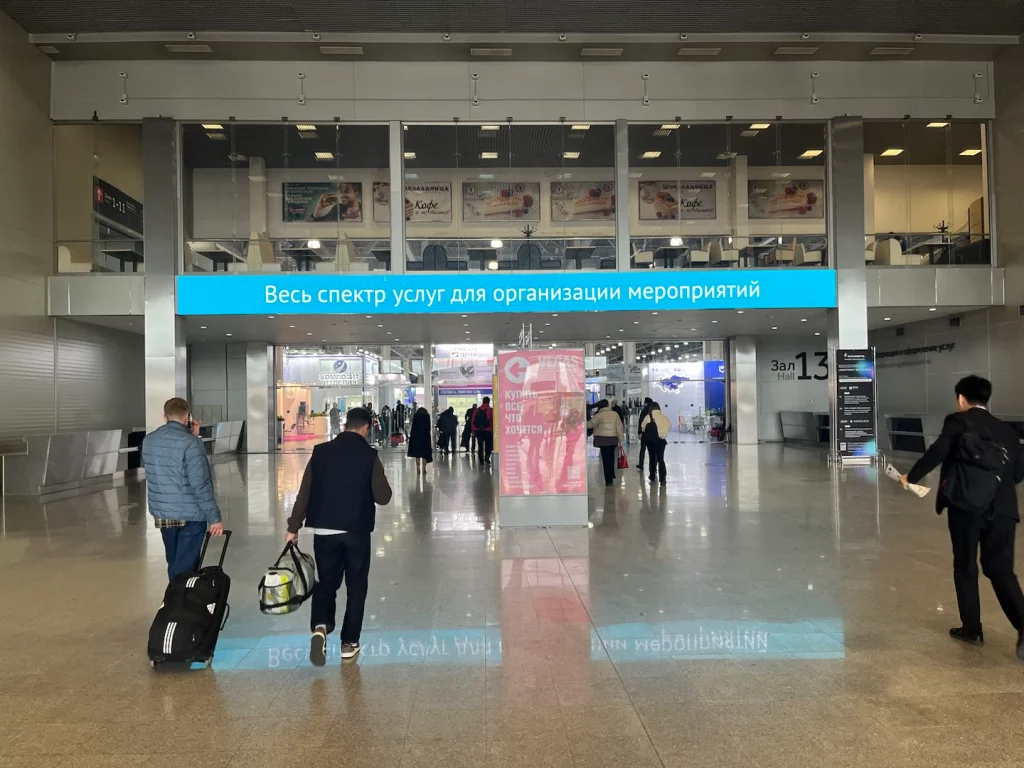
Exhibition overview
The exhibition covered 18,000 m² and brought together approximately 335 companies from countries and regions including China, Türkiye, Belarus, Kazakhstan and the UAE. It welcomed more than 12,500 professional visitors. Concurrent events included the 3rd Conference on Polyurethane Material Production and Application Technologies and multiple company presentations.
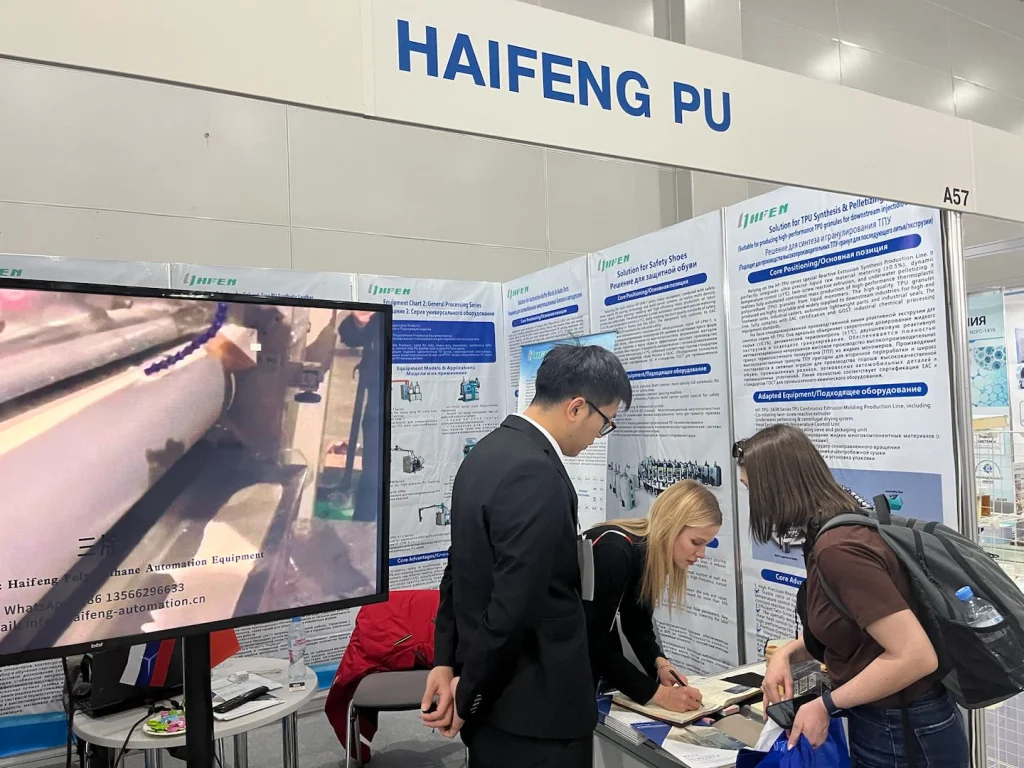
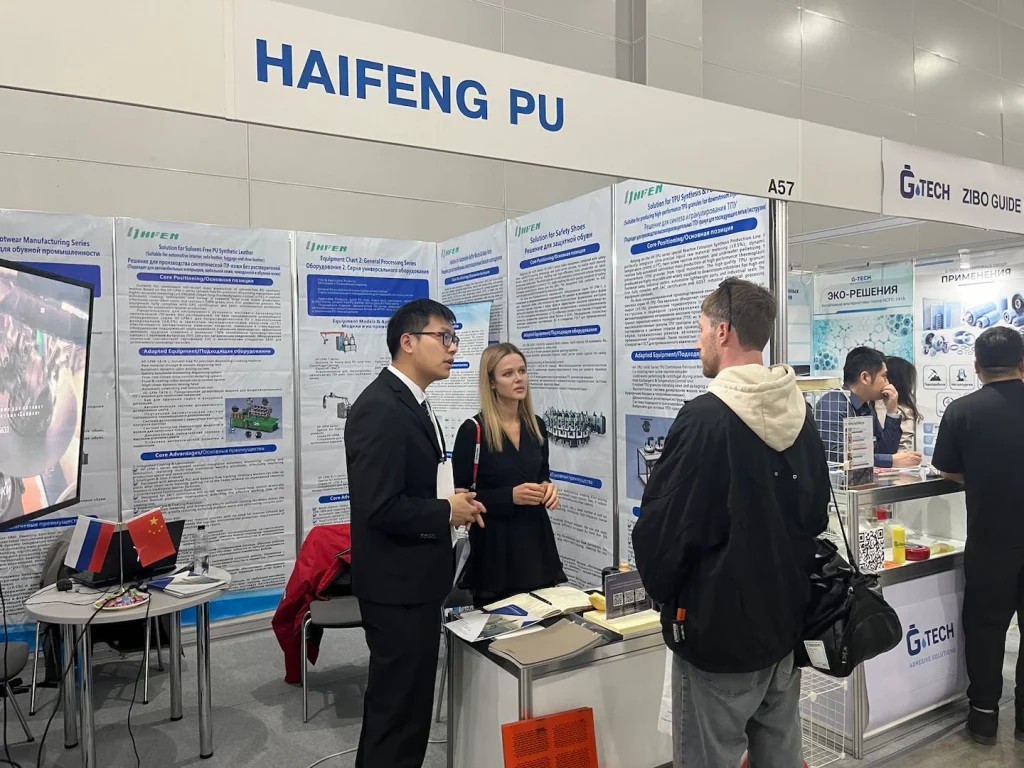
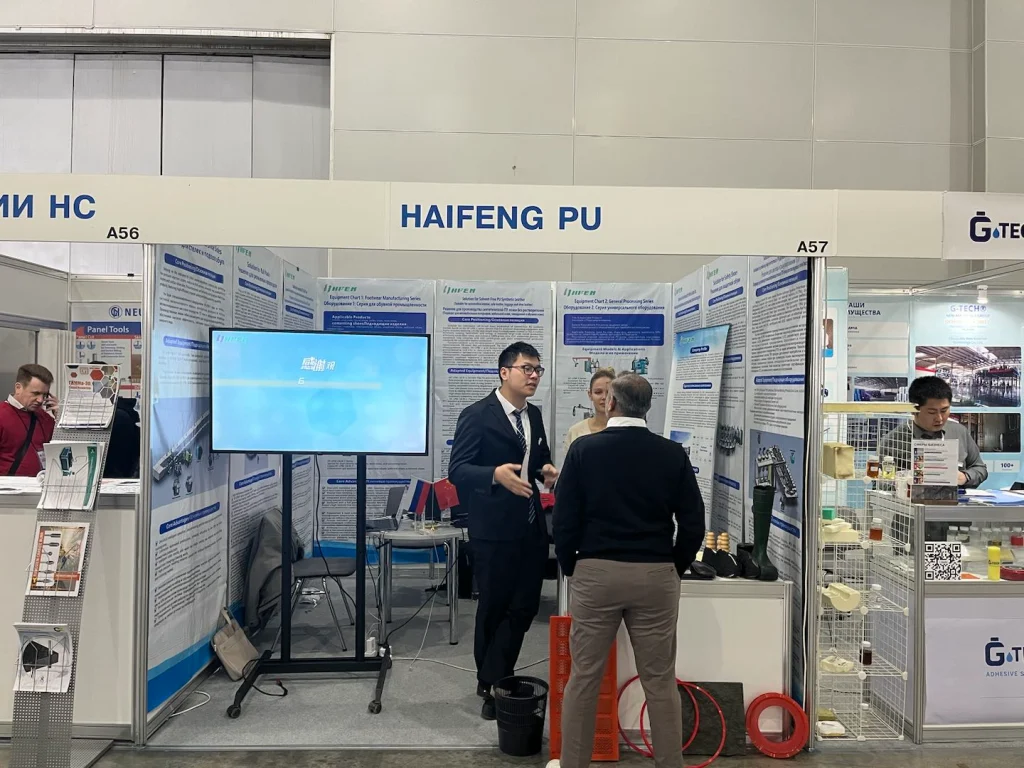
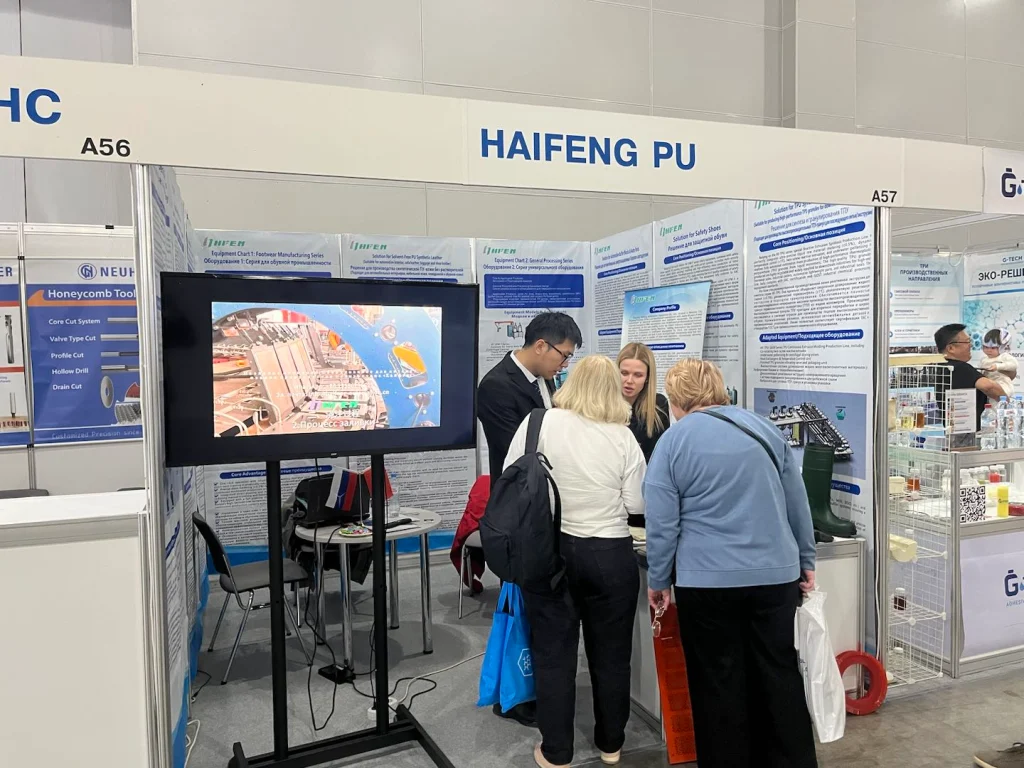
Exhibiting and connecting
At this exhibition, we focused on presenting high-pressure polyurethane foaming machines, low-pressure dispensing machines and related production-line solutions. Our booth used process-demonstration videos and case-study boards to show how the products perform in real applications. We also presented a polyurethane spraying solution: precision spraying can produce a more uniform microporous structure in shoe soles while combining low weight with high resilience.
Polyurethane spraying solution
By precisely controlling spray volume, spray paths and raw-material ratios, this process can create a more favorable density gradient and microporous structure during sole forming. It combines lightweight construction with high resilience while reducing material waste and subsequent edge-trimming operations.
Compared with traditional casting, spraying offers greater flexibility for footwear-material orders with many styles and short lead times. Formulations and mold configurations can be changed quickly, matching footwear manufacturers’ need for production flexibility.
Several footwear-material manufacturers asked detailed questions about the technology. Their main concerns included batch-to-batch consistency in spray uniformity, the effect of raw-material viscosity at low temperatures and whether the equipment could be integrated into compact production lines.
Listening to customer priorities and deepening on-site discussions
Visitors during the exhibition mainly came from Russia, Belarus and Central Asia, representing sectors such as building insulation, automotive-component manufacturing and furniture production.
Customer questions were specific and practical, focusing on three areas:
First, flexibility in capacity configuration. Many local companies operate small- to medium-volume, high-mix production, and buyers asked detailed questions about changeover efficiency and the ability to handle multiple product types.
Second, operating stability in low-temperature conditions. Winters are long in Russia and Central Asia, and factory temperatures and material conditions differ from those at room temperature. Equipment startup and continuous operation in low temperatures were recurring concerns.
Third, responsiveness of after-sales service. Spare-parts lead times and the time required for technical support to reach a site were viewed as conditions as important as the equipment itself.
Drawing on existing customer cases in Russian-speaking markets, our team addressed these questions one by one and shared equipment operating data from real conditions. This application-based discussion, rather than a simple presentation of specifications, received practical feedback from visitors.
Opportunity and direction
In recent years, Russia’s polyurethane market has grown at an average annual rate approaching 10%, with continued demand from construction, automotive and pipe-insulation applications. Changes in Western supply chains have also increased local demand for imported polyurethane production equipment and materials, creating market opportunities for companies with reliable supply capabilities.
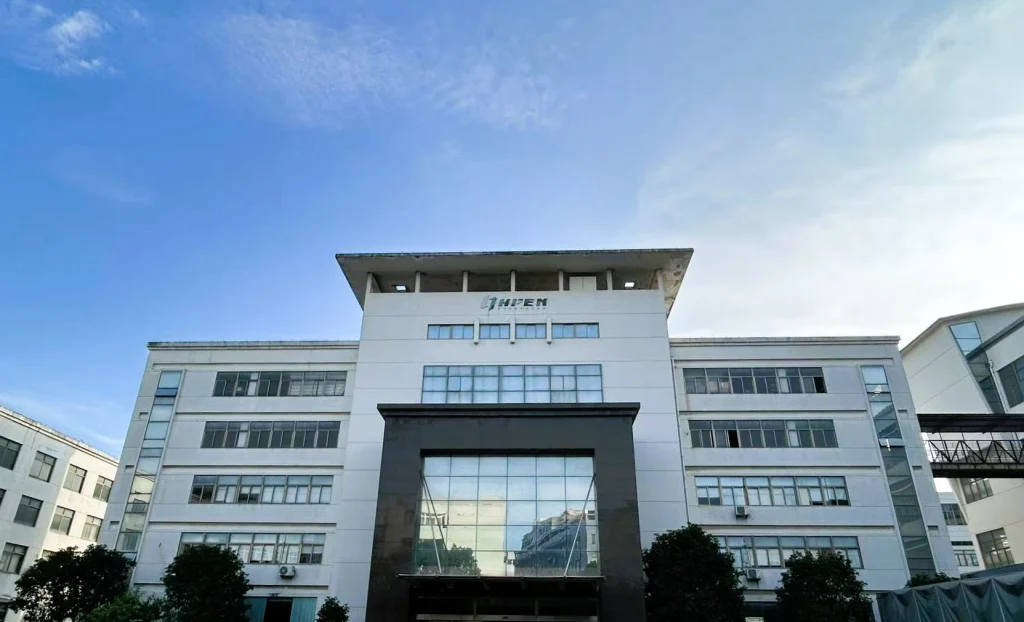
In response to these opportunities, we bring more than equipment: we bring nearly 40 years of industry experience.
Since its beginnings in 1986, Haifeng has established itself as a technology pioneer in China’s polyurethane equipment industry. The company has grown from individual machines to integrated solutions covering high-pressure foaming, low-pressure dispensing, spraying processes and complete production lines. Through continued technical development, we have accumulated 51 patents and built an R&D team led by multiple senior engineers. This experience helps us provide validated solutions to practical challenges such as low-temperature operation, rapid changeovers for multiple products and consistent spray uniformity, instead of relying on claims alone.
Next steps
The exhibition helped our team turn customer requirements for equipment performance, local adaptation and service support into first-hand insights and a group of project leads for follow-up.
Our next steps focus on two areas. First, we will organize the customer information collected at the exhibition and prioritize business follow-up to convert interest into projects. Second, we will use the field feedback to refine equipment solutions and service standards for Russian-speaking markets and further improve local adaptation.