

This guide covers shaping already-manufactured thermoplastic polyurethane (TPU) pellets by melting, injection molding or extrusion. TPU resin manufacture is a separate chemical-production route involving the selected raw materials, metering and reaction process. The designation system for TPU molding and extrusion grades is described in ISO 16365-1 [1].
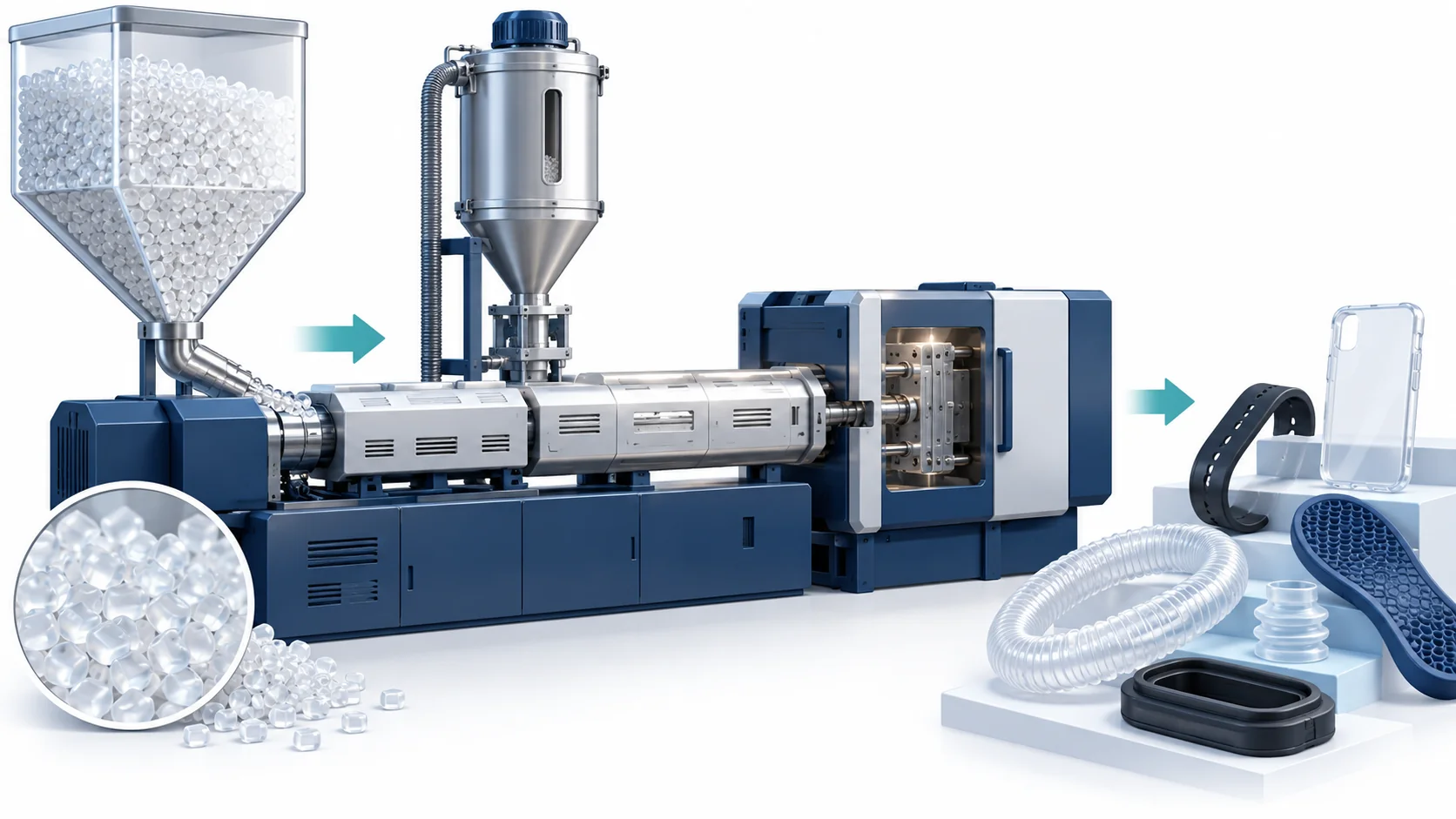
TPU pellet processing differs from casting a reactive polyurethane material into a finished part. Define whether the project concerns resin manufacturing, pellet processing or cast-elastomer production before comparing equipment.
What Makes TPU a Polyurethane and a Thermoplastic
All polyurethanes contain urethane linkages formed when an isocyanate group reacts with a hydroxyl group. In cast polyurethane, those reactions are allowed to continue inside the mold until the part becomes a crosslinked network that can no longer be melted. TPU is built differently.
TPU is a linear segmented block copolymer. Its polymer chains contain alternating hard and soft blocks along the same backbone. The hard blocks come from a diisocyanate and a short-chain diol chain extender, most often butanediol. The soft blocks come from a long-chain macroglycol, either polyester or polyether. Because the resulting chains are predominantly linear, the finished material can be heated, softened, and shaped again [1].
That single change in molecular architecture explains nearly every practical difference between TPU and thermoset polyurethane. In cast PU, the shape is created by a chemical reaction that cannot be reversed. In TPU, the shape is created by a thermal cycle that can, within reasonable limits, be repeated.
Hard Segments, Soft Segments, and Why They Separate
The hard segment is the part of the TPU chain that gives the material stiffness, hardness, and thermal resistance. It is polar, rigid, and capable of forming strong hydrogen bonds between adjacent chains. The soft segment is more flexible and less polar, giving the material its elastomeric character and low-temperature mobility.
Because the hard and soft blocks are chemically quite different, they tend to separate into domains. The hard segments cluster into glassy or semicrystalline regions that act as physical crosslinks. These hard domains work like the covalent crosslinks in a thermoset polyurethane, but they are reversible. At melt-processing temperature, the hard domains soften or disperse. When the part cools, the domains reform and the mechanical strength returns.
The separation is never complete. A useful way to think about TPU is as a material whose properties change continuously with hard segment content. More hard segment shifts the material toward higher hardness, higher modulus, and better load capacity, while reducing elastic recovery and low-temperature flexibility. More soft segment does the opposite. That is the main dial a formulator turns when designing a grade for a shoe sole, a cable jacket, a hydraulic seal, or a drive belt.
How Segment Structure Drives TPU Properties
Hardness is usually the first property checked. TPU is measured with Shore durometers, normally Shore A or Shore D depending on the rigidity of the grade, following the test method in ISO 868 [2]. The same TPU part can read acceptably on one scale and almost unmeasurable on another, so specifying the correct scale is part of the material call. Hardness gives a fast screen, but it says little by itself about tear propagation, flex fatigue, or chemical attack.
Tensile behavior is determined by methods such as ISO 527-2 [3]. Many TPU grades show high elongation and a pronounced strain-hardening region, which is what makes them useful in demanding film, hose, and belting applications. The exact stress-strain curve depends heavily on hard segment content, molecular weight, and processing history. A part that was dried poorly or over-sheared in the barrel will not reach the same curve as the laboratory plaque.
Chemical resistance also depends on the soft segment type. Polyester TPU tends to offer stronger resistance to oils, fuels, and cutting fluids but is more sensitive to hydrolysis in hot, humid service. Polyether TPU generally resists hydrolysis and microbial attack better, with better low-temperature flexibility, but may give up some oil resistance. The correct choice is a service-environment decision, not a generic performance ranking.
Hardness is the fastest screening test, but it is not a full material specification. Shore A vs Shore D Hardness In Polyurethane covers how Shore A and Shore D map to part function and why the same hardness value alone cannot tell you whether a part will survive impact, flex fatigue, or chemical exposure.
TPU Grades: Polyester vs Polyether
The two common TPU families differ mainly in soft segment chemistry. A polyester soft segment is usually selected when oil resistance, fuel resistance, and mechanical strength have high priority. A polyether soft segment is usually selected when hydrolysis resistance, microbial resistance, and low-temperature flexibility dominate the service conditions.
| Service condition | Polyester TPU | Polyether TPU |
|---|---|---|
| Hot, humid service | More prone to hydrolysis | Better resistance |
| Cutting oils and fuels | Usually stronger | Good, but verify |
| Low-temperature impact | Good | Often better |
| Long-term water immersion | Weaker without countermeasures | Stronger |
This table is a starting point, not a final specification. Plasticizer content, stabilizer package, molecular weight, and part design all shift the comparison. When the shortage of published data becomes a problem, the practical move is to test both families against the actual operating fluid at the actual service temperature.
Processing TPU: Injection Molding and Extrusion
TPU is hygroscopic. Polyester grades in particular can pick up enough moisture to hydrolyze at melt temperature, producing surface defects, reduced molecular weight, and weak weld lines. Drying before molding is not a formality; the required moisture level depends on grade, hardness, and downstream cosmetic or mechanical requirements.
Melt processing requires a temperature high enough to disrupt the hard domains but low enough to avoid thermal degradation. Shear history matters just as much as barrel temperature. A high-shear screw with excessive back pressure can overwork the melt and reduce mechanical properties, while insufficient plastication can leave hard and soft segments poorly homogenized. The practical guide is to evaluate flow with a method such as ISO 1133-1 [4], but then verify actual process behavior because TPU does not flow like a simple polyolefin.
Injection molding demands attention to shot size, cushion, and hold pressure. TPU compresses under pressure, and its density changes between melt and solid state, so a shot calculation based on an unrelated material will often be wrong in the wrong direction.
For TPU injection molding, calculate the part, sprue and runner requirement and verify the selected machine’s usable shot capacity and process settings. A reactive-PU dosing calculation does not directly define TPU screw cushion or melt shot capacity.
TPU vs Cast Polyurethane: A Process Decision
TPU and cast polyurethane can overlap on hardness and even on some application names, but they are not interchangeable process routes.
A typical cast-elastomer line meters a prepolymer and curative, mixes the liquid streams, fills tooling and follows the approved cure schedule. It is often selected for rollers, wheels, mining screens and rail components. TPU pellet molding uses a melt-and-cool route. Compare both against part geometry, volume, tooling, cooling or curing needs and validated material performance.
TPU is stronger where annual volume is high, walls are relatively thin, and the part must be produced rapidly with minimal post-cure. Its ability to be reground and reprocessed inside limits also helps process economics. The decision should be made on part geometry, production volume, cure time, hardness, and end-use environment.
If the part is a large roller, the word polyurethane can hide two completely different supply chains. How Polyurethane Rollers Are Made From Casting To Cure covers the casting, cure, and demold steps behind the thermoset alternative and why those steps change cost at low volume.
A Practical Selection Sequence
Before a final material call, work through this order rather than starting from a datasheet hardness number:
- Define the part function, not just the part name.
- Identify the dominant failure mode: abrasion, cut growth, hydrolysis, compression set, fatigue, or impact.
- State the true service temperature and contact fluid.
- Estimate annual volume and maximum wall thickness.
- Decide whether the process can support TPU tooling or whether cast PU better matches low-volume, thick-section production.
- Test the shortlisted material in a production-like thermal history, not only as a molded plaque.
This sequence is deliberately unglamorous. It catches most bad decisions early and prevents the common mistake of selecting a grade because a datasheet looks impressive under test conditions the part will never see.
Process reality check: If you are comparing TPU and cast polyurethane for the same part, do not make the call on hardness alone. Send the target Shore range, end-use temperature, media exposure, and annual volume to info@chinahaifeng.com or WhatsApp +86 13566296633. State whether your concern is process, material, or tooling, and the answer comes back in plain process terms.
Need a Specification Cross-Check?
Haifeng Polyurethane Machinery has spent 40 years on the process side of polyurethane production, from high-pressure foaming and casting lines to precision metering systems. That work involves the practical distinctions between thermoplastic and thermoset polyurethane every week.
If you are building a line around cast polyurethane, evaluating TPU, or deciding between the two, send the part drawing and annual quantity to info@chinahaifeng.com or WhatsApp +86 13566296633. The goal is not to sell you a machine on the first message; it is to define the five or six process parameters that determine whether a thermoplastic or a cast thermoset is the lower-risk route.
Frequently Asked Questions About TPU
Is TPU the same as cast polyurethane?
No. This article concerns TPU pellets that are melted and shaped. Typical cast-elastomer production mixes reactive liquid streams and follows a cure schedule. TPU resin synthesis is another stage; these equipment scopes should not be treated as interchangeable.
Can TPU be reprocessed like other thermoplastics?
Within practical limits, yes. TPU can be reground and reprocessed, but repeated heat history damages the polymer. Hardness, molecular weight, and mechanical properties can drift after repeated cycles, so reclaim ratio and thermal history need to be controlled like any engineering thermoplastic.
Which is better, polyester or polyether TPU for wet conditions?
Polyether TPU is generally preferred for hot, humid, or continuously wet service. Polyester TPU is generally stronger in oils and fuels but more susceptible to hydrolysis. The answer depends on the specific fluid, temperature, and exposure duration.
What hardness ranges are common in TPU?
TPU grades span a wide durometer range, from soft elastomer-like materials measured on Shore A to rigid materials measured on Shore D. The correct scale and target should come from the part function rather than from a single preferred number.
Why do TPU parts need drying before molding?
TPU absorbs enough moisture to hydrolyze at melt temperature, especially polyester grades. Wet resin can cause surface defects, weak weld lines, and reduced mechanical properties, so drying is a process requirement, not an optional step.
References
BASF Elastollan processing recommendations: drying and processing guidance is grade-specific.
[2] ISO 868:2003, Plastics and ebonite — Determination of indentation hardness by means of a durometer (Shore hardness). International Organization for Standardization.
[3] ISO 527-2:2012, Plastics — Determination of tensile properties — Part 2: Test conditions for moulding and extrusion plastics. International Organization for Standardization.
[4] ISO 1133-1:2022, Plastics — Determination of the melt mass-flow rate (MFR) and melt volume-flow rate (MVR) of thermoplastics — Part 1: Standard method. International Organization for Standardization.





