

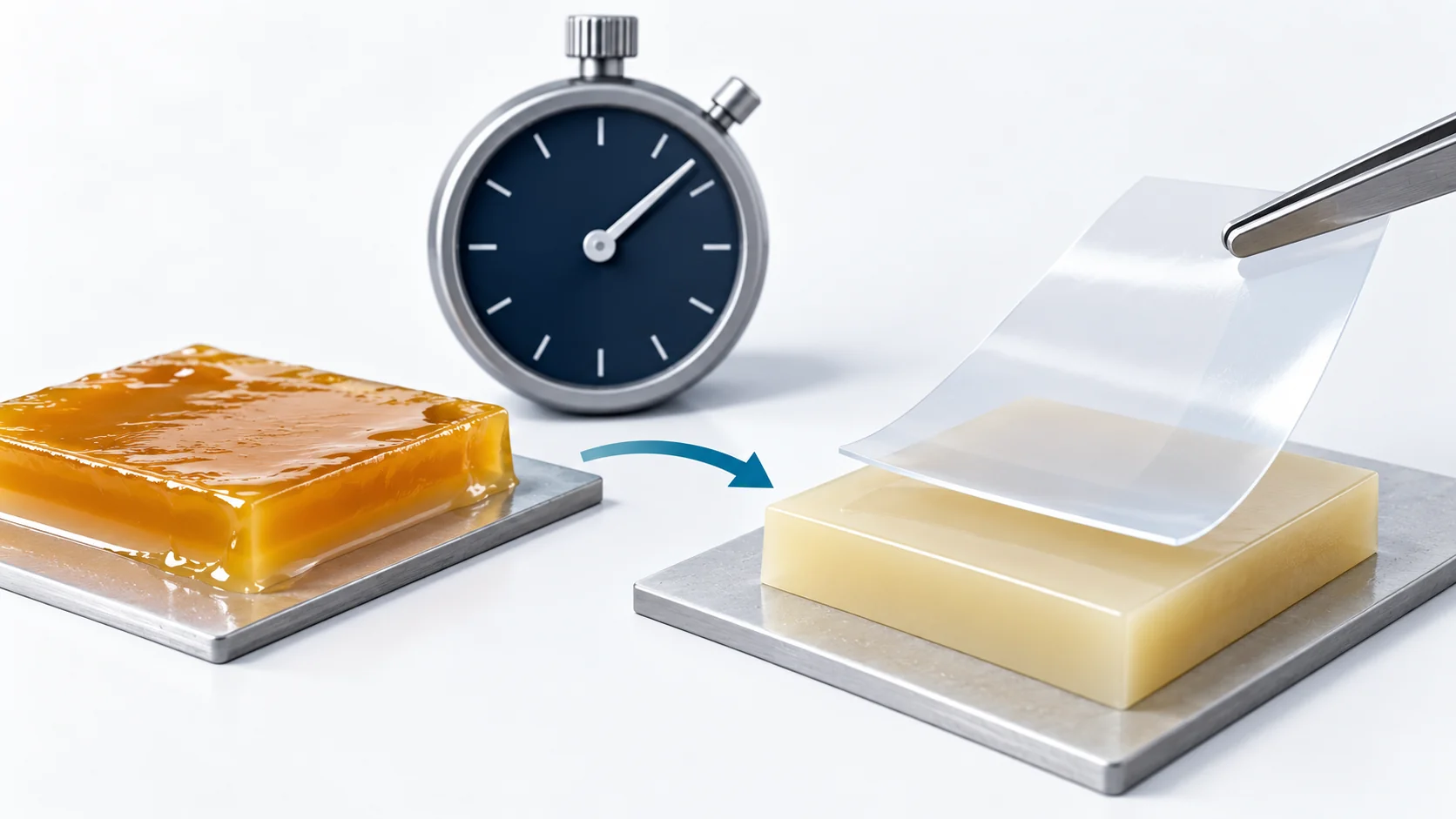
A molded polyurethane part that leaves a fingerprint after demolding is not just a handling nuisance. It is a signal that the surface reaction has not advanced far enough for the part to survive trimming, stacking, or the next process step without marking. That point—when the surface no longer transfers to a clean fingertip or a piece of polyethylene film under light pressure—is the tack-free time. In production, tack-free time is less about a single laboratory number and more about a repeatable surface-cure checkpoint that protects both cycle time and scrap rate.
What Tack-Free Time Actually Measures
Tack-free time is a surface phenomenon. It marks the point at which the outermost layer of the polyurethane has built enough molecular weight and crosslink density to stop transferring material to a clean test surface. It does not mean the part has reached full cure, full mechanical properties, or even demold strength. Those properties develop later.
The surface tends to cure by chain extension and crosslinking near the air interface, so tack-free time is controlled by the same variables that drive the later cure—temperature, catalyst activity, isocyanate index, and the mobility of reactive groups [1].
Where Tack-Free Time Sits in the Reaction Profile
On a well-run machine, the operator tracks several time markers in order: cream time, gel time, rise or free-rise time, tack-free time, demold time, and final cure. They describe one continuous reaction but refer to different physical states.
Tack-free time is therefore a surface event, not a bulk event. It usually arrives after gel time but before the part has developed enough green strength for demolding. If demolding is attempted before tack-free time, the part can mark, tear, or bond to mold surfaces. If tack-free time arrives far too early, the surface may skin before the interior stops rising, creating trapped cells or a split skin.
The reaction profile is easier to control when each term is mapped to what the operator actually sees at the mixing head and in the mold. The Role Of Rise Time In Polyurethane Foaming covers how rise time fits between gel time and the later stages of cure.
How to Measure Tack-Free Time on the Line and in the Lab
The simplest plant-floor check is a clean-finger test: press a clean, dry fingertip against the surface with light, repeatable pressure. If no material transfers and the surface does not feel sticky, record the elapsed time. A more consistent version replaces the fingertip with a small strip of polyethylene film under a fixed light weight; the material is tack-free when the film releases cleanly without residue.
For elastomeric sealants and similar soft polyurethane systems, ASTM C679 is the standard method for tack-free time [2]. For thin organic coatings and cast films, ASTM D1640 provides a surface-film method that can be adapted for polyurethane topcoats and lacquer-like layers [3]. There is no single universal standard for every slabstock foam or cast elastomer part, so the most useful number is the one measured under your process conditions and recorded with the process variables.
Whichever method you choose, record the material temperature, substrate temperature, and ambient humidity at the moment of the check. Without those three numbers, a tack-free reading is not transferable from shift to shift.
A repeatable measurement depends on controlling more than the timing method—sample preparation and conditioning matter just as much. Measuring Polyurethane Foam Resilience A Practical Test Guide covers a testing workflow that treats practical measurement the same way.
Factors That Move Tack-Free Time
| Factor | Effect on tack-free time | What to watch on the line |
|---|---|---|
| Material temperature | Warmer shortens | Tank setpoint vs. actual return temperature |
| Mold or substrate temperature | Warmer shortens | Surface temperature, not air temperature |
| Catalyst type and loading | Higher activity shortens | Shifts in cream and gel times appear first |
| Isocyanate index | Off-ratio leaves reactive groups | A/B metering accuracy and pump calibration |
| Ambient humidity | Varies by system | Moisture-cure can skin faster; moisture-sensitive prepolymers can develop defects |
| Mold release and surface residues | Can alter adhesion and skin formation | Application weight and coverage |
The trap in adjusting any one factor is that tack-free time reacts fast, while final properties react slowly. A catalyst addition that shortens tack-free time today can lower elongation or increase exotherm in the same shot. Any change should be evaluated at both the surface checkpoint and the final property set, not one or the other.
Why Tack-Free Time Matters for Equipment and Cycle Planning
If tack-free time is longer than planned, downstream handling starts before the part is ready. Operators compensate by extending open-mold time, reducing output, or adding release sprays. If it is too short, the surface can skin before the interior has risen or filled the mold, causing surface defects or trapped gas. Both directions convert a process timing issue into scrap.
The equipment variables that matter most are the ones that hold temperature and ratio constant. Tank temperature control, hose and mixing-head heating, mold temperature control, and metering accuracy all change how fast the surface reaches its non-tacky state. When a line runs the same formulation but different tack-free readings between shifts, the cause is usually a machine or ambient variable, not the chemistry.
Spray applications turn tack-free time into a moving target because substrate temperature and pass thickness change the skin-formation rate. What Is Spray Polyurethane Foam Composition And Application covers the system variables behind that behavior.
In one footwear line, a dual-density sole began marking during stacking only on the third shift. The formula had not changed; the B-side tank setpoint had drifted lower overnight. The surface was reaching tack-free time later because the fluid was colder, not because the catalyst was weak. Correcting the heating setpoint brought the tack-free checkpoint back without a single formulation change.
Before you change catalysts, check whether your machine is holding the variables you think it is holding. Send your current cycle, shot weight, material temperature setpoints, and the tack-free time you are seeing to Info@chinahaifeng.com with “tack-free time” in the subject. You can also reach us on WhatsApp at 86 13566296633. An equipment-side check often identifies the variable faster than a full reformulation trial.
Adjusting Tack-Free Time Without Destabilizing the Part
Adjustments should follow a hierarchy: verify metering and temperature first, then mold temperature, then catalyst or index. If formulation work is needed, change one variable at a time and record tack-free time together with gel time, rise time, and demold hardness. That way a surface improvement that creates a hidden bulk problem becomes visible in the next property check.
For molded elastomers, higher mold temperature often shortens tack-free time but can also increase shrinkage or reduce working life. For high-resilience foam, a more active amine catalyst may shorten tack-free time while also accelerating cell opening; the result may be a lower density or softer foam than intended. The decision depends on line speed, part thickness, and the property spec [1].
A Practical Pre-Run Checklist
Before each shift, verify:
- A-side and B-side tank temperatures match the formulation card and the return-temperature reading.
- Mold or substrate surface temperature is within the specified window.
- A/B metering ratio is calibrated and stable at the actual shot size.
- Ambient temperature and humidity are recorded at first shot.
- Tack-free check follows the same method, operator, and contact pressure.
- Demold timing is adjusted only after the surface checkpoint is confirmed.
Get Help With Tack-Free Time on Your Line
If you need a second set of eyes on the equipment side, send us the following details:
- Part or foam type and target density/hardness
- Material system and shot weight
- Tank, hose, and mold temperature setpoints
- Cream, gel, rise, and tack-free timings from the last stable run
- The defect or handling problem you are trying to eliminate
Email: Info@chinahaifeng.com
WhatsApp: 86 13566296633
We will respond with what to verify first and what to leave alone.
FAQ
Is tack-free time the same as demold time?
No. Tack-free time is when the surface stops transferring residue; demold time is when the part has enough green strength to be removed without tearing or excessive deformation. Demold time usually comes later.
Does higher humidity always shorten tack-free time?
No. In moisture-cure systems, higher humidity can accelerate surface cure, but in moisture-sensitive prepolymer systems it can cause bubbling or surface defects. Record humidity rather than assuming direction.
Can I use one tack-free number for all polyurethane systems?
No. Rigid foam, flexible foam, cast elastomer, coating, and sealant systems reach the surface checkpoint differently. Use the number for your specific system and process temperature.
Why does tack-free time change between shifts when the formula does not?
The most common causes are tank or mold temperature drift, ambient conditions, pump ratio variation, or changes in how the operator performs the tack-free test. Check measured temperatures and the test method before changing chemistry.
References
[1] D. Randall and S. Lee, The Polyurethanes Book, Wiley, 2002.
[2] ASTM C679-15, Standard Test Method for Tack-Free Time of Elastomeric Sealants, ASTM International, West Conshohocken, PA, 2015.
[3] ASTM D1640/D1640M-14, Standard Test Methods for Drying, Curing, or Film Formation of Organic Coatings, ASTM International, West Conshohocken, PA, 2014.
If you’re interested, check out these related articles:
Shore A Vs Shore D Hardness In Polyurethane
How To Calculate Shot Weight In Polyurethane





