
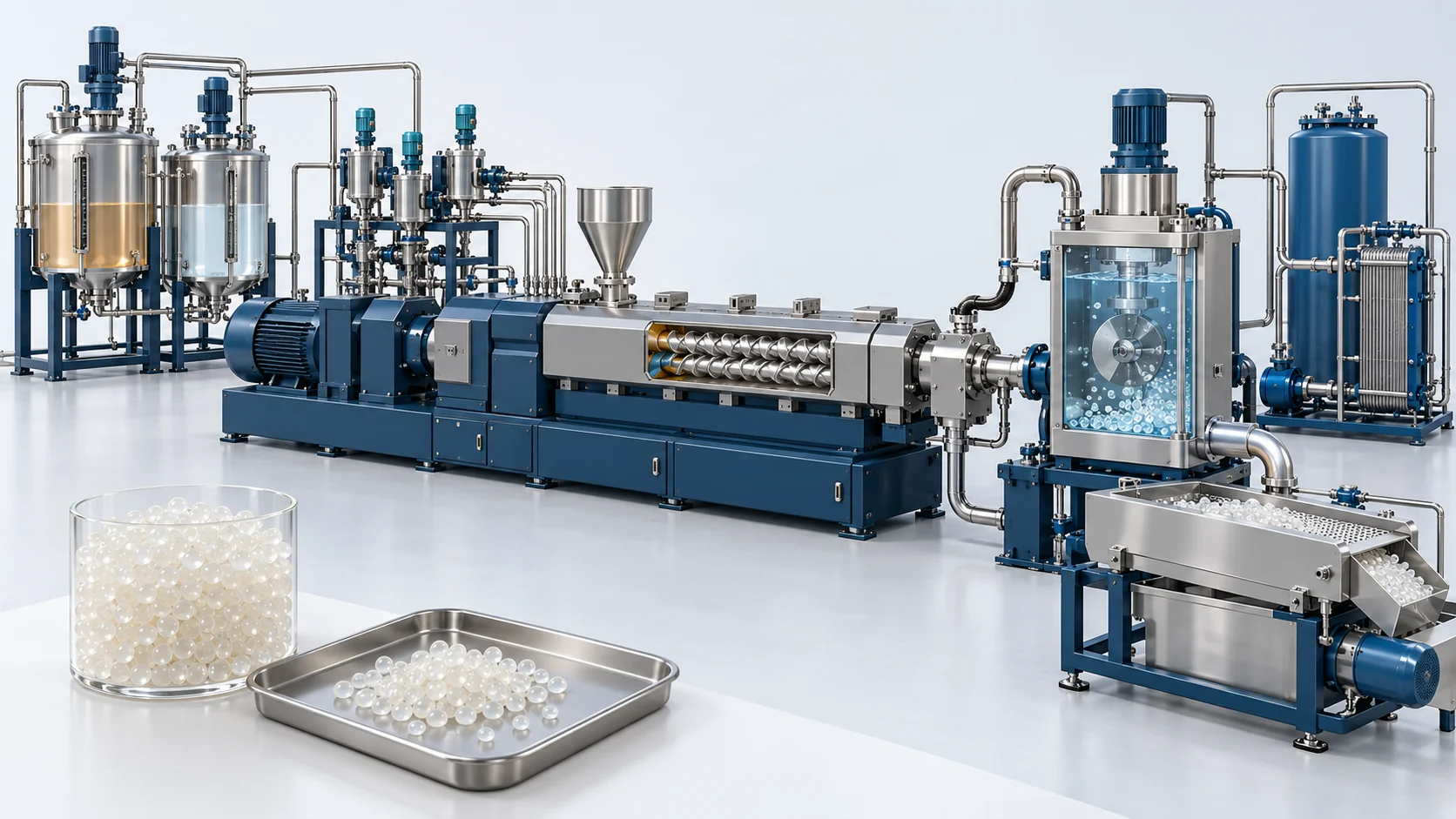
TPU Reactive Extrusion Pelletizing Solution
Turnkey equipment engineering for continuous one-shot TPU synthesis. Combining four-stream mass flow dosing, high-torque L/D 56 twin-screw reaction, and closed-loop underwater pelletizing up to 1,200 kg/h.
Continuous Reaction Engineering for Technical TPU Polymers
High-performance thermoplastic polyurethanes required for optical films, expanding shoe midsoles (ETPU), and technical wire jackets demand strict control over molecular architecture and melt consistency. Traditional batch reactor casting followed by slab aging and grinding produces broad molecular weight variations, thermal history degradation, and excessive pellet dust. Haifeng’s Continuous TPU Reactive Extrusion Solution achieves single-step, automated chemical synthesis and underwater pelletizing within an enclosed, continuous process footprint.
Single-Step One-Shot Conversion
Liquid polyol, MDI, and extenders react in a continuous shear field across an L/D = 56 barrel, completing polymerization within 3 minutes and eliminating days of slab aging.
Precision Die-Face Underwater Cutting
Extruded polymer strands are cut immediately at the die surface in conditioned water, preventing air oxidation and producing dust-free spherical pellets with high bulk density.
Designed for both virgin polymer synthesizers and high-end specialty compounders, our engineering solutions eliminate intermediate aging warehouses, drastically lower unit energy consumption, and deliver uniform spherical pellets ready for downstream processing.
End-to-End Reactive Extrusion Workflow
A synchronized, automated manufacturing sequence from liquid chemical feed to packaged spherical TPU pellets.
Continuous Multi-Stream Liquid Feeding
Dehydrated polyol, molten pure MDI (65°C), chain extender (BDO), and catalyst are metered via Coriolis flow meters into the extruder throat under positive nitrogen.
Co-Rotating Twin-Screw Reactive Extrusion
Reactants enter the extended L/D = 56 co-rotating screw, undergoing progressive chain growth and polymerization across 14 independently controlled temperature zones.
Multi-Stage Vacuum Volatile Stripping
Unreacted trace monomers and entrained moisture are extracted through dual vacuum vents operating below 0.05 kPa to ensure polymer purity and bubble-free optical clarity.
Reference Solution Engineering Envelope
Typical capability matrix for Haifeng turnkey continuous TPU reactive extrusion and pelletizing packages.
| Parameter | Value / Unit | Applicable Configuration / Conditions |
|---|---|---|
| Extruder Production Output | 400.0 to 1,200.0 kg/h | Co-rotating twin-screw extruder with servo drive |
| Screw Diameter & Length | Ø 75 mm, L/D = 52– 64 | Modular intermeshing screw blocks on splined shafts |
| Liquid Dosing Accuracy | Ratio tolerance within ±0.15% | Four-stream Coriolis mass-flow closed-loop skid |
| Polymer Hardness Envelope | Shore 60A to Shore 75D | Polyester, polyether, and polycaprolactone systems |
| Pellet Moisture Content | Less than 0.02% (200 ppm) | Target from the supplied brief; final drying and sampling conditions require verification |
| Polymer Molecular Dispersion | Mw/Mn ≤ 1.85 | Reported project target; grade and original GPC records require verification |
Core Equipment for This Solution
The package covers liquid feed conditioning and multi-stream metering, twin-screw reactive extrusion, melt pumping, underwater pelletizing and the specified dewatering/drying stages. A prepolymer reactor for a two-step route and solid feeders are optional. Materials, utilities and nitrogen supply are agreed external interfaces. One-step and two-step process layouts are confirmed separately.
Core Advantages of Haifeng TPU Systems
Engineering features designed to solve broad molecular weight distributions, die-face smearing, and pellet contamination.
Extended L/D 56 Reaction Barrel
The specified modular co-rotating barrel provides staged reaction and devolatilization zones.
Four-Stream Mass-Flow Dosing
Independent metering loops track the specified liquid feed formulation and process setpoints.
Underwater Pelletizing
A conditioned-water die-face cutting stage forms pellets; size and fines are checked for the grade and die.
Devolatilization and Drying Interfaces
Vacuum ports, dewatering and secondary drying are specified separately; final residuals and moisture require testing.
Related Project Draft
Review the project configuration described in the supplied brief. Project records and reported results require verification before public use.
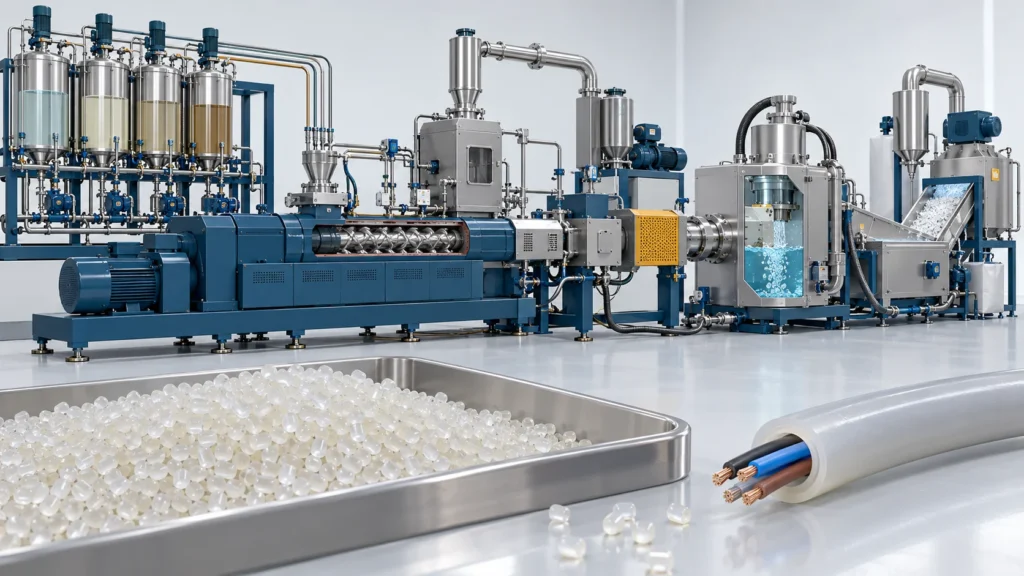
Frequently Asked Questions
Find answers about TPU Reactive Extrusion Pelletizing Solution, including material selection, equipment configuration and the information needed to plan a production line.
How does one-shot reactive extrusion differ from two-step TPU production?
Can this reactive line process aliphatic isocyanates like H12MDI or HDI?
What prevents the underwater pelletizer from jamming during line startups?
How does the system achieve low moisture without lengthy dehumidifying?
Request a TPU Reactive Extrusion Proposal
Submit your target polymer chemistry, hardness ranges, and hourly capacity targets for a custom equipment plan.


