
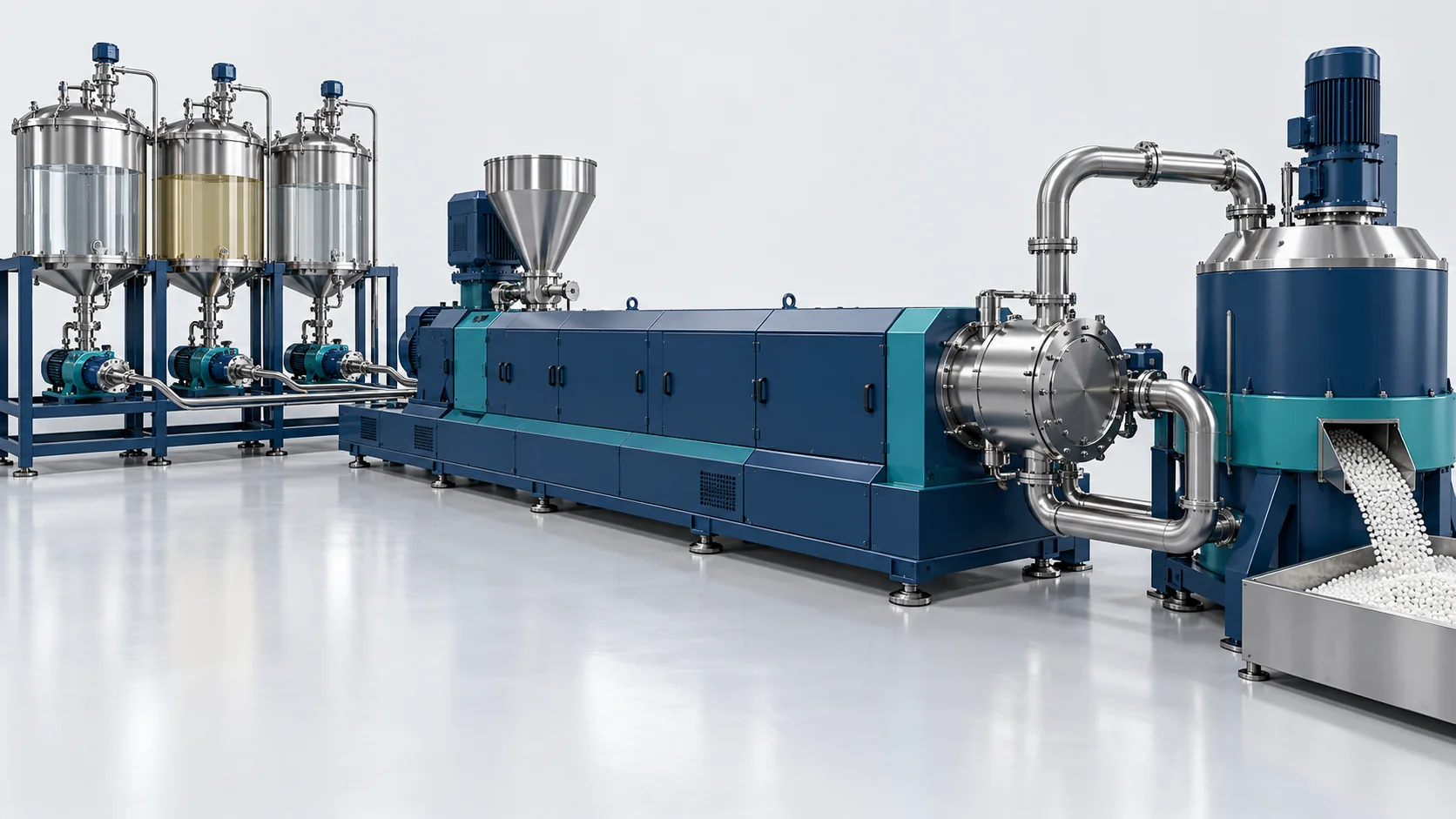
TPU Reactive Extrusion Line | Underwater Pelletizing
Built for continuous one-shot TPU polymerization, the HF-TPU75-REX delivers precision four-stream liquid dosing, high-torque twin-screw reactive extrusion with L/D 56, and closed-loop underwater pelletizing up to 1,200 kg/h.
Continuous High-Torque Reactive Polymerization for TPU
The HF-TPU75-REX is a continuous twin-screw reactive extrusion and underwater pelletizing line engineered for one-shot TPU synthesis, tight molecular weight distribution, and uniform spherical pellet production.
The HF-TPU75-REX is an industrial-scale twin-screw reactive extrusion (REX) and underwater pelletizing system engineered specifically for continuous thermoplastic polyurethane (TPU) production. Replacing inefficient batch casting and slab-curing granulation methods, this system introduces high-viscosity polyols, molten MDI, chain extenders, and catalysts directly into the co-rotating twin-screw extruder to achieve single-step continuous polymerization, de-volatilization, and spherical underwater cutting.
Featuring an extended process length (L/D = 56) and segmented barrel temperature control across 14 independent zones, the system provides narrow residence time distributions and precise reaction exotherm management. The output melt is pumped through a diverted start-up valve into an automated underwater pelletizer, producing uniform micro-spherical pellets suitable for high-end optical films, expanding beads (ETPU), and medical tubing with molecular weight dispersion (Mw/Mn) held below 1.85.
Material Flow and Working Principle
Continuous Molten Chemical Feeding
Dehydrated polyol, molten pure MDI (65°C), and chain extender (BDO) are fed through dedicated lines under Coriolis mass flow control, with high-pressure micro-injection valves delivering chemicals into the feed throat under nitrogen blanketing.
Co-Rotating Twin-Screw Reactive Polymerization
The liquid streams enter the high-torque co-rotating twin-screw extruder (L/D = 56), progressing through fast prepolymerization, high-shear polymerization, and multi-stage vacuum de-volatilization zones where volatile monomers are stripped.
Melt Gear Pump Pressure Stabilization
An electrically heated melt gear pump draws the viscous polymer from the extruder screw tips, decoupling extrusion pressure from the die head to maintain stable discharge pressure fluctuations below 0.05 MPa.
Die-Face Underwater Pelletizing
The molten polymer is extruded through a multi-orifice heated die plate into a flooded cutting chamber, where rotating multi-blade cutter heads cut the strands into spherical pellets under conditioned water flow.
Centrifugal Dewatering & Fluidized Bed Drying
The pellet-water slurry is pumped to a continuous centrifugal dryer that separates transport water within seconds, followed by a vibrating fluidized bed for secondary moisture reduction below 0.02%.
Model and Technical Parameters
Configuration values from the supplied equipment brief. Final settings and capability are confirmed for the selected material and project conditions.
| Technical Parameter | HF-TPU75-REX |
|---|---|
| Components | 4 Streams (Polyol, Isocyanate, Extender, Catalyst/Color) |
| Output Range (g/s) | 400.0 to 1,200.0 kg/h (Continuous pellet production) |
| Mixing Ratio Range | 100:25:8 to 100:65:22 (Adjustable based on formulation) |
| Ratio Accuracy | ±0.15% (Coriolis mass flow continuous tracking) |
| Power Supply | 380V, 3-Phase, 50Hz (Custom 440V/480V 60Hz optional) |
| Working Pressure | 12.0 to 18.0 MPa (Extruder die discharge & pelletizer head) |
| Tank Capacity (L) | Day tanks: 2 x 1,500 L (Jacketed), 2 x 300 L (Additives) |
| Weight | 18,500 kg (Extruder, skid, and pelletizer system) |
| Dimensions (L×W×H) | 24,000 mm x 3,500 mm x 3,200 mm |
| Screw Diameter & L/D Ratio | Ø 75 mm, L/D = 56 (Co-rotating intermeshing); Extruder Process Section |
| Maximum Screw Speed | Up to 600 RPM (High-torque AC motor drive); Reactive Polymerization |
| Pellet Size Variance | 2.5 mm ± 0.1 mm (Spherical pellet diameter); Standard cutting die plate |
| Total Installed Power | 245 kW (Drive motor, barrel heaters, water pump); Peak production load |
Key Equipment Features
The package covers liquid feed conditioning and multi-stream metering, twin-screw reactive extrusion, melt pumping, underwater pelletizing and the specified dewatering/drying stages. A prepolymer reactor for a two-step route and solid feeders are optional. Materials, utilities and nitrogen supply are agreed external interfaces. One-step and two-step process layouts are confirmed separately.
Extended L/D 56 Reaction Barrel
The specified modular co-rotating barrel provides staged reaction and devolatilization zones.
Four-Stream Mass-Flow Dosing
Independent metering loops track the specified liquid feed formulation and process setpoints.
Underwater Pelletizing
A conditioned-water die-face cutting stage forms pellets; size and fines are checked for the grade and die.
Devolatilization and Drying Interfaces
Vacuum ports, dewatering and secondary drying are specified separately; final residuals and moisture require testing.


