
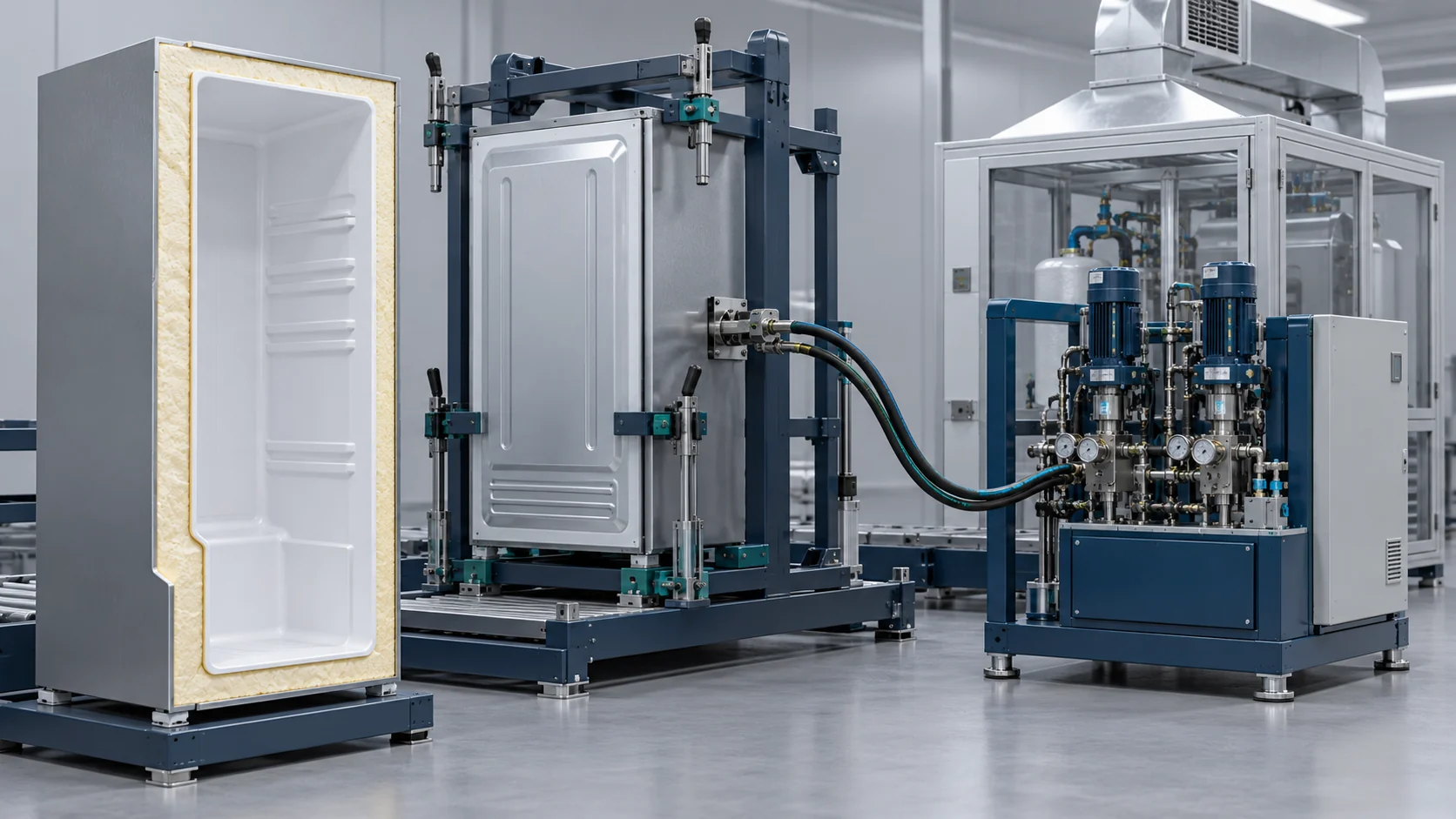
Refrigerator Cyclopentane Foaming Solution
Cyclopentane high-pressure metering and mixing with online premixing, fixture vacuum-assist interfaces and project-specific safety engineering.
Advanced Thermal Efficiency for Modern Cold Appliances
Global refrigeration standards demand increasingly stringent energy efficiency ratings, pushing manufacturers to reduce insulation thermal conductivities while minimizing foam pack weights. Traditional chemical blowing agents face environmental phase-outs, while hydrocarbon alternatives like cyclopentane require specialized explosion protection and ultra-fine cell control. Haifeng’s Refrigerator Cyclopentane Foaming Solution addresses these engineering demands by integrating project-specific hazardous-area configuration safety logic, dynamic online premixing, and high-pressure vacuum-assisted injection into high-volume appliance assembly lines.
Zero-Phase Separation Online Blending
The inline premixing module blends liquid cyclopentane into polyol streams under continuous mass-flow feedback, eliminating chemical segregation and saving bulk formulation costs.
Vacuum-Assisted Thin-Wall Penetration
Drawing an 80 kPa vacuum on the cabinet fixture lowers chemical flow resistance, allowing fast-reacting foam to penetrate 45 mm ultra-thin walls without forming air voids or surface sink marks.
Engineered for multi-door refrigerators, commercial horizontal freezers, and ultra-low temperature medical cold boxes, our equipment packages deliver uniform density distribution, superior skin adhesion, and long-term structural integrity.
End-to-End Refrigerator Foaming Process
A synchronized, automated workflow engineered for high-throughput appliance manufacturing lines.
Inline Cyclopentane Premixing & Gas Monitoring
The specified premix unit combines polyol and cyclopentane before the main metering stage. Gas detection, ventilation and interlocks are coordinated with the approved hazardous-area and site design.
High-Pressure Recirculation & Conditioning
Polyol-cyclopentane blend and isocyanate are pressurized to 15–20 MPa by servo-driven axial piston pumps, circulating through thermal jackets to maintain exact reaction temperatures.
Cabinet Fixture Clamping & Vacuum Assist
The assembled refrigerator shell is locked inside a hydraulic fixture, and the cavity is evacuated to 80 kPa absolute pressure to facilitate complete liquid spread.
Standard Engineering Parameters for Appliance Foaming
Reference technical capability envelope for Haifeng turnkey refrigerator and freezer foaming equipment packages.
| Parameter | Value / Unit | Applicable Configuration / Conditions |
|---|---|---|
| Continuous Dispensing Output | 60.0 to 240.0 kg/min | High-pressure servo-controlled axial piston metering |
| Fluid Working Pressure | 15.0 to 20.0 MPa | Impingement mixing without mechanical stirrer |
| Premixing Dosing Accuracy | Ratio tolerance within ±0.1% | Closed-loop Coriolis feedback across polyol and C-pentane |
| Core Foam Thermal Conductivity | 18.0 to 18.5 mW/(m·K) | Measured at 10°C mean temperature on aged samples |
| Mold Cavity Vacuum Assist | Down to 80 kPa (Absolute) | Pneumatically sealed docking valve on cabinet fixtures |
| Explosion-Proof Rating | Project-specific hazardous-area configuration; certificates to be verified | Detection, ventilation and interlocks reviewed with the site design |
Core Equipment for This Solution
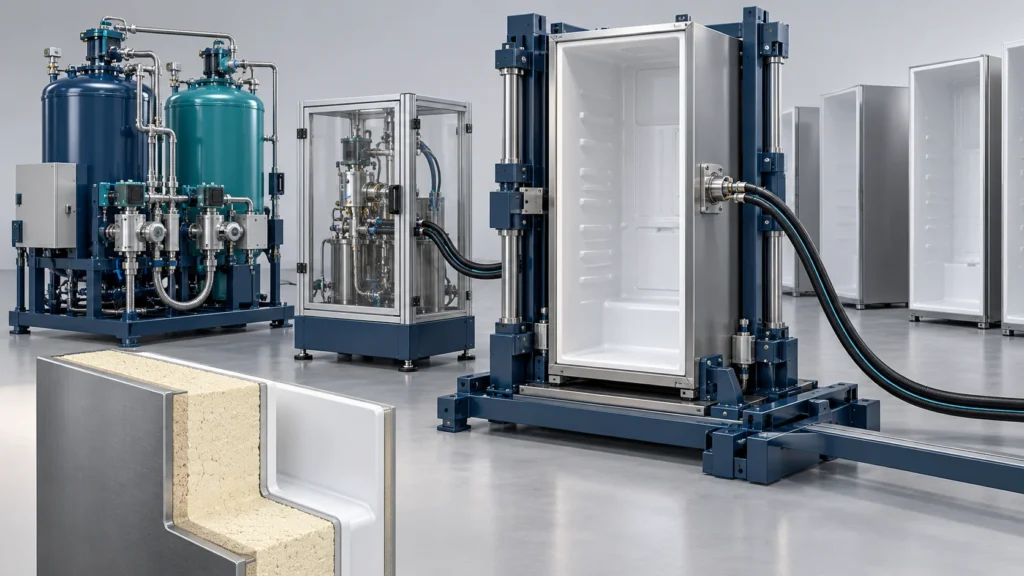
The package covers cyclopentane premixing, high-pressure metering and mixing, mold vacuum-assist interfaces and project-specific safety controls. Carousels and robot handling are optional. Chemistry, ventilation and site power are agreed external interfaces. Hazardous-area suitability, detection and interlocks require project-specific engineering and documentation.
Core Advantages of Haifeng Refrigerator Systems
Engineering highlights designed to solve hydrocarbon explosion risks, foam density variation, and cabinet sink defects.
Project-Specific Safety Interfaces
Hazardous-area components, gas detection, ventilation and interlocks require coordinated engineering and supporting documentation.
Online Cyclopentane Premixing
The specified premix unit controls blowing-agent dosing before the main metering and mixing stage.
Mold Vacuum-Assist Interface
Vacuum assistance is configured with the cabinet fixture to support filling; it is distinct from vacuum-insulated panels.
Mechanical Head Cleanout
A cleanout piston is specified for the mixing chamber; maintenance and chemical handling follow the validated project procedures.
Related Project Draft
Review the project configuration described in the supplied brief. Project records and reported results require verification before public use.
Frequently Asked Questions
Find answers about Refrigerator Cyclopentane Foaming Solution, including material selection, equipment configuration and the information needed to plan a production line.
How does inline premixing reduce appliance manufacturing costs?
What safety measures trigger if a cyclopentane gas leak is detected?
How does mold vacuum assistance prevent surface sink marks on refrigerators?
Can this foaming solution support vacuum insulation panels (VIP)?
Request an Appliance Foaming Solution Proposal
Submit your cabinet dimensions, daily output targets, and energy rating requirements for a customized equipment proposal.


