
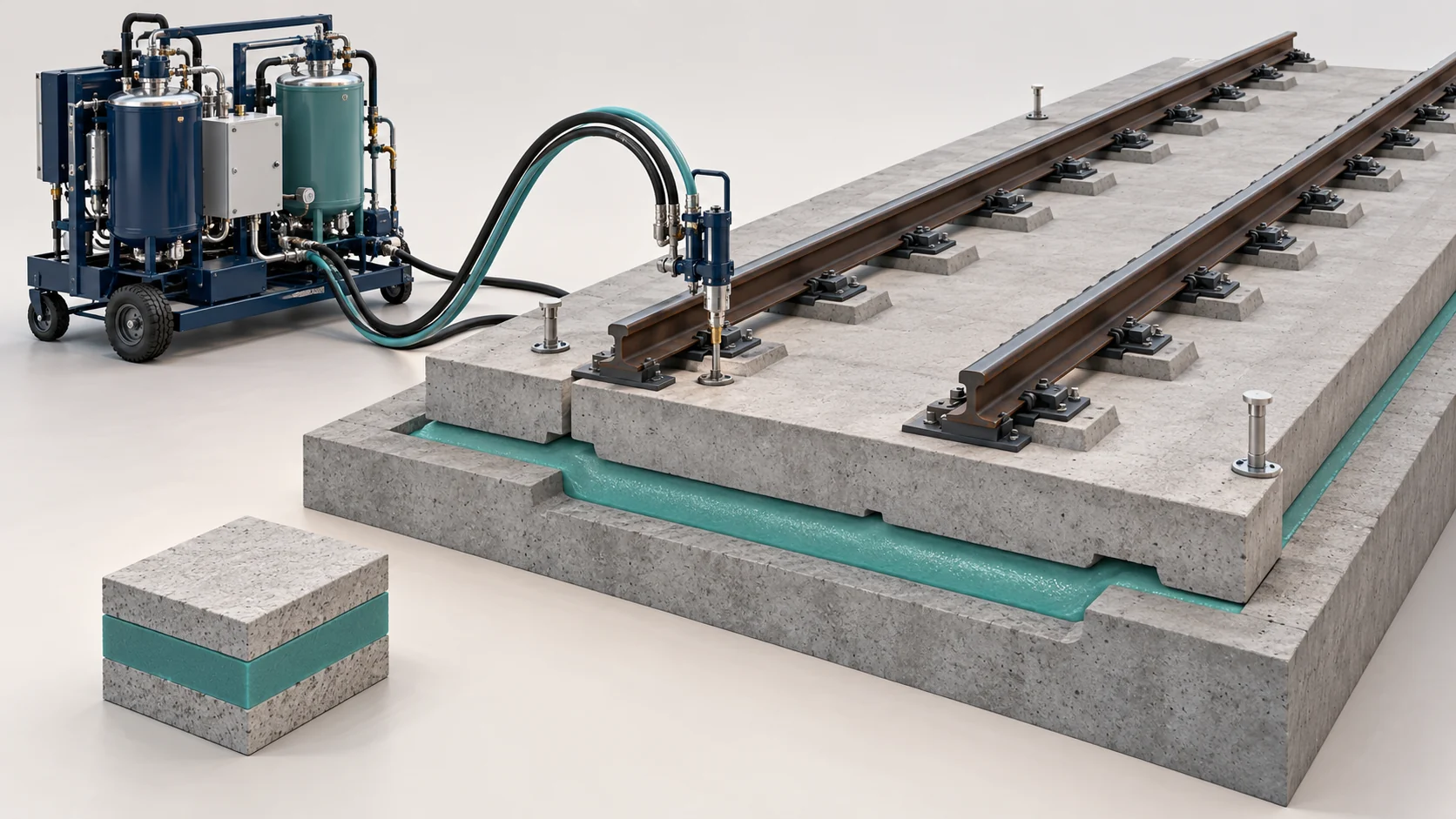
Rail Transit Polyurethane Damping Solution
Configure in-situ PU track-slab cushion grouting with defined fill inspection and possession-window planning.
Engineered Polyurethane Damping for High-Speed and Urban Rail
Track-slab grouting coordinates material preparation, dynamic mixing, controlled delivery and venting in the surveyed cavity. Delivered volume and emerging material at vents are process observations; they do not alone prove complete fill, acoustic performance or rail qualification. Agree the layer inspection and test basis separately.
Defined supply scope
Define material supply, conditioning, metering, delivery, cleaning and site handling. Injection time is one segment of slab preparation, filling, cure, inspection and track handback.
Inputs for process selection
Cavity survey, slab dimensions, vents, temperature conditions, material data, inspection plan and available possession window.
Equipment scope, retained factory interfaces and acceptance are agreed for the selected material and part. Define material supply, conditioning, metering, delivery, cleaning and site handling. Injection time is one segment of slab preparation, filling, cure, inspection and track handback.
Rail Transit Polyurethane Damping Workflow
Survey and prepare the cavity → Condition and meter → Grout and observe → Inspect and release. Define preparation, filling, cure and output timing separately for the selected configuration.
Survey and prepare the cavity
Confirm geometry, thickness, access, seals and vent paths.
Condition and meter
Review material temperatures, ratio and calibrated delivery.
Grout and observe
Use the agreed filling sequence and monitor vents and delivered material.
Reference Solution Engineering Envelope
Existing configuration and test references. Equipment settings, material results and finished-assembly results are separate; apply each value only to its documented configuration and conditions.
| Parameter | Value / Unit | Applicable Configuration / Conditions |
|---|---|---|
| Continuous Discharge Rate | 10.0 to 60.0 kg/min | Variable servo-controlled gear pump displacement |
| Metering Ratio Precision | Tolerance within ±0.5% | Closed-loop Coriolis feedback across laminar flow conditions |
| Dynamic Mixing Rotor Speed | 1,500 to 4,500 RPM | Multi-stage dynamic rotor with frequency-inverter control |
| Thermal Conditioning Range | Ambient up to 60°C | Multi-zone electric and thermal fluid jacket tracing (±1.0°C) |
| Delivery Line Working Radius | 25 meters standard (Extendable) | Jacketed, electrically heated, and wear-resistant trackside hose |
| In-Situ Polyurethane Density | 0.85 to 1.10 g/cm³ | Controlled microcellular expansion without unreacted gas voids |
Core Equipment for This Solution
Equipment references are selected by their documented process. Main metering, auxiliary supply and alternative routes are not a single standard package.
Process controls and application checks
Evaluate these functions with the selected material, tooling and production brief. Finished-part results require their own acceptance evidence.
Defined fill evidence
Specify inspection coverage, detection limits and sampling without equating a pass rate to void content.
Complete work-window planning
Include preparation, movement, interruptions, cleaning, cure and inspection in crew output.
Material and site controls
Review the selected formulation and work arrangements rather than claiming universal environmental safety.
Related Projects
These are related application references. Compare the actual material, process and delivered modules; reported project figures are not acceptance results for another line.
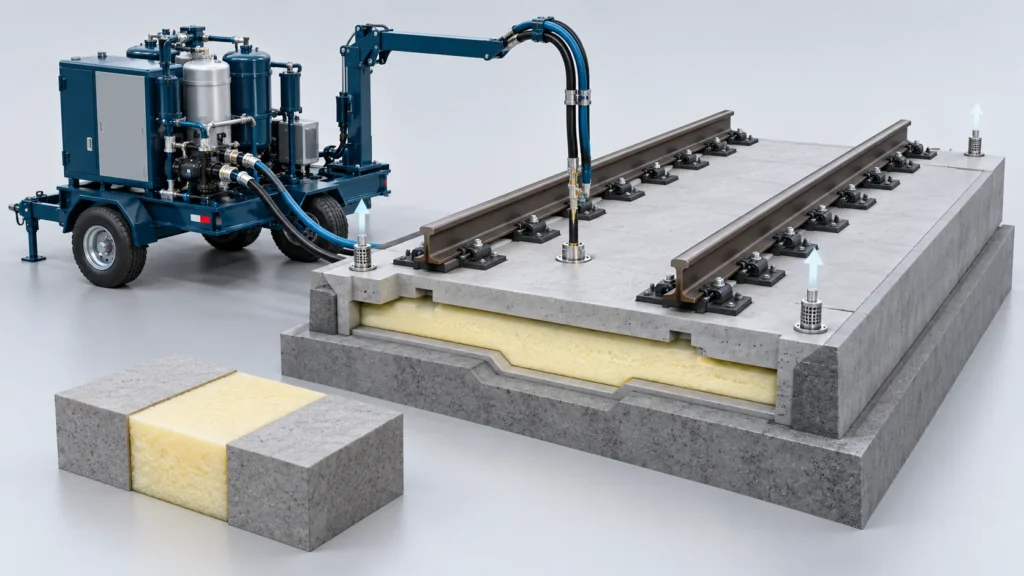
Frequently Asked Questions
Find answers about Rail Transit Polyurethane Damping Solution, including material selection, equipment configuration and the information needed to plan a production line.
Does visible material at the vents prove there are no voids?
Does the rapid injection reference equal a ready-for-service cycle?
What information is needed for a preliminary configuration?
Request a Rail Transit Polyurethane Proposal
Share the following with your production brief: Cavity survey, slab dimensions, vents, temperature conditions, material data, inspection plan and available possession window. Our team will reply within one business day. Once requirements are clear, we provide a preliminary proposal within two business days.


