
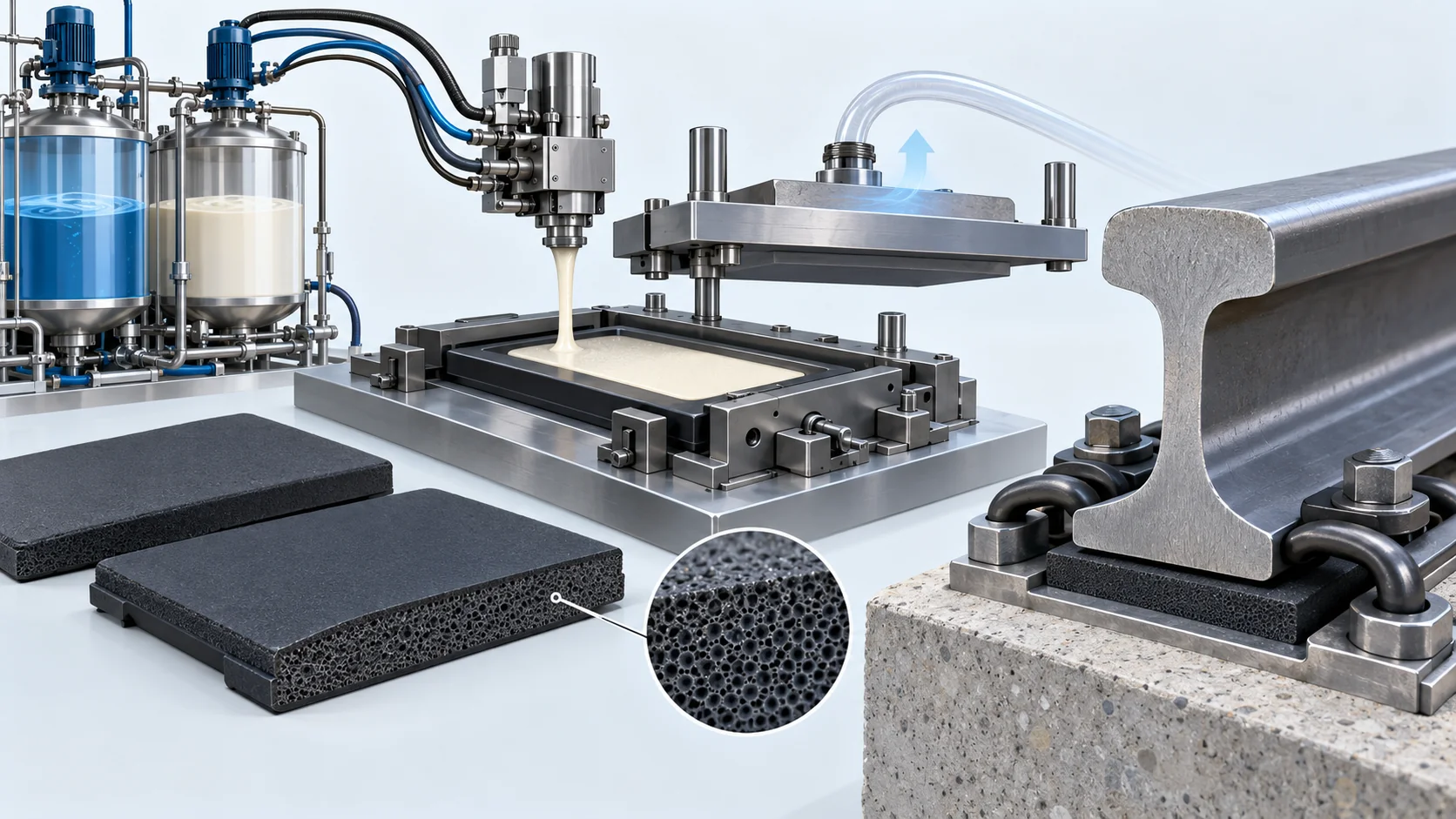
Rail Transit MCU Elastic Pad Solution
Configure water-blown microcellular polyurethane rail-pad production with high-pressure mixing, vacuum-assisted tooling, mold-temperature control and indexed curing.
Low-Hysteresis Microcellular Damping for High-Speed Track Beds
Configure water-blown microcellular polyurethane rail-pad production with high-pressure mixing, vacuum-assisted tooling, mold-temperature control and indexed curing. Core interfaces cover conditioned feed, high-pressure metering and mixing, multi-station clamping, mold evacuation and temperature control. Release-agent spraying and thickness sorting are optional. The formulation, inserts, utilities and component qualification are confirmed separately.
Product, material and tooling
Core interfaces cover conditioned feed, high-pressure metering and mixing, multi-station clamping, mold evacuation and temperature control. Release-agent spraying and thickness sorting are optional. The formulation, inserts, utilities and component qualification are confirmed separately.
Capacity and acceptance
Review all preparation, dispensing, curing, handling and inspection stages. Material and component results require separate original test records.
Configuration references are reviewed for the selected material, product geometry and acceptance conditions. EN 13146 part, specimen, load history and stiffness method require original reports. Fatigue, cell size and dynamic stiffness are material/component results, not machine certification. Mold vacuum -0.08 MPa is a gauge-pressure reference.
Turnkey MCU Fastener Pad Manufacturing Process
The supplied process sequence is a configuration reference. Temperature, pressure, output and cure settings are confirmed for the selected material and tooling. EN 13146 part, specimen, load history and stiffness method require original reports. Fatigue, cell size and dynamic stiffness are material/component results, not machine certification. Mold vacuum -0.08 MPa is a gauge-pressure reference.
Chemical Conditioning & Water-Blowing Blending
Configured reference: Polyether polyols, extenders, and catalysts are conditioned with deionized water in stainless steel day tanks at 40°C under continuous dry nitrogen blankets.
18 MPa High-Pressure Servo-Piston Metering
Configured reference: Variable-displacement axial piston pumps meter components at 16.0–18.0 MPa under Coriolis feedback, holding stoichiometric accuracy within ±0.2%.
Multi-Cavity Tool Clamping & Deep Evacuation
Configured reference: Multi-cavity precision aluminum molds are clamped under 50 tons of hydraulic force and evacuated to -0.08 MPa to eliminate cavity air entrapment.
Reference Solution Engineering Envelope
Values transcribed from the supplied configuration brief. Material properties and finished-product benchmarks are separate validation targets, not general equipment guarantees.
| Parameter | Value / Unit | Applicable Configuration / Conditions |
|---|---|---|
| Continuous Injection Pressure | 16.0 to 18.0 MPa | High-pressure axial piston metering station; supplied reference requiring configuration or test verification |
| Single Shot Dispensing Weight | 30.0 to 300.0 g/shot | Programmable servo shot displacement (tolerance ±0.2 g); supplied reference requiring configuration or test verification |
| Microcellular Pore Diameter | 30 to 50 µm | Water-blown closed-cell microcellular foam; supplied reference requiring configuration or test verification |
| Mold Temperature Accuracy | 55°C ± 1°C | Multi-zone closed-loop circulating tempered water skid; supplied reference requiring configuration or test verification |
| Dynamic-to-Static Stiffness | 1.15 to 1.30 | EN 13146-4 compliance under 4–10 Hz frequencies; supplied reference requiring configuration or test verification |
| Fatigue Endurance Benchmark | > 3 Million Cycles | Cyclic load 20–70 kN with static stiffness change < 5%; supplied reference requiring configuration or test verification |
Core Equipment for This Solution
The linked pages describe shared preparation or feed-system families, not proof of delivery of the dedicated models listed in the case. Core interfaces cover conditioned feed, high-pressure metering and mixing, multi-station clamping, mold evacuation and temperature control. Release-agent spraying and thickness sorting are optional. The formulation, inserts, utilities and component qualification are confirmed separately.
Core Advantages of Haifeng MCU Fastener Systems
Engineering functions and interfaces developed for the specified product and material system.
Water-Blown MCU Processing
Configure and validate water-blown mcu processing for the selected product, formulation, tooling and production conditions.
High-Pressure Mixing
Configure and validate high-pressure mixing for the selected product, formulation, tooling and production conditions.
Vacuum-Assisted Tooling
Configure and validate vacuum-assisted tooling for the selected product, formulation, tooling and production conditions.
Pad Qualification Planning
Configure and validate pad qualification planning for the selected product, formulation, tooling and production conditions.
Related Project Draft
Review the project configuration described in the supplied brief. Project records and reported results require verification before public use.
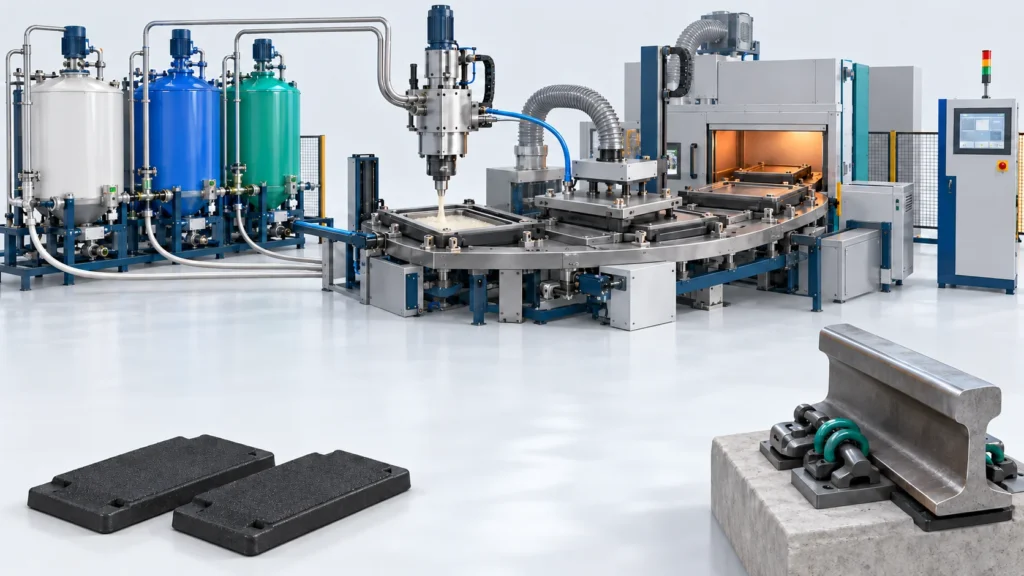
Frequently Asked Questions
Technical questions to establish the equipment scope, material window and validation plan.
How is water-blown MCU rail-pad processing defined?
How is cavity-to-cavity consistency established?
How are mold temperatures selected?
Can inserts be incorporated into pad tooling?
Request an MCU Rail Pad Equipment Proposal
Share your finished product or drawing, material system, target capacity, automation requirements and factory conditions to discuss the line configuration.


