
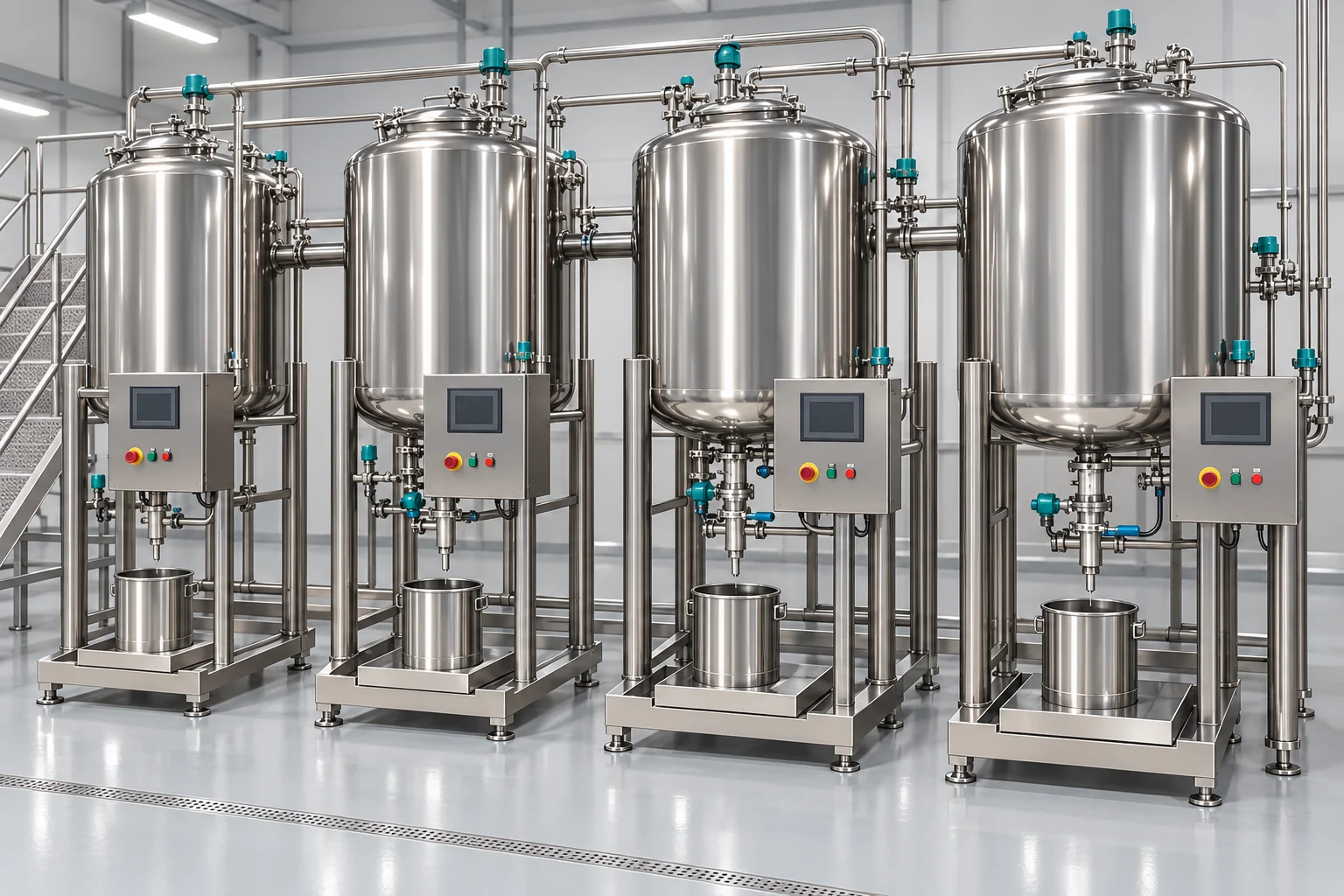
Liquid Ingredient Batching and Filling Solution
Concept illustration · Configuration varies
Coordinate main-ingredient batch preparation with a separately sized container-filling station. Match weighing, transfer, valve selection and receiving containers to the material system and production schedule.
Scope and Material Requirements
Coordinate main-ingredient batch preparation with a separately sized container-filling station. Match weighing, transfer, valve selection and receiving containers to the material system and production schedule.
Application Boundary
Batching and filling are different duties. The main-ingredient preparation scale and downstream filling scale can have different capacities and tolerances. Mixing, storage, closure, labeling and packaging machinery are included only where expressly specified.
Configuration Inputs
Share ingredient identities and material data, minimum additions, batch sizes, container details, output goals and site interfaces. Equipment selection and acceptance are agreed for the actual application.
Concept illustration: the equipment views on this page are generated engineering visualizations, not photographs of delivered installations.
Material Preparation and Batching Process
Coordinate the selected equipment, recipe, material conditions and receiving-process interfaces. The workflow below describes the planning scope rather than a fixed configuration for every installation.
Define batching and filling duties
Identify material properties, recipe additions, preparation batch mass and target filled-container mass separately.
Prepare the main batch
Use the selected supply valves and weighing range, then complete any required mixing and quality checks.
Release and transfer the material
Confirm batch identity, receiving station, transfer path and cleanliness before filling.
Parameters and Operating Conditions
All numerical values describe selected reference configurations. Confirm the material properties, minimum dose, batch size, weighing conditions and acceptance method before equipment selection. Scale readability, ingredient dosing error and total batch tolerance are separate quantities.
All numerical values describe selected reference configurations. Confirm the material properties, minimum dose, batch size, weighing conditions and acceptance method before equipment selection. Scale readability, ingredient dosing error and total batch tolerance are separate quantities.
Main-Ingredient Batching Reference
| Parameter | Reference configuration | Scope and conditions |
|---|---|---|
| Material type | Liquid ingredients | Confirm viscosity, compatibility and supply method. |
| Dispensing valves | 1–10 | Selected ingredient circuits. |
| Weighing capacity | 300–2,000 kg across configurations | Select capacity and minimum ingredient addition together. |
| Scale figure | 100 g stated | Clarify readability, calibrated error and complete dosing tolerance. |
| Batch-time examples | 300 kg: 6–10 min; 2,000 kg: 30–40 min | Reference preparation times; define the included operations. |
Separate Filling Reference
| Parameter | Reference configuration | Scope and conditions |
|---|---|---|
| Material type | Liquid | Confirm transfer and filling behavior with the actual product. |
| Filling valves | 1 | Do not infer a multi-head packaging line. |
| Container weighing range | 30–200 kg across configurations | Separate from the main batching scale. |
| Scale figures | 30 kg / 1 g; 200 kg / 10 g | Source notation; distinguish readability from calibrated and process accuracy. |
| Filling-time examples | 30 kg: 2–3 min; 200 kg: 3–5 min | Define whether container handling and valve/line preparation are included. |
Related Production Routes
Dry-process synthetic leather production · PU synthetic leather solutions
Batch and Filling Acceptance
Set acceptance for ingredient additions and finished-container filling separately. Include receiving-container tare, residual material, fill cutoff, labeling and the handover of filled containers in the operating procedure.
Related Preparation Systems
Chemical Processing Turnkey Plant · Batching-room integration
Equipment and Integration Scope
Define the main batching station, compatible transfer route and separate filling/weighing station as coordinated modules. The final schedule identifies receiving containers, control handshakes and manual handling. The catalog feed station below is a related supply module rather than the exact batching-and-filling equipment.
Configuration Benefits
Benefits depend on the agreed material, equipment and operating workflow. Validate dosing, handling and product acceptance separately.
Separate measurement duties
Specify main-batch and filled-container tolerances independently.
Traceable transfer
Maintain batch and receiving-container identities across the transfer and filling steps.
Clear packaging boundary
Identify which handling, closure and labeling tasks require operator work or additional machinery.
Production Planning FAQ
Clarify the configuration, measurement conditions and delivery scope before requesting a proposal.
Are batching and filling performed on the same scale?
Does the filling-time reference equal total packaging output?
Does this include capping and labeling?
What determines the final filling arrangement?
Can batch weighing and container filling share one acceptance tolerance?
Discuss Your Batching and Filling Requirements
Share your material data, batch or sample requirements, receiving-process details and factory conditions. Our team will reply within one business day. Once requirements are clear, we provide a preliminary proposal within two business days.


