
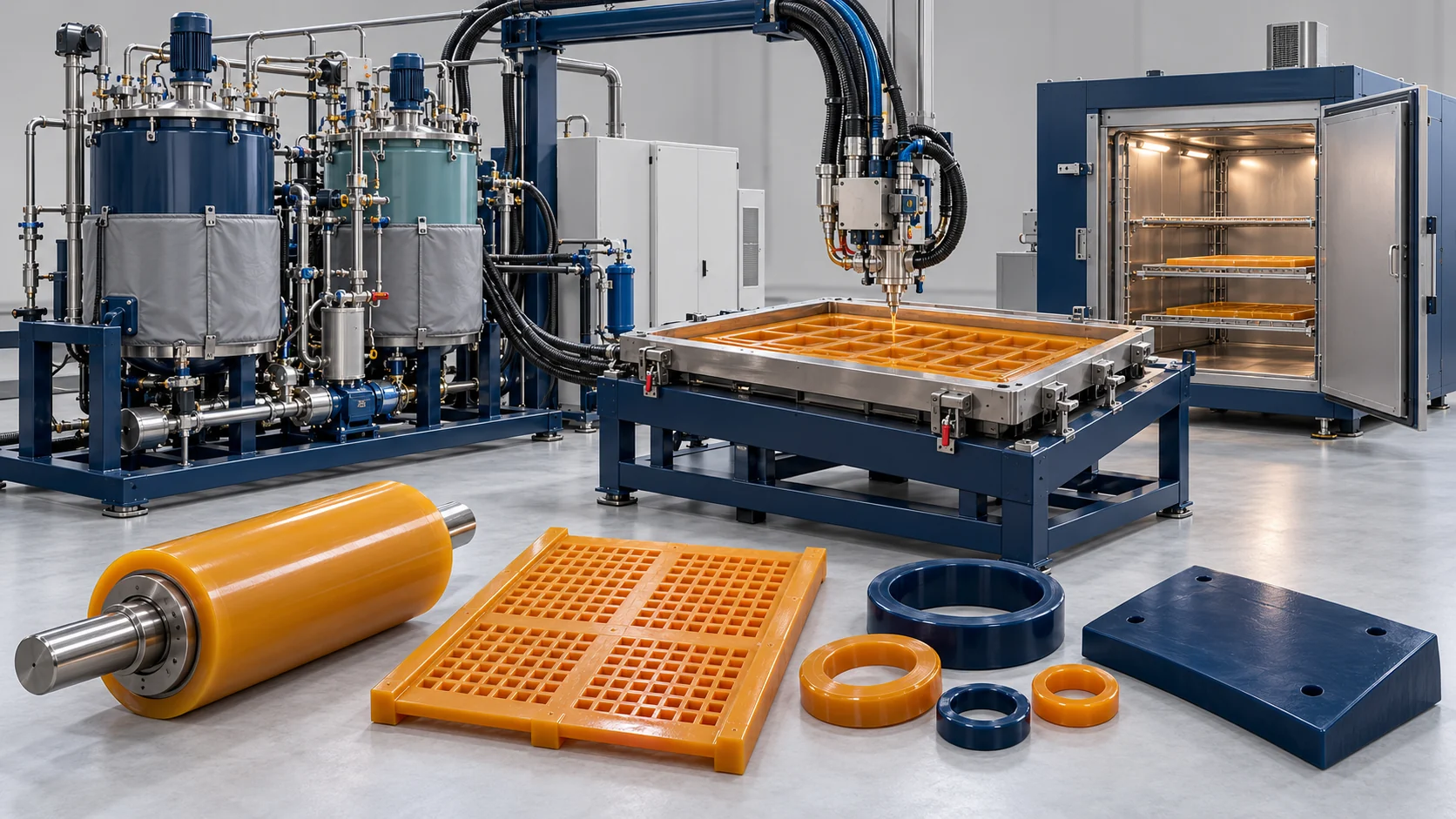
Industrial Cast Polyurethane Elastomer Solution
Configured CPU casting with heated material circuits, thin-film degassing and dynamic mixing for the specified formulation and part. Finished-part performance is determined by the selected materials, processing conditions and agreed tests.
Configure Industrial Cast PU Processing
Configure material conditioning, degassing, metering and dynamic mixing around the selected cast polyurethane formulation, part geometry and output. Tooling, cure schedules, post-treatment and inspection are defined for the application. Finished-part performance is determined by the selected materials, processing conditions and agreed tests.
Material Preparation and Degassing
Thin-film degassing and heated preparation are configured for the selected components, viscosity and moisture sensitivity. Finished castings are inspected against the agreed acceptance criteria.
Material-Specific Thermal Control
Tank, pump and delivery-circuit temperatures follow the selected prepolymer and curative data. The heating arrangement and operating limits are confirmed for the ordered configuration.
Define each main material and auxiliary feed, its temperature window and the shared mixing path. Grade or hardness changes need material compatibility, cleaning and release checks; thermal circulation supports processing but does not remove every crystallization or hold-time limitation.
End-to-End CPU Casting Workflow
An integrated engineering sequence delivering complete chemical conditioning, precise metering, and controlled curing.
Material Preparation & Vacuum Thin-Film Degassing
Prepolymer and polyol streams undergo continuous heating and are passed through falling-film vacuum chambers to eliminate entrapped micro-air and residual moisture before feeding.
Closed-Loop Precision Dosing
High-accuracy rotary gear pumps drive components through heated supply lines. Coriolis mass flow meters measure mass flow rates continuously to dynamically eliminate ratio drifts.
High-Shear Homogeneous Dynamic Mixing
The component streams meet within a variable-speed dynamic mixing head. Special rotor profiles prevent thermal buildup while achieving thorough physical blending across different viscosities.
Reference Solution Specifications
Typical capability matrix for Haifeng standard CPU casting solutions. Configurations are tailored to match specific resin chemistries, part geometries, and production volumes.
| Parameter | Value / Unit | Applicable Configuration / Conditions |
|---|---|---|
| Component Capacity | 2 to 4 primary streams + color/catalyst | Modular design supporting MDI, TDI, NDI, and additives |
| Flow Output Range | 5.0 to 35.0 kg/min (Custom up to 60 kg/min) | Continuous variable servo speed control |
| Stoichiometric Accuracy | Ratio tolerance within ±0.3% | Closed-loop Coriolis feedback across laminar flows |
| Operating Temperature | Ambient up to 140°C | Multi-zone thermal oil circulating system (±0.5°C) |
| Degassing Pressure | Absolute pressure ≤ 0.08 kPa | Multi-stage falling-film continuous vacuum vessel |
| Fluid Viscosity Handling | 100 to 50,000 mPa·s | Standard pumps; higher viscosity on custom request |
Core Equipment for This Solution
The linked casting reference is a selected main-feed configuration. Additional primary streams, pigments and catalysts require their own hardware and control scope.
Engineering Advantages of Haifeng CPU Systems
Designed to solve common processing defects including voiding, ratio drift, and thermal degradation.
Controlled Material Preparation
Configured degassing, thermal control and mixing support the selected formulation. Finished-part void content and performance are verified through agreed inspections.
Precise Temperature Uniformity
Configured thermal circulation supports the selected material temperature and viscosity window. Review hold, restart and crystallization behavior using the actual formulation.
Flexible Multi-Component Dosing
Specify main and auxiliary material circuits separately. Feed selection does not remove shared-head residues; agree material compatibility, cleaning and release checks for each grade change.
Lower Material Waste
Snuffer cut-off valves combined with automated solvent and air purge cycles minimize chemical loss during shot transitions.
Related Projects
The screen-casting upgrade supports its documented material and delivery modules, not every industrial elastomer component.
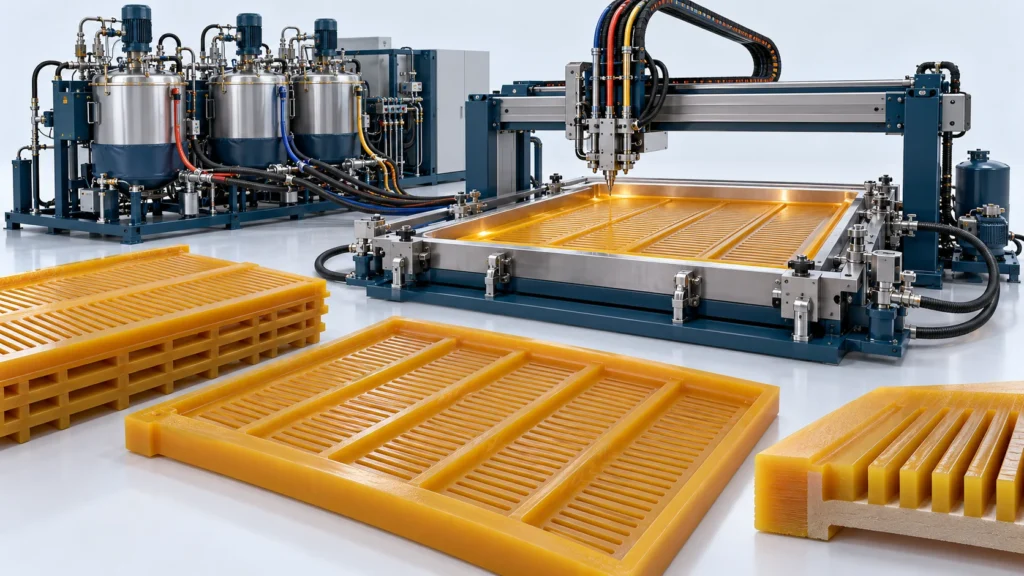
Frequently Asked Questions
Find answers about Industrial Cast Polyurethane Elastomer Solution, including material selection, equipment configuration and the information needed to plan a production line.
How is heating selected for the material system?
Can the system switch between different formulations or hardness grades?
What determines finished-part performance?
Can automated mold handling be integrated?
What inputs are needed for this configuration?
What should be reviewed before switching CPU formulations?
Request an Industrial Elastomer Solution Proposal
Share the following for this application: Prepolymer/curative/additive data, temperatures and viscosity, filler, shot/flow range, grade changes, molds and cure. Our team will reply within one business day. Once requirements are clear, we provide a preliminary proposal within two business days.


