
Heavy-Haul Ballast Consolidation Solution
Develop a site-specific polyurethane ballast-stabilization process around injection control, aggregate condition, drainage, cure development and railway maintenance requirements.
Resilient Ballast Stabilization for Extreme Axle Load Corridors
Develop a site-specific polyurethane ballast-stabilization process around injection control, aggregate condition, drainage, cure development and railway maintenance requirements. The described package covers drum-fed two-component proportioning, pressure-rated hoses, static mixing and perforated lances. Compressors, lance handling, material and railway possession arrangements are agreed interfaces. Actual injection pressure, lifting risk, drainage and reopening criteria require field trials and infrastructure-owner approval.
Product, material and tooling
The described package covers drum-fed two-component proportioning, pressure-rated hoses, static mixing and perforated lances. Compressors, lance handling, material and railway possession arrangements are agreed interfaces. Actual injection pressure, lifting risk, drainage and reopening criteria require field trials and infrastructure-owner approval.
Capacity and acceptance
Review all preparation, dispensing, curing, handling and inspection stages. Material and component results require separate original test records.
Configuration references are reviewed for the selected material, product geometry and acceptance conditions. A November 2025 implementation date cannot establish a completed >36-month follow-up by October 2026. The claimed three-year interval needs dated historical records before it can be used as a completed result. Pump rating up to 25 MPa is not a universal safe ballast injection pressure; drainage and return to traffic require validation.
Turnkey Trackbed Ballast Stabilization Workflow
The supplied process sequence is a configuration reference. Temperature, pressure, output and cure settings are confirmed for the selected material and tooling. A November 2025 implementation date cannot establish a completed >36-month follow-up by October 2026. The claimed three-year interval needs dated historical records before it can be used as a completed result. Pump rating up to 25 MPa is not a universal safe ballast injection pressure; drainage and return to traffic require validation.
Grid Positioning & Lance Penetration
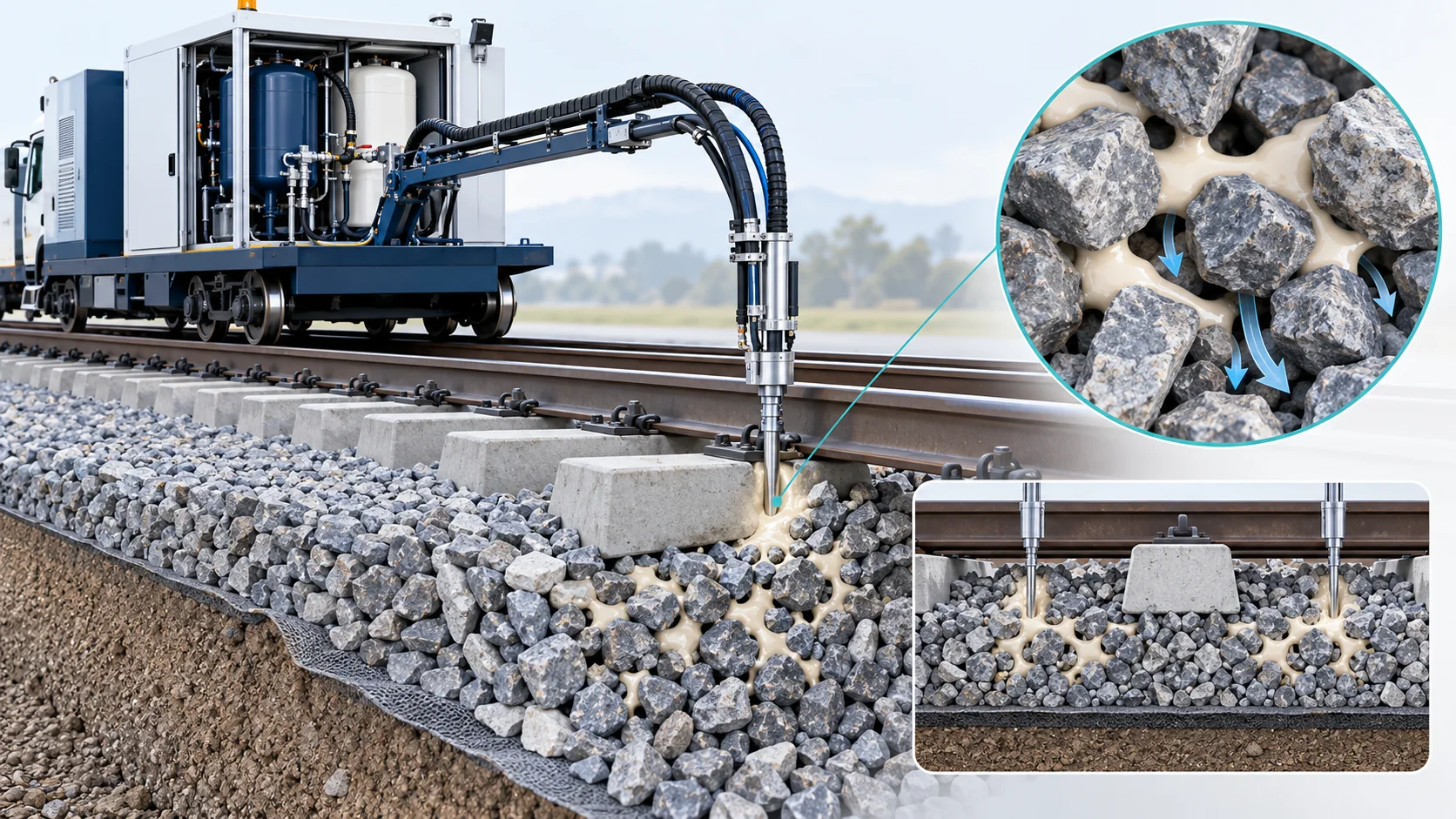
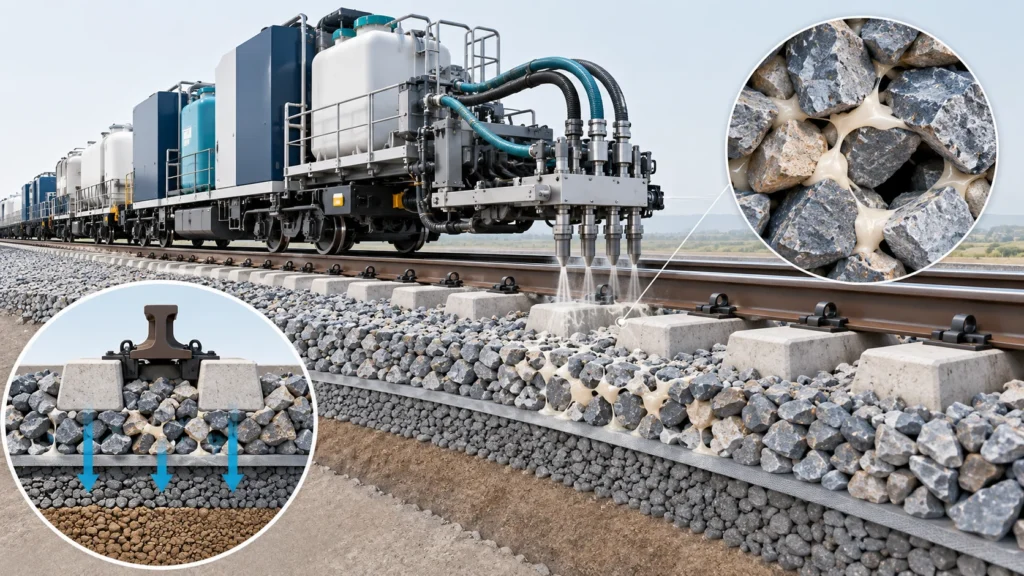
Configured reference: Steel perforated lances are driven mechanically into sleeper cribs and shoulders arranged in a staggered pattern to target depths of 30–50 cm.
25 MPa Pneumatic Dual-Liquid Proportioning
Configured reference: The coaxial pneumatic pump draws components A and B directly from 200 L drums, pressurizing fluids up to 25 MPa at a strict 1:1 volumetric ratio.
In-Line High-Pressure Static Mixing
Configured reference: Chemicals pass into a heavy-duty in-line static mixing manifold mounted to the lance, blending the 35 mPa·s components thoroughly without moving parts.
Reference Solution Engineering Envelope
Values transcribed from the supplied configuration brief. Material properties and finished-product benchmarks are separate validation targets, not general equipment guarantees.
| Parameter | Value / Unit | Applicable Configuration / Conditions |
|---|---|---|
| Peak Injection Pressure | Up to 25.0 MPa | Pump rating reference; actual field injection pressure and lifting risk must be validated for the ballast and substrate |
| Maximum Dispensing Output | 2.0 to 15.0 L/min | Continuous dual-liquid variable displacement; supplied reference requiring configuration or test verification |
| In-Situ Ballast Infiltration Depth | 30 to 50 cm | Radial perforated steel lances in compacted granite; supplied reference requiring configuration or test verification |
| Liquid Resin Viscosity | 30 to 50 mPa·s | Ultra-low viscosity polyurethane formulation at 20°C; supplied reference requiring configuration or test verification |
| Cured Matrix Compressive Strength | Greater than 15.0 MPa | ASTM D695 testing on bonded crushed stone matrix; supplied reference requiring configuration or test verification |
| Traffic Restoration Time | Within 30 minutes | Fast-setting polyurethane formulation at 15°C ambient; supplied reference requiring configuration or test verification |
Core Advantages of Haifeng Ballast Solutions
Engineering functions and interfaces developed for the specified product and material system.
Portable Drum-Fed Supply
Configure and validate portable drum-fed supply for the selected product, formulation, tooling and production conditions.
Pressure-Controlled Injection
Configure and validate pressure-controlled injection for the selected product, formulation, tooling and production conditions.
Lance Grid Planning
Configure and validate lance grid planning for the selected product, formulation, tooling and production conditions.
Drainage and Cure Verification
Configure and validate drainage and cure verification for the selected product, formulation, tooling and production conditions.
Related Project Draft
Review the project configuration described in the supplied brief. Project records and reported results require verification before public use.
Frequently Asked Questions
Technical questions to establish the equipment scope, material window and validation plan.
How does stabilization affect future track maintenance?
How are penetration and drainage controlled?
How is low-temperature operation assessed?
How is crew output estimated for a possession window?
Request a Ballast Stabilization Equipment Proposal
Share your finished product or drawing, material system, target capacity, automation requirements and factory conditions to discuss the line configuration.


