
Solución de consolidación de balasto para transporte de gran tonelaje
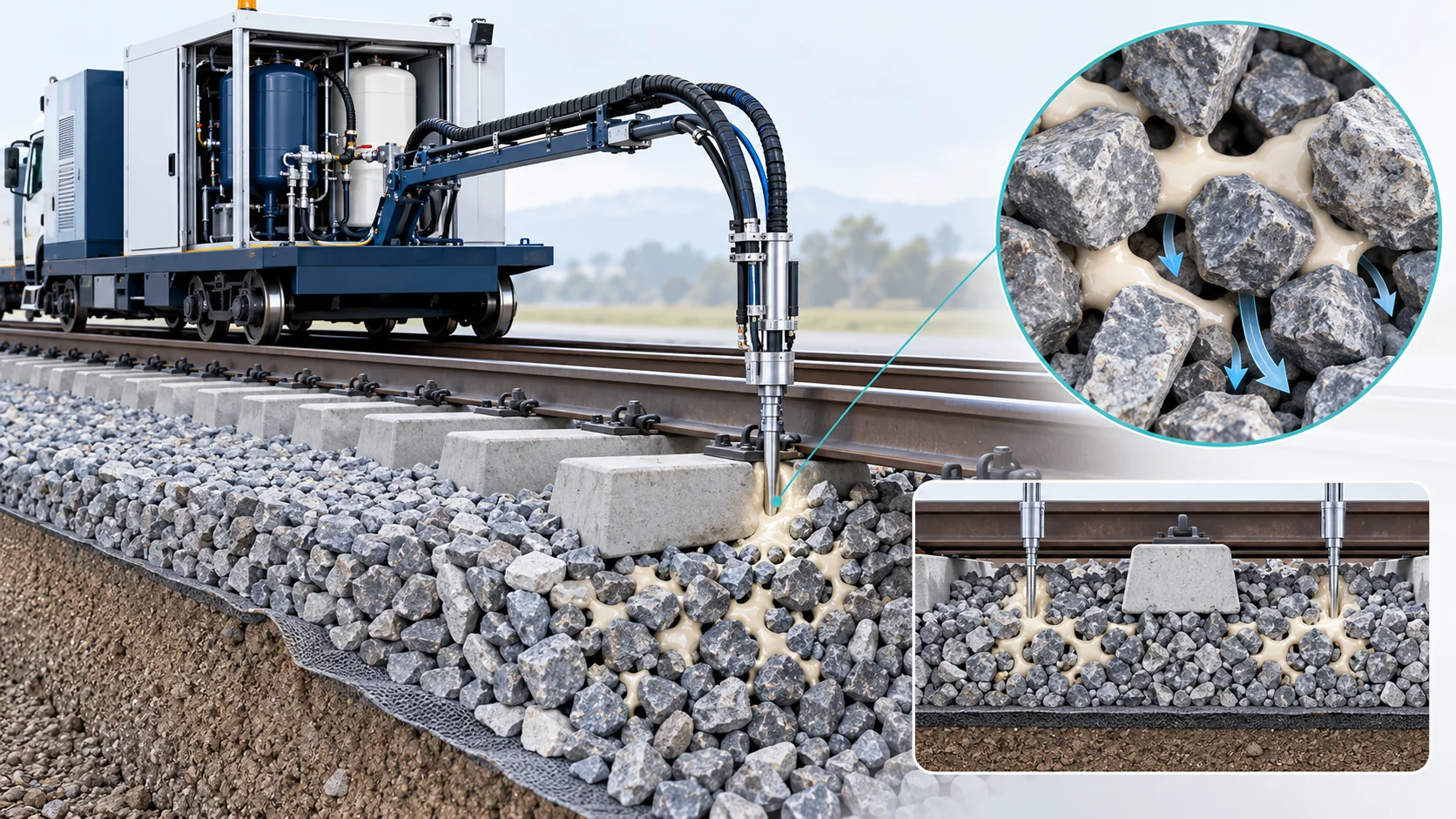
Desarrollar un proceso de estabilización de balasto con poliuretano específico para cada obra, en torno al control de la inyección, el estado del árido, el drenaje, la evolución del curado y los requisitos de mantenimiento ferroviario.
Resilient Ballast Stabilization for Extreme Axle Load Corridors
Develop a site-specific polyurethane ballast-stabilization process around injection control, aggregate condition, drainage, cure development and railway maintenance requirements. The described package covers drum-fed two-component proportioning, pressure-rated hoses, static mixing and perforated lances. Compressors, lance handling, material and railway possession arrangements are agreed interfaces. Actual injection pressure, lifting risk, drainage and reopening criteria require field trials and infrastructure-owner approval.
Producto, material y utillaje
The described package covers drum-fed two-component proportioning, pressure-rated hoses, static mixing and perforated lances. Compressors, lance handling, material and railway possession arrangements are agreed interfaces. Actual injection pressure, lifting risk, drainage and reopening criteria require field trials and infrastructure-owner approval.
Capacidad y aceptación
Revise todas las etapas de preparación, dispensación, curado, manipulación e inspección. Los resultados de materiales y componentes requieren condiciones de ensayo acordadas por separado.
Develop the ballast trial with aggregate condition, drainage and future maintenance in view. Separate pump rating from actual injection settings, then plan lance positions, delivered resin, cure and the possession-window inspection.
Turnkey Trackbed Ballast Stabilization Workflow
La secuencia de proceso suministrada es una referencia de configuración. La temperatura, la presión, la producción y los ajustes de curado se confirman para el material y el utillaje seleccionados.
Grid Positioning & Lance Penetration
Configured reference: Steel perforated lances are driven mechanically into sleeper cribs and shoulders arranged in a staggered pattern to target depths of 30–50 cm.
25 MPa Pneumatic Dual-Liquid Proportioning
Configured reference: The coaxial pneumatic pump draws components A and B directly from 200 L drums, pressurizing fluids up to 25 MPa at a strict 1:1 volumetric ratio.
In-Line High-Pressure Static Mixing
Configured reference: Chemicals pass into a heavy-duty in-line static mixing manifold mounted to the lance, blending the 35 mPa·s components thoroughly without moving parts.
Envolvente de ingeniería de la solución de referencia
Valores transcritos del informe de configuración suministrado. Las propiedades de los materiales y los parámetros de referencia del producto terminado son objetivos de validación independientes, no garantías generales del equipo.
| Parámetro | Valor / Unidad | Configuración / Condiciones aplicables |
|---|---|---|
| Presión máxima de inyección | Up to 25.0 MPa | Pump rating reference; actual field injection pressure and lifting risk must be validated for the ballast and substrate |
| Maximum Dispensing Output | 2.0 to 15.0 L/min | Continuous dual-liquid variable displacement; supplied reference requiring configuration or test verification |
| In-Situ Ballast Infiltration Depth | 30 to 50 cm | Radial perforated steel lances in compacted granite; supplied reference requiring configuration or test verification |
| Liquid Resin Viscosity | 30 to 50 mPa·s | Ultra-low viscosity polyurethane formulation at 20°C; supplied reference requiring configuration or test verification |
| Cured Matrix Compressive Strength | Greater than 15.0 MPa | ASTM D695 testing on bonded crushed stone matrix; supplied reference requiring configuration or test verification |
| Return-to-Service Authorization | Released by the infrastructure owner after the agreed checks | Verify material cure and load readiness, drainage and track geometry for the actual site; not an equipment-guaranteed time |
Core Advantages of Haifeng Ballast Solutions
Funciones de ingeniería e interfaces desarrolladas para el producto y el sistema de materiales especificados.
Supply organization
Plan drum changes, material temperature and delivery continuity.
Injection control
Validate site pressure and lifting/movement risk independently of pump rating.
Lance pattern
Trial positions and penetration in the actual ballast and foundation.
Drainage and handback
Inspect flow paths, cure and the agreed maintenance/operating requirements.
Proyectos relacionados
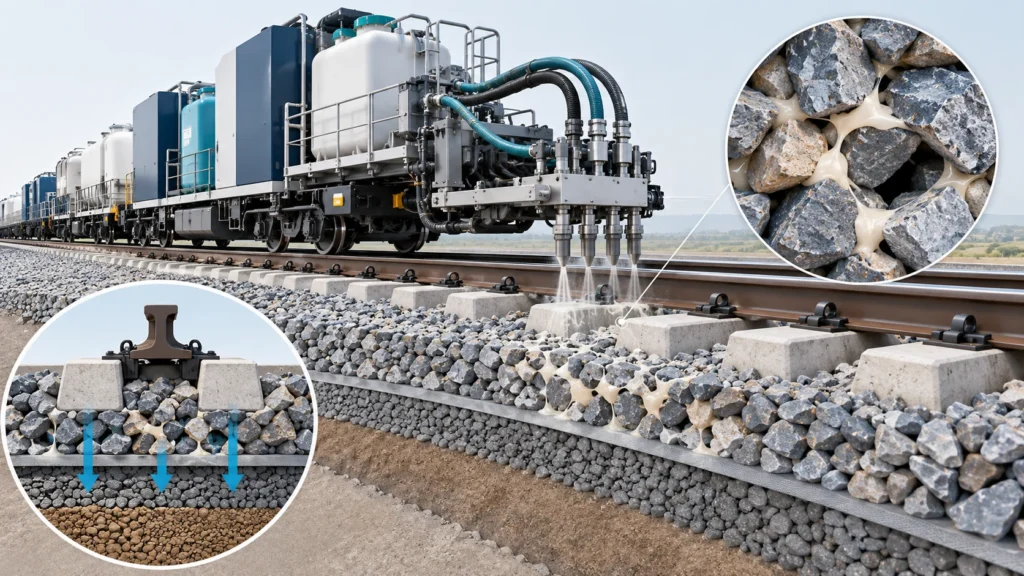
The heavy-haul project supports its own site and treatment zone; it does not establish a standard grid or universal reopening time.
Preguntas frecuentes
Preguntas técnicas para definir el alcance del equipo, la ventana de materiales y el plan de validación.
How does stabilization affect future track maintenance?
How are penetration and drainage controlled?
How is low-temperature operation assessed?
How is crew output estimated for a possession window?
When may the track return to service?
¿Qué datos se necesitan para esta configuración?
What should a ballast-stabilization trial demonstrate?
Request a Ballast Stabilization Equipment Proposal
Share the following for this application: Ballast/foundation survey, drainage, injection trial, resin data, lances, temperature, available window and future maintenance. Our team will reply within one business day. Once requirements are clear, we provide a preliminary proposal within two business days.


