
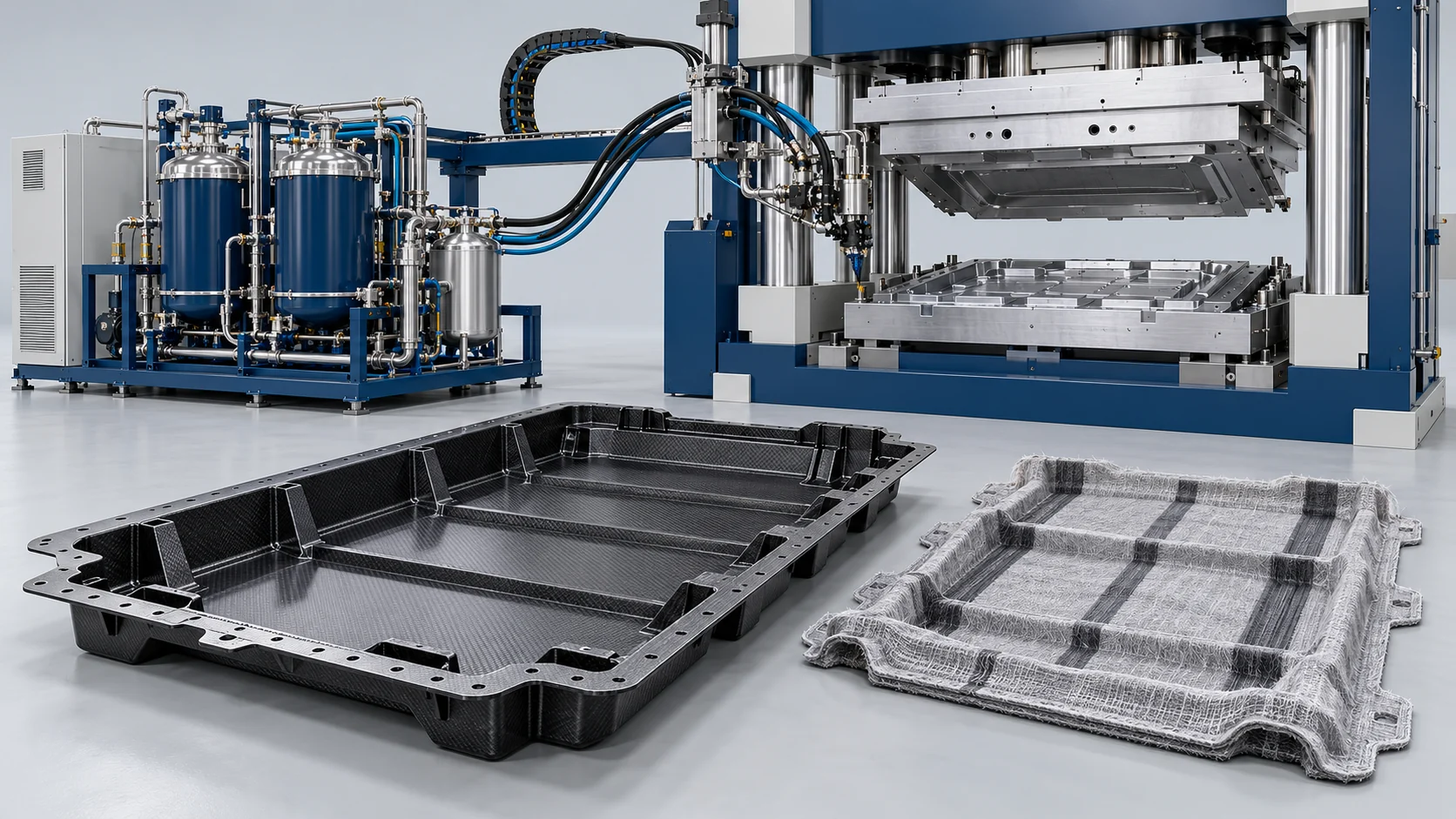
EV Battery Tray HP-RTM Molding Solution
HP-RTM processing for composite EV battery enclosures. The reference project reports 40% lower tray component weight against its aluminum baseline; structural, electrical and battery-system safety are validated separately.
Structural Composite HP-RTM Solutions for EV Battery Enclosures
Haifeng HP-RTM equipment coordinates resin metering, injection, tool vacuum and temperature control for composite battery trays. The related project reports 40% lower tray weight than its welded aluminum assembly baseline. That component comparison is not a universal reduction for every composite design or for total vehicle weight. Flame-retardant epoxy or polyurethane and glass or carbon reinforcement are selected for the laminate. UL94 V-0 applies to the tested material specimens; it does not establish thermal-runaway containment. Corrosion behavior, impact response, leakage and electrical insulation are evaluated for the complete material, geometry and interfaces. Carbon reinforcement can conduct electricity, so electrical safety requires the corresponding enclosure and battery-system validation.
Laminate-Specific Electrical Insulation
Electrical insulation is evaluated for the complete laminate, coatings and interfaces. Carbon reinforcement can conduct electricity; the selected construction requires application-specific electrical testing.
Reference Impact Condition: 150 J
The supplied application reference describes a 150 J steel-ball impact condition. The specimen construction, impact location and acceptance criteria are tied to the qualified part; this does not establish complete battery-system protection for every enclosure.
Haifeng delivers the complete processing scope—from high-pressure composite injection skids and vacuum management to optional heavy hydraulic presses—enabling EV battery pack suppliers to scale safe, lightweight enclosure manufacturing.Concept illustration — not a photograph of delivered equipment or a customer installation.
Composite Battery Tray HP-RTM Production Workflow
A synchronized four-stage workflow delivering high-integrity, fire-resistant composite battery enclosures.
Preform Preparation & Vacuum
Multi-layer continuous fiber preforms are seated into the open tool; the press closes and a deep vacuum of <10 mbar is drawn
High-Pressure Resin Injection
The HP-RTM machine injects flame-retardant resin at extreme pressures, driving rapid wet-out across wide 2-meter battery tray spans
Heated Consolidation & Cure
Multi-zone dynamic TCU units hold precise mold curing temperatures, crosslinking the composite rapidly within 4 minutes
Engineering Specifications & Production Capacity
Technical parameters for this Haifeng HP-RTM production system.
| Technical Parameter | Standard Specification / Value | Engineering Context & Verification |
|---|---|---|
| Target Application | EV Battery Pack Lower Trays, Under-Shield Modules | Heavy-duty structural & electrical containment |
| Material Matrix | Flame-Retardant PU/Epoxy + Continuous Glass/Carbon Fiber | UL94 V-0 reference for tested material specimens; qualify the selected laminate separately |
| Metering Output Capacity | 40 – 120 kg/min (Customizable) | Servo axial piston pumps with Ratio Lock |
| Injection Pressure Range | 40 – 150 bar | High-pressure penetration for wide-area preforms |
| Flame Retardancy Rating | UL94 V-0 Rated | Material-specimen flammability rating under its test conditions; not battery thermal-runaway compliance |
| Demolding Cycle Time | 210 – 270 seconds (Standard 4 min) | High-throughput series pack assembly |
| Weight Reduction | ~40% vs. Extruded Aluminum Trays | Reference project component comparison with its aluminum tray baseline; geometry and laminate specific |
| Scope of Supply | Turnkey (HP-RTM Skid, Vacuum Skid, TCU + Press/Tooling) | Full workcell integration or press retrofit |
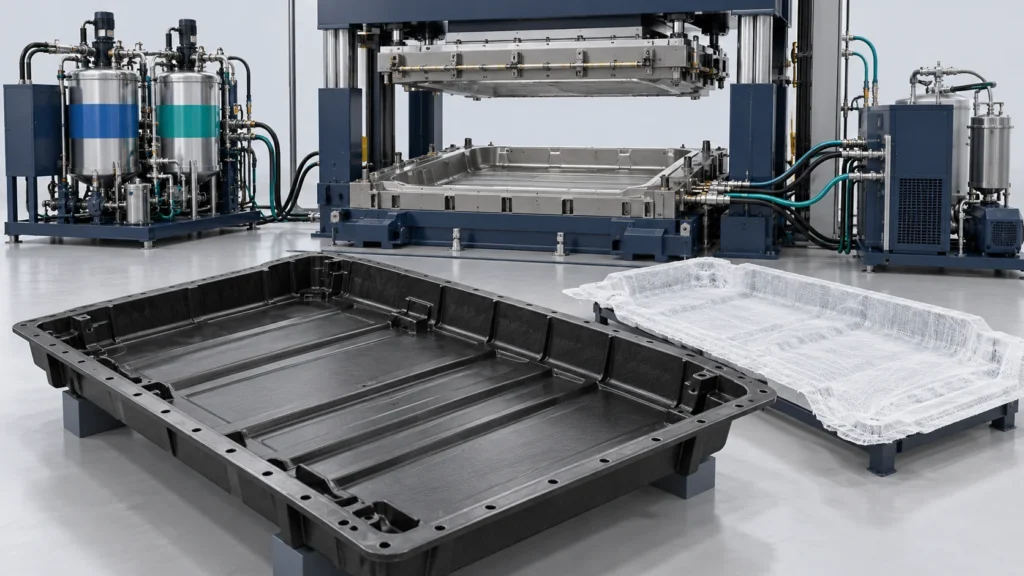
HP-RTM Equipment for This Application
A large-part configuration focused on flow-front balance, molded interfaces and enclosure consistency.
Key Engineering Advantages
For EV Battery Tray Composite HP-RTM Molding Line, assess material compatibility, process control, equipment interfaces and changeover needs against your production brief.
Reference Tray Weight Reduction
The related project reports 40% lower tray component weight versus its welded aluminum baseline. A different design requires its own mass comparison; driving range is not inferred from this value.
Construction-Specific Electrical Validation
Electrical properties depend on the reinforcement, laminate, coatings and interfaces. Carbon reinforcement can conduct electricity; the complete construction requires electrical testing.
UL94 V-0 Material Reference
The rating describes tested material specimens. Thermal-runaway containment, structural integrity and complete battery safety require separate application-specific validation.
Environment-Specific Corrosion Evaluation
Resistance to road salts, moisture and cleaning chemicals is assessed for the selected material and interfaces. A universal lifetime corrosion guarantee is not implied.
Proven Manufacturing Project
See how an EV battery supplier implemented Haifeng's HP-RTM line to manufacture flame-retardant composite battery trays.
Frequently Asked Questions
Engineering and purchasing questions about this HP-RTM production route.
Why replace aluminum with composite HP-RTM for battery enclosures?
How does this system ensure complete resin wet-out over large 2-meter battery trays?
Can this HP-RTM line integrate with our existing composite press?
Does Haifeng provide complete turnkey lines including presses and molds?
What is the typical installation and commissioning timeline on-site?
Discuss Your HP-RTM Production Project
Share your component, material and production targets for a tailored solution.


