

Automotive Carpet PU Foaming Solution
Configure automotive carpet backfoaming with metered delivery, mold-carrier motion and defined finishing interfaces.
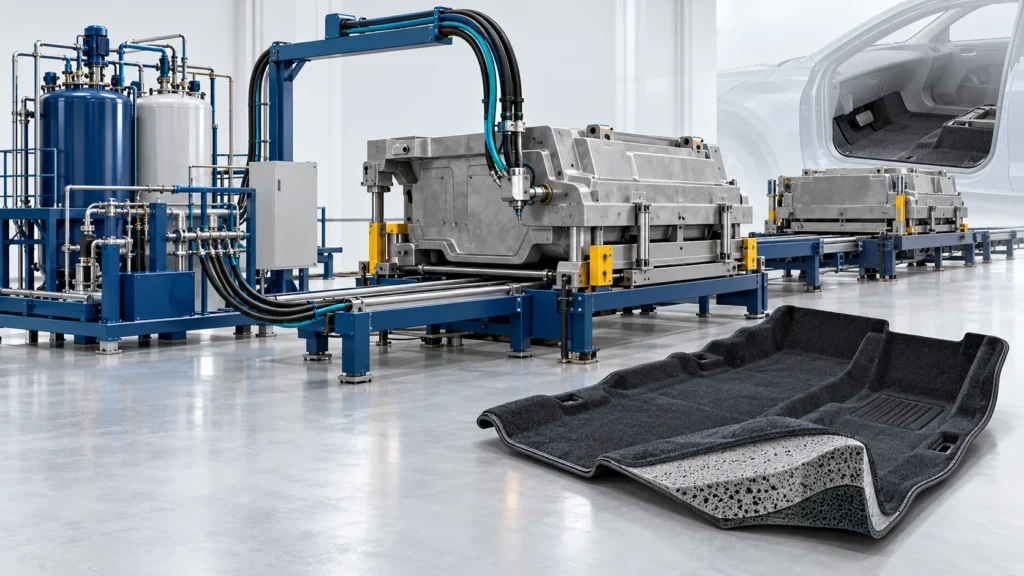
PU Foaming Line for Automobile Carpets
This page focuses on the production cell for molded PU carpet backing: substrate placement, metered pouring, mold closing, curing and removal. Carrier geometry, opening motions and the pouring path must match the carpet tool. Acoustic performance belongs to the finished carpet construction and its test plan.
Defined supply scope
Identify the supplied metering unit and hydraulic carrier, then specify robot, trimming, tooling and material services separately. A solvent-free head-cleaning method does not establish every formulation or the finished assembly emissions.
Inputs for process selection
Carpet and mold drawings, opening/rotation needs, shot mass, substrate, trimming method, shift output and existing interfaces.
Equipment scope, retained factory interfaces and acceptance are agreed for the selected material and part. Identify the supplied metering unit and hydraulic carrier, then specify robot, trimming, tooling and material services separately. A solvent-free head-cleaning method does not establish every formulation or the finished assembly emissions.
Automotive Carpet PU Foaming Workflow
Position the carpet and tool → Prepare and meter the PU → Pour, close and cure → Remove, finish and inspect. Define preparation, filling, cure and output timing separately for the selected configuration.
Position the carpet and tool
Confirm substrate preparation, carrier access and mold orientation.
Prepare and meter the PU
Review material conditioning, shot mass and selected mixing-head settings.
Pour, close and cure
Validate the pouring path and carrier sequence for the carpet contours.
Technical Parameters
Existing configuration and test references. Equipment settings, material results and finished-assembly results are separate; apply each value only to its documented configuration and conditions.
HF-HPM Series High-Pressure Foaming Machine
| Parameter | Value |
|---|---|
| Pouring rate | 50–1000 g/s, customizable per project |
| Mix ratio | Polyether : Isocyanate = 100 : 45~60 |
| Tank capacity | 100L / 150L per tank, optional |
| Dosing accuracy | ≤±0.3%, full dynamic range |
| Temperature control | 20–45℃ |
| Mixing pressure | 10–18 MPa |
| Cleaning system | Automatic air purge, solvent-free |
| Control system | PLC + touch screen + multi-formula storage |
| Certification | CE, ISO9001 |
Carpet Molding Machine
| Parameter | Value |
|---|---|
| Mold installation board area | 2,550 × 1,950 mm |
| Mold installation space height | 670 mm |
| Movable mold-plate stroke | 50 mm |
| Mold plate above open angle | 180° |
| Mold plate below open angle | 90° |
| Hydraulic working pressure | 10–12 MPa |
| Control voltage | AC 220V / DC 24V |
Supporting Equipment for Your Foaming Line
Equipment references are selected by their documented process. Main metering, auxiliary supply and alternative routes are not a single standard package.
Process controls and application checks
Evaluate these functions with the selected material, tooling and production brief. Finished-part results require their own acceptance evidence.
Carrier-to-tool fit
Review platen area, daylight, stroke and rotation against the actual mold.
Defined pouring sequence
Coordinate material delivery with carpet positioning and mold closing.
Comparable project evidence
Use carpet-backfoaming references without transferring unrelated seat-line performance.
Related Projects
These are related application references. Compare the actual material, process and delivered modules; reported project figures are not acceptance results for another line.
Production Planning FAQ
Selection, supply scope and validation for this production route.
How does this differ from the acoustic carpet page?
Is automatic trimming included with every carrier?
What information is needed for a preliminary configuration?
Get a Free Quote
Share the following with your production brief: Carpet and mold drawings, opening/rotation needs, shot mass, substrate, trimming method, shift output and existing interfaces. Our team will reply within one business day. Once requirements are clear, we provide a preliminary proposal within two business days.


