
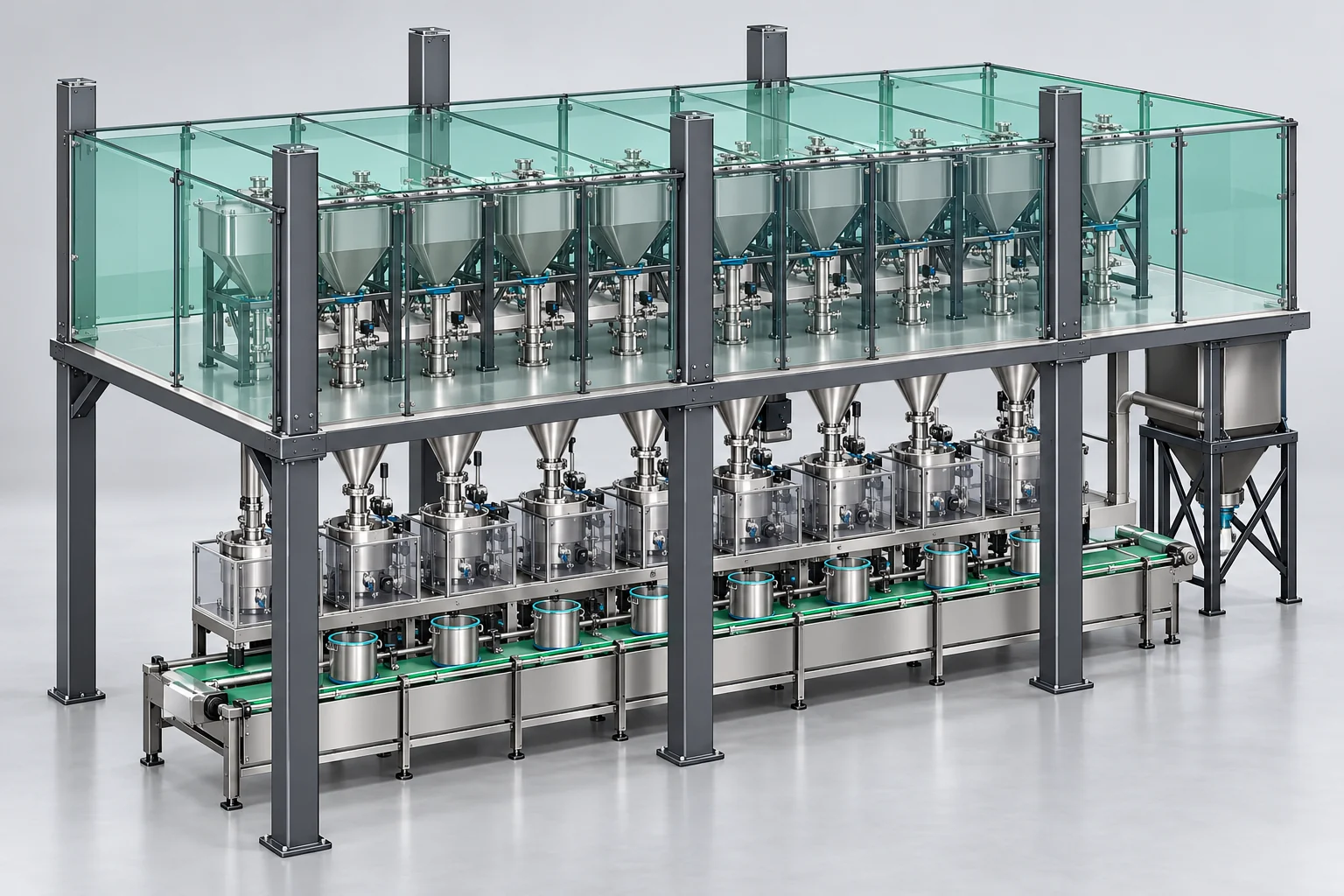
Automatic Powder Batching Solution
Concept illustration · Configuration varies
Plan powder ingredient storage, controlled discharge, weighing and receiving-container handling as one configured batching route. Hopper arrangement and dosing methods follow the actual powder and recipe.
Scope and Material Requirements
Plan powder ingredient storage, controlled discharge, weighing and receiving-container handling as one configured batching route. Hopper arrangement and dosing methods follow the actual powder and recipe.
Application Boundary
The route weighs powder ingredients before a separately defined receiving process. It does not establish automatic dust-hazard compliance, universal free-flow behavior or finished-mixture uniformity. Material classification and the required containment and protection measures are project inputs.
Configuration Inputs
Share ingredient identities and material data, minimum additions, batch sizes, container details, output goals and site interfaces. Equipment selection and acceptance are agreed for the actual application.
Concept illustration: the equipment views on this page are generated engineering visualizations, not photographs of delivered installations.
Material Preparation and Batching Process
Coordinate the selected equipment, recipe, material conditions and receiving-process interfaces. The workflow below describes the planning scope rather than a fixed configuration for every installation.
Characterize the powders
Provide bulk density, particle distribution, moisture, flow behavior, segregation tendency and material handling information.
Size storage and discharge modules
Choose ingredient positions, refill access, hopper geometry and discharge aids after material evaluation.
Identify and tare the receiving container
Confirm recipe, batch mass, container capacity and the selected weighing range.
Parameters and Operating Conditions
All numerical values describe selected reference configurations. Confirm the material properties, minimum dose, batch size, weighing conditions and acceptance method before equipment selection. Scale readability, ingredient dosing error and total batch tolerance are separate quantities.
All numerical values describe selected reference configurations. Confirm the material properties, minimum dose, batch size, weighing conditions and acceptance method before equipment selection. Scale readability, ingredient dosing error and total batch tolerance are separate quantities.
Powder Batching Design References
| Parameter | Reference configuration | Scope and conditions |
|---|---|---|
| Material type | Powder ingredients | Actual powder properties determine the design. |
| Dispensing positions | 18–300 stated design range | Architecture and actual ingredient count must be confirmed; the illustration is not a count specification. |
| Scale capacity | 30–300 kg across configurations | Match batch size and minimum addition. |
| Scale figure | 10 g; optional 1 g stated | Clarify readability, calibrated error and complete dosing tolerance separately. |
| Batch time | 30–60 min per container | Batch mass and full recipe conditions are unspecified in the reference. |
| Equipment arrangement | Supported hoppers, discharge modules and container handling | Dimensions, structure, access and interfaces follow the approved layout. |
Related Production Routes
Dry-process synthetic leather production · PU synthetic leather solutions
Powder Changeover and Collection
Review powder flow, bridging, dust behavior and shared contact paths. Define container placement, collection and cleaning for the selected powders; ingredient count alone does not establish achievable dose accuracy.
Related Preparation Systems
Chemical Processing Turnkey Plant · Batching-room integration
Equipment and Integration Scope
A powder-batching scope can include ingredient hoppers, compatible feed/discharge devices, weighing, receiving-container positioning and recipe controls. Containment, extraction, cleaning and any required protection measures are defined for the actual powder. The catalog premixing station below is a related downstream preparation route for suitable filled-polyol applications; it is not the powder-batching machine itself.
Configuration Benefits
Benefits depend on the agreed material, equipment and operating workflow. Validate dosing, handling and product acceptance separately.
Powder-specific discharge
Select feed and hopper arrangements for the evaluated material rather than assuming every powder is free flowing.
Controlled ingredient records
Connect recipe identity with individual powder additions and receiving-container records.
Defined receiving interface
Coordinate batching with the actual mixer or preparation stage without claiming unverified final-mixture performance.
Production Planning FAQ
Clarify the configuration, measurement conditions and delivery scope before requesting a proposal.
Can the system dose every powder without bridging?
Does a 1 g option establish 1 g dosing accuracy?
Is explosion protection automatically included?
Does this system also mix the powder into polyol?
How should powder cross-contamination be assessed?
Discuss Your Powder Batching Requirements
Share your material data, batch or sample requirements, receiving-process details and factory conditions. Our team will reply within one business day. Once requirements are clear, we provide a preliminary proposal within two business days.


