

One of the fastest ways to destabilize a polyurethane line is to treat every silicone-containing liquid as interchangeable. A plain polydimethylsiloxane silicone oil and a silicone-polyether surfactant are not the same material, and in foam work they do very different jobs. One can stabilize or over-stabilize cells; the other can sit at the surface and create release, adhesion, or paint-wetting problems. Most defects trace back to the same root: the additive is selected without matching its molecular structure to the process function.
What Silicone Oil Actually Does in Polyurethane
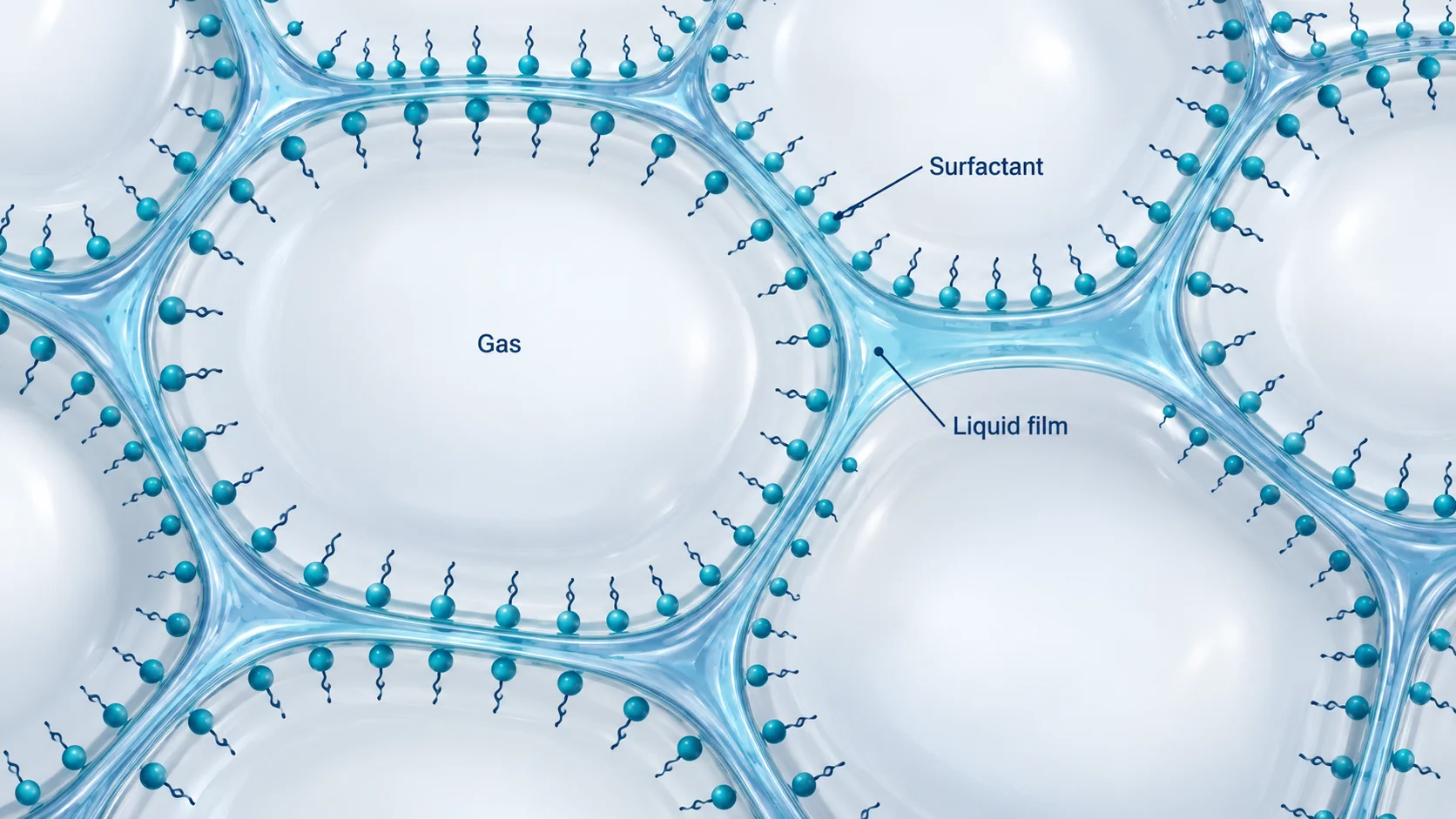
Silicone oils lower surface tension and spread easily at air-liquid and liquid-solid interfaces [1]. That property is useful, but it must be aimed at the right target. In flexible and rigid polyurethane foaming, silicone-containing surfactants reduce surface tension, emulsify the polyol, isocyanate, water, and blowing-agent mixture, and prevent growing bubbles from coalescing before the polymer network builds enough strength [2]. In cast elastomers and reaction injection molding, silicone oil is more often used as a mold-release aid or an internal lubricant. In coatings, sealants, and bonded parts, the same surface activity becomes a contamination risk because residual silicone can interfere with adhesion and crater control [3].
Silicone Oil vs. Silicone Surfactant: The Distinction That Explains Most Defects
Plain polydimethylsiloxane oil is a linear, nonpolar silicone fluid. It lowers surface tension, but it does not stay where it is needed during a fast foaming reaction. A silicone surfactant is different: a polydimethylsiloxane backbone carries polyether side chains, and the ethylene oxide/propylene oxide ratio controls solubility and emulsification [1], [2]. That architecture is what lets the molecule move with the expanding foam and stabilize cell walls until gelation.
This distinction matters in practice. If a formulator replaces a silicone surfactant with a cheaper silicone oil, the foam can settle, blow open at the surface, or develop coarse, irregular cells. If a mold-release silicone is carried into the next process step, it can transfer to part surfaces and create fisheyes, paint delamination, or poor secondary bonding [3]. The problem is rarely the presence of silicone itself; it is using the wrong silicone architecture for the function.
Foam Cell Control and Dosage
In foaming, the silicone surfactant level is tied to water level, density target, and cell-size requirement. Too little surfactant allows bubble coalescence, surface collapse, and wide cell-size distribution. Too much can over-stabilize the system, shift the open-cell/closed-cell balance, and make the foam more sensitive to flow marks or post-cure dimensional change. Most commercial systems fall in a working range of roughly 0.5 to 2.0 parts per hundred polyol, with the exact level set by the formulation and the foaming route [4].
Surfactant level only stabilizes what the reaction timing creates; when gel and blow fall out of step, even the best cell stabilization cannot hold the structure. The Role Of Rise Time In Polyurethane Foaming covers how gel and blow reactions interact during expansion.
Once cells are stabilized, dimensional stability depends on how much gas remains trapped and how the polymer network relaxes. Causes Of Shrinkage In Polyurethane Foam How To Control It covers the formulation and processing causes of post-cure shrinkage.
If the target is a resilient part rather than only a stable cell structure, the test method matters as much as the surfactant dose. Measuring Polyurethane Foam Resilience A Practical Test Guide covers the practical side of resilience testing.
Mold Release, Lubrication, and Contamination Risk
Silicone oil is a common external and internal mold-release aid for polyurethane elastomers, shoe soles, and RIM parts. Internal silicone oils can reduce demolding force, but they also migrate to the surface over time. That migration is where the contamination problem begins: a low level may improve release, while a slightly higher level can leave a surface that rejects paint, adhesive, or printing ink [3].
The same logic applies across processes. A silicone release spray that drifts onto a mold surface can build up unevenly and leave glossy or hazy patches. If parts are later bonded or coated, the defect may not appear until the next operation, which makes the silicone trace hard to isolate from the original molding step.
Equipment Variables That Decide the Result
Silicone oil and silicone surfactant behavior is not only a formulation issue. The entry point, mixing energy, and metering stability determine whether the additive is distributed finely enough to do its job. A low-pressure machine with inadequate shear may drop the silicone into the mix as large domains instead of dispersing it across the interface. A high-pressure mixing head with good impingement can create the dispersion, but only if the additive stream is metered consistently.
In practice, moving a silicone surfactant from a large preblended polyol tank into a dedicated low-flow additive stream at the mix head gives tighter control over cell-size drift. The trade-off is that the additive line must be sized for the small dose rate, kept homogeneous, and checked for viscosity-related lag. If you are chasing inconsistent cell structure, periodic surface defects, or release failures that move around the mold, contact Info@chinahaifeng.com or WhatsApp 86 13566296633 with your machine model, formulation, and defect photos.
Plan the Silicone Oil Change as a Process, Not a Drop-In
Before changing silicone oil type or level, map the interaction between additive and equipment. Send the following and we will help you work through the change:
- Current machine type and mixing head configuration
- Silicone oil or surfactant type and dosage
- Shot weight or foaming throughput
- Defect photos and cell-size measurements if available
Email: Info@chinahaifeng.com
WhatsApp: 86 13566296633
Frequently Asked Questions
Is silicone oil the same as silicone surfactant?
No. Plain polydimethylsiloxane silicone oil reduces surface tension but does not have the polyether structure needed to stabilize polyurethane foam cells. Silicone surfactants are silicone-polyether copolymers designed to emulsify the components and hold the foam structure during rise.
Can I replace a silicone surfactant with any silicone oil?
Not safely. The foam stabilization function comes from the polyether-modified architecture, not from silicone content alone. Substituting a plain silicone oil can cause foam settle, collapse, coarse cells, or surface defects.
Why do parts show paint adhesion failure after switching silicone release agents?
Silicone release agents can migrate to the part surface. If the new release agent is more mobile or is applied at a higher level, it can leave a low-surface-energy layer that rejects paint, adhesive, or ink. The failure often appears in a later operation, even if molding looks normal.
How much silicone surfactant should be used?
Common commercial foaming systems run in the range of about 0.5 to 2.0 parts per hundred polyol, depending on water level, density target, and cell-size requirement. The correct level should be set by trial on the actual machine because mixing energy and temperature shift the response.
Does silicone oil affect polyurethane equipment?
Yes, mainly through viscosity, metering, and cleaning behavior. High-viscosity silicone oils may need temperature-controlled lines and proper agitation. If silicone is metered inaccurately or separates in the tank, the foam or part surface will show variation that looks like a machine fault but originates in additive delivery.
Can silicone contamination be removed once it reaches a part surface?
Removing surface silicone is difficult and often requires solvent cleaning, surface treatment, or mechanical abrasion, and results are inconsistent. Preventing cross-contamination between release and bonding areas is the more reliable approach.
References
[1] G. Oertel, Ed., Polyurethane Handbook, 2nd ed. Munich, Germany: Hanser Publishers, 1994.
[2] M. Ionescu, Chemistry and Technology of Polyols for Polyurethanes, 2nd ed. Shawbury, U.K.: Smithers Rapra Technology, 2016.
[3] D. Randall and S. Lee, The Polyurethanes Book. New York, NY, USA: Wiley, 2002.
[4] R. Herrington and K. Hock, Flexible Polyurethane Foams, 2nd ed. Midland, MI, USA: The Dow Chemical Company, 1997.
If you’re interested, check out these related articles:
Shore A Vs Shore D Hardness In Polyurethane
Causes Of Shrinkage In Polyurethane Foam How To Control It
What Is Spray Polyurethane Foam Composition And Application





