
Automotive Headliner Box Foaming Project in China
Automotive headliner Box Foaming project using low-pressure metering and dynamic mixing, followed by curing and slicing of semi-rigid PU foam blocks.
Project Overview
Illustration notice. Process illustrations are not verified photographs of this installation.
Project reference basis. Figures and configuration details are reported in the supplied project brief. They are reference values for the stated application, rather than verified acceptance results or a guarantee for another installation. Confirm the source records, material, tooling, operating schedule and test method when assessing a comparable project.
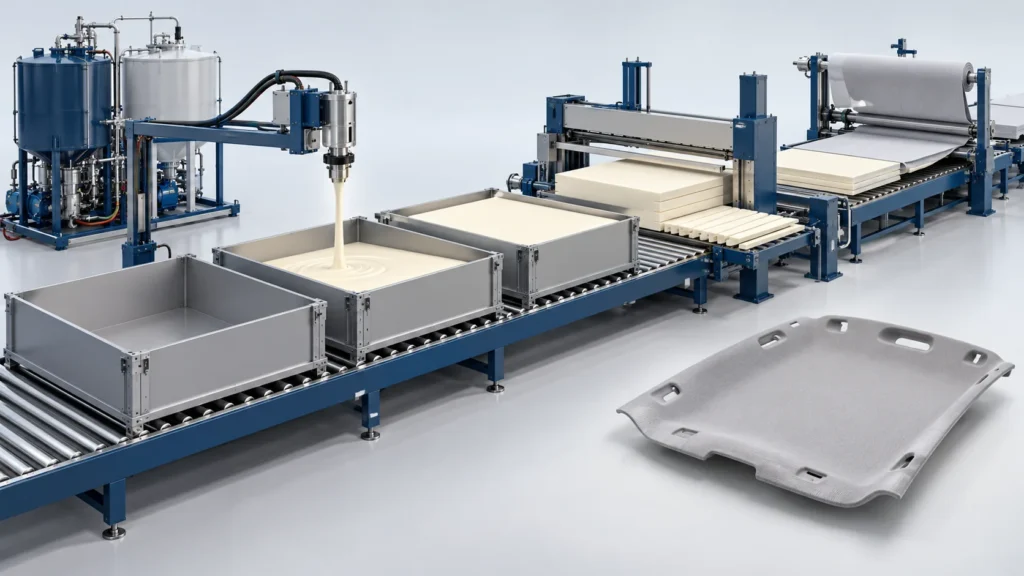
Box Foaming in this project uses low-pressure metering and dynamic mechanical mixing to pour semi-rigid polyurethane into box molds. The individual blocks rise freely, cure and are sliced into automotive headliner blanks; downstream lamination and thermoforming are separate operations.
Haifeng delivered a low-pressure polyurethane box-foaming system for an anonymized automotive overhead interior supplier in China. The line produces semi-rigid foam blocks at a project target density of 22 kg/m³. After free rise, the blocks are cured and sliced into blanks for low-emission headliner panels.
The customer needed lighter acoustic headliner material with consistent cellular structure and lower interior emissions. The process therefore separates foam block production from subsequent slicing, lamination and thermoforming. Low-pressure metering and dynamic mechanical mixing feed the box-foaming station; process controls manage the recipe and material temperature.
Commissioned in May 2025, the 260 m² workcell operates two shifts per day. The supplied project reports VDA 278 air-quality test results and a 70-second downstream thermoforming press cycle. That press cycle is separate from box-foam rise, curing and conditioning time.
Concept illustration: The process image is a concept illustration used to explain the equipment arrangement; it does not document the delivered site.
Solutions Delivery
Haifeng configured a traditional low-pressure polyurethane box-foaming route for semi-rigid headliner blanks:
1. Low-pressure metering and dynamic mixing: Condition and dose polyol and isocyanate to the project recipe, then mix mechanically before dispensing.
2. Box pouring and free rise: Pour the reactive mix into a box mold and allow uniform block expansion.
3. Cure and slicing interface: Condition the foam block before cutting it into blanks of the required thickness.
4. Downstream forming interface: Coordinate blank supply with lamination and thermoforming. The recorded 70-second press cycle belongs to this later stage, not to foam-box demolding.
| Equipment | Model | Qty | Function |
|---|---|---|---|
| Low-Pressure Box Foaming Unit | Project-specific configuration | 1 Unit | Meters and dispenses the semi-rigid PU recipe |
| Dynamic Mechanical Mixing Head | Project-specific configuration | 1 Unit | Mixes the components before box pouring |
| Dual-Circuit Temperature Control System | HF-TCU-36 | 2 Units | Conditions raw materials for repeatable box foaming |
| Integrated Master PLC Control Cabinet | HF-PLC-COMPACT | 1 Set | Coordinates metering, mixing and box-pour timing |
Project Results
Start a Similar Automotive Project
Discuss your component, production targets and automation requirements with Haifeng engineering.


