
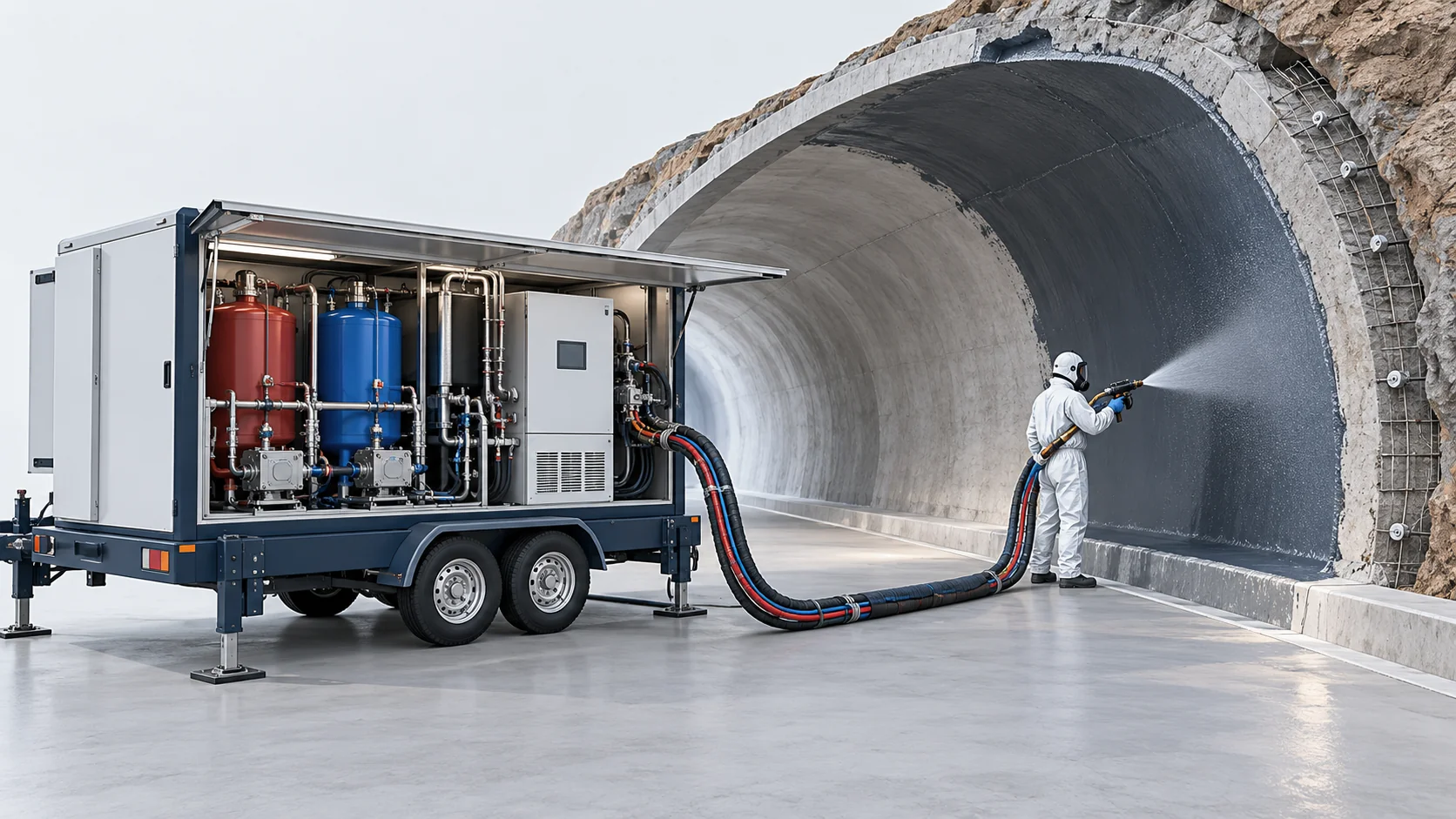
Mobile Polyurea Spray Machine | Tunnel Waterproofing
A mobile dual-circuit package for primer application and two-component polyurea waterproofing, with configured surface-conditioning interfaces.
Integrated Mobile Waterproofing for Tunnel Infrastructure
A mobile dual-circuit package for primer application and two-component polyurea waterproofing, with configured surface-conditioning interfaces.
A mobile dual-circuit package for primer application and two-component polyurea waterproofing, with configured surface-conditioning interfaces.
The package covers the mobile spray chassis, infrared surface-conditioning module, separate primer and polyurea circuits, gun and controls. Generation and laser-guided scanning are optional. Coating and primer are supplied separately; lighting and drainage are customer interfaces. Site ventilation, exposure control and access arrangements are addressed separately from formulation solids content.
Material Flow and Working Principle
Substrate Infrared Flash-Drying
The vehicle traverses the tunnel bay while its front-mounted short-wave infrared lamps heat and flash-dry damp concrete surfaces to lower surface moisture below 6%.
Medium-Pressure Primer Impregnation
An integrated medium-pressure airless pump applies a penetrating moisture-tolerant epoxy primer, filling surface capillaries and pinholes to prevent subsequent outgassing.
High-Pressure Hydraulic Proportioning
Dual hydraulic proportioning cylinders displace polyol and isocyanate streams at a strict 1:1 volumetric ratio, delivering fluids at 18.0 MPa through heated delivery lines.
High-Elongation Impingement Spraying
The materials impinge at 100 m/s inside a mechanical-purge gun, depositing a 2.0 mm elastomeric membrane that cures in 20 seconds, bridging expansion joint bevels smoothly.
Crack-Bridging & Hydrostatic Verification
The elastomeric membrane cures fully within 2 hours, capable of bridging 2.0 mm dynamic fissures and sealing against hydrostatic pressures up to 0.5 MPa.
Model and Technical Parameters
Configuration references from the supplied HF-TUN120-MOB brief. Pressure circuit designation, output, heating and hose capability require confirmation under the stated operating conditions. Coating properties and laboratory qualification belong to the selected material/substrate system and require original reports.
| Technical Parameter | HF-TUN120-MOB |
|---|---|
| Components | Dual System: 1-Component Primer + 2-Component Polyurea |
| Output Range (g/s) | Polyurea: 2.0 to 9.0 kg/min; Primer: 1.0 to 4.0 kg/min |
| Mixing Ratio Range | Polyurea 1:1 Fixed; Primer Single Component |
| Ratio Accuracy | ±1.0% (Under steady hydraulic displacement) |
| Power Supply | 380V, 3-Phase, 50Hz (Optional 30 kW onboard generator) |
| Working Pressure | Polyurea: 16.0 to 18.0 MPa; Primer: 8.0 to 12.0 MPa |
| Tank Capacity (L) | Direct drum feed (Accommodates 4 x 200 L drums on truck) |
| Weight | 3,400 kg (Vehicle chassis with full equipment package) |
| Dimensions (L×W×H) | 4200 mm x 1750 mm x 1950 mm |
| Polyurea Tensile Elongation | ≥ 450% (Break elongation); Cured pure polyurea membrane; supplied coating-system result pending original specimen and test records |
| Dynamic Crack Bridging | Up to 2.0 mm (Cyclic joint movement); Concrete expansion joint test; supplied coating-system result pending original specimen and test records |
| Hydrostatic Resistance | 0.5 MPa (Sustained 72 hours); Waterproof membrane test cell; supplied coating-system result pending original specimen and test records |
| Infrared Drying Bank Power | 12 kW (Short-wave quartz lamps); Concrete surface preheating |
Key Equipment Features
The package covers the mobile spray chassis, infrared surface-conditioning module, separate primer and polyurea circuits, gun and controls. Generation and laser-guided scanning are optional. Coating and primer are supplied separately; lighting and drainage are customer interfaces. Site ventilation, exposure control and access arrangements are addressed separately from formulation solids content.
Mobile Dual-Circuit Package
The primer and polyurea circuits are separately configured on the specified mobile chassis.
Surface-Conditioning Interfaces
Preparation, drying and priming are selected for the substrate and coating supplier requirements.
Joint-System Design
Movement capacity depends on the complete joint detail, reinforcement and tested coating build-up.
Waterproofing Verification
Hydrostatic performance and application output require defined specimens, curing conditions and project records.


