
HP-RTM Injection Machine | Carbon Fiber Composites
The HF-HPRTM-250 uses high-pressure metering and impingement circuits up to 20 MPa, instantaneous flow rates up to 250 g/s and press synchronization. Mold-cavity pressure and complete cycle depend on the resin, tool and application configuration.
Ultra-High-Pressure Liquid Composite Injection for Structural Carbon Parts
The HF-HPRTM-250 is an ultra-high-pressure resin transfer molding machine engineered for automated, rapid-cycle liquid composite molding of carbon fiber automotive structural components with fiber volume fractions exceeding 55%.
The HF-HPRTM-250 is an industrial-grade high-pressure resin transfer molding (HP-RTM) metering and dispensing unit purpose-built for the high-volume manufacturing of lightweight automotive and aerospace composite components. Developed to overcome the lengthy cure cycles of conventional low-pressure RTM and autoclave processes, this system meters and mixes fast-reacting epoxy or polyurethane resin for injection into sealed, pre-evacuated tooling. The specified pressure up to 20 MPa applies to the metering and impingement lines; mold-cavity pressure is a separate tool and process quantity.
Equipped with an advanced die-mounted mechanical self-cleaning mixing head, the specified mechanical cleanout head supports cleaning and runner cut-off for the selected tool and resin. The master control system integrates seamlessly via EtherCAT with high-tonnage hydraulic compression presses, executing micro-gap injection (HP-CRTM) where resin spreads across dry plies before full mold clamp compression. The qualified gap/injection sequence is selected to control preform displacement and support filling; actual internal defects and void content require part inspection.
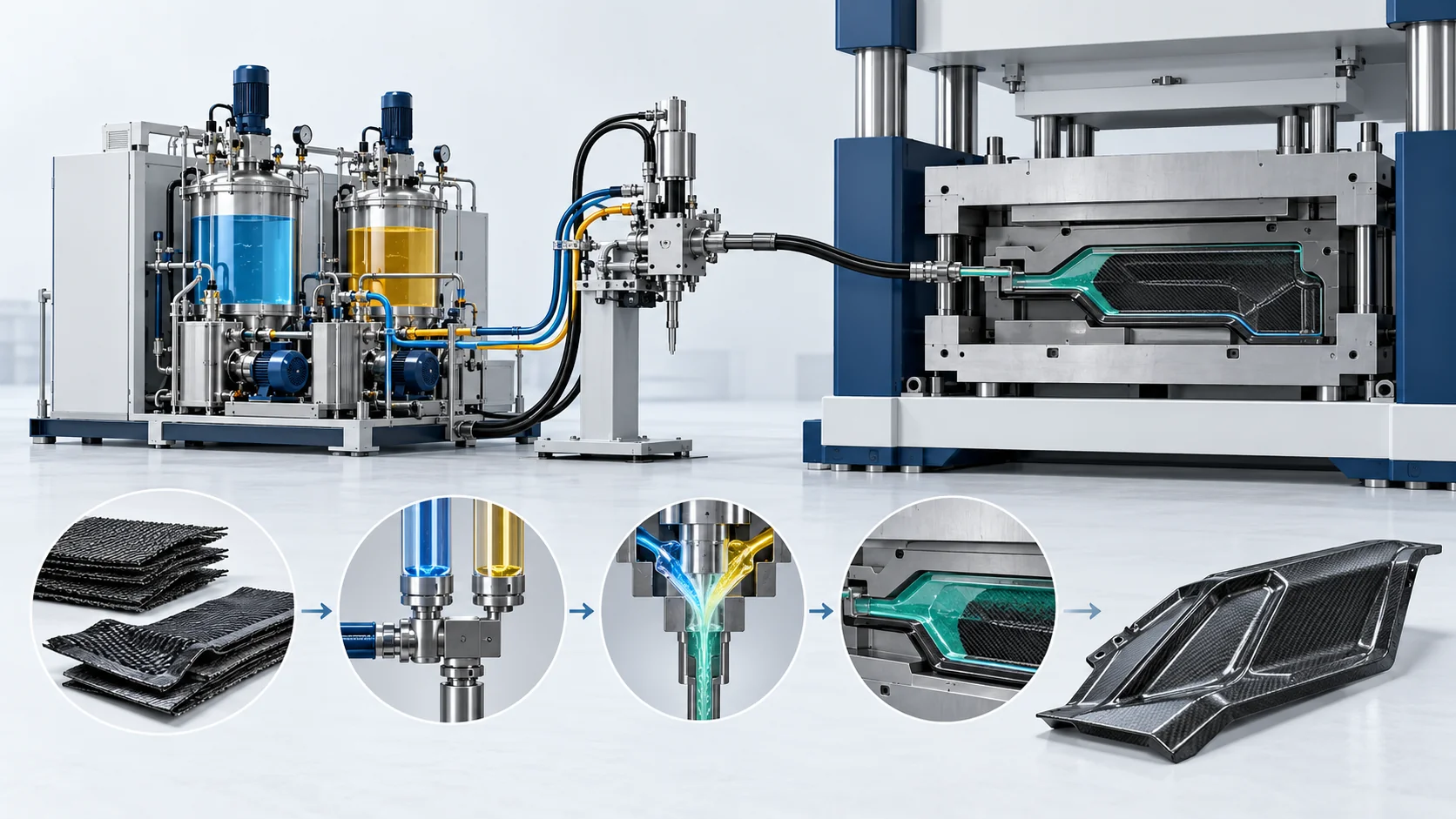
Concept illustration — not a photograph of delivered equipment or a customer installation.
Material Flow and Working Principle
Automated Degassing & Thermal Conditioning
Resin and hardener are stored in dual-jacketed stainless steel vessels with continuous thermal oil heating up to 80°C and thin-film vacuum degassing below 0.05 kPa to extract microscopic air voids.
High-Pressure Servo-Hydraulic Metering
High-pressure axial piston dosing units driven by closed-loop servo drives meter the resin and hardener at exact stoichiometric ratios, building fluid injection pressures up to 20 MPa.
High-Velocity Impingement Mixing
The components enter the miniature ceramic-coated mixing chamber at velocities over 120 m/s, achieving molecular-level homogenization before discharging through the die interface.
Micro-Gap Mold Injection & Press Compaction (HP-CRTM)
The mix is injected through a calibrated mold port into a micro-gap (0.5–2.0 mm) between tool halves; the hydraulic press then executes instant high-speed compaction to drive resin through the carbon preform thickness.
In-Mold Rapid Cure & Mechanical Purge
The part cures within heated tooling (120–140°C) within 90–120 seconds while the mixing head's cleanout piston mechanically seals the injection runner flush with the part surface without solvents.
Model and Technical Parameters
Supplied HF-HPRTM-250 configuration for HP-RTM/HP-CRTM. The stated 12–20 MPa refers to the metering/impingement circuit; cavity pressure and press settings are established separately for the tool and material.
| Technical Parameter | HF-HPRTM-250 |
|---|---|
| Components | 2 Components (A: Resin, B: Hardener) + Optional Internal Release Agent |
| Output Range (g/s) | 10.0 to 250.0 g/s (Instantaneous adjustable injection rate) |
| Mixing Ratio Range | 100:15 to 100:50 (By weight) |
| Ratio Accuracy | ±0.2% (Continuous mass flow closed-loop feedback) |
| Power Supply | 380V, 3-Phase, 50Hz (Custom 440V/480V 60Hz optional) |
| Working Pressure | 12.0 to 20.0 MPa (High-pressure metering and impingement lines) |
| Tank Capacity (L) | Tank A: 80 L, Tank B: 80 L (Stainless steel with vacuum/heat jacket) |
| Weight | 2,800 kg (Main injection skid) |
| Dimensions (L×W×H) | 2400 mm x 1800 mm x 2200 mm |
| Mold Vacuum Level | Down to 0.05 kPa (Absolute pressure); Pre-injection mold cavity |
| Maximum Process Temperature | Up to 80°C (Thermal oil jacketed fluid path); Tanks, pumps, and hoses |
| Press Communication Bus | EtherCAT / PROFINET (Real-time sync); Injection & press cycle link |
| Total Installed Power | 45 kW (Drive motor, heaters, hydraulic pack); Peak operational load |
Key Equipment Features
The package covers resin conditioning and degassing, metering, high-pressure mixing, tool-mounted injection interfaces and press synchronization. Tool shuttles and robotic preform handling are optional. The press, site utilities, fibers and resin are agreed external interfaces. This brief covers HP-RTM and HP-CRTM; other composite processes have separate configurations.
High-Pressure Impingement Mixing
Metering and impingement circuits are configured for the selected resin and hardener.
Press-Synchronized HP-CRTM
Injection and compression timing are coordinated through the specified press interface.
Vacuum-Assisted Processing
Material degassing and mold evacuation are configured to control air entrapment; part void content requires inspection.
Mechanical Head Cleanout
A tool-mounted mechanical cleanout system is specified; runner and cleaning requirements depend on the tool and resin.


