

Blowing agent selection is often treated as a small formulation detail until the first full trial comes back with a density outside specification, a missed thermal conductivity target, or a compliance gap on the production floor. The choice affects far more than gas generation: it sets cell structure, dimensional stability, processing window, equipment safety, and long-term regulatory exposure. This guide separates the major polyurethane blowing agent families and gives a practical sequence for matching them to the part, the process, and the line.
What a Blowing Agent Does in a Polyurethane System
A blowing agent creates the gas that expands the reacting polymer into a cellular structure. In closed-cell rigid foam, that gas then remains trapped in the cells and becomes a large part of the insulation performance. In flexible foam, the gas creates the open-cell network that determines softness, recovery, and breathability.
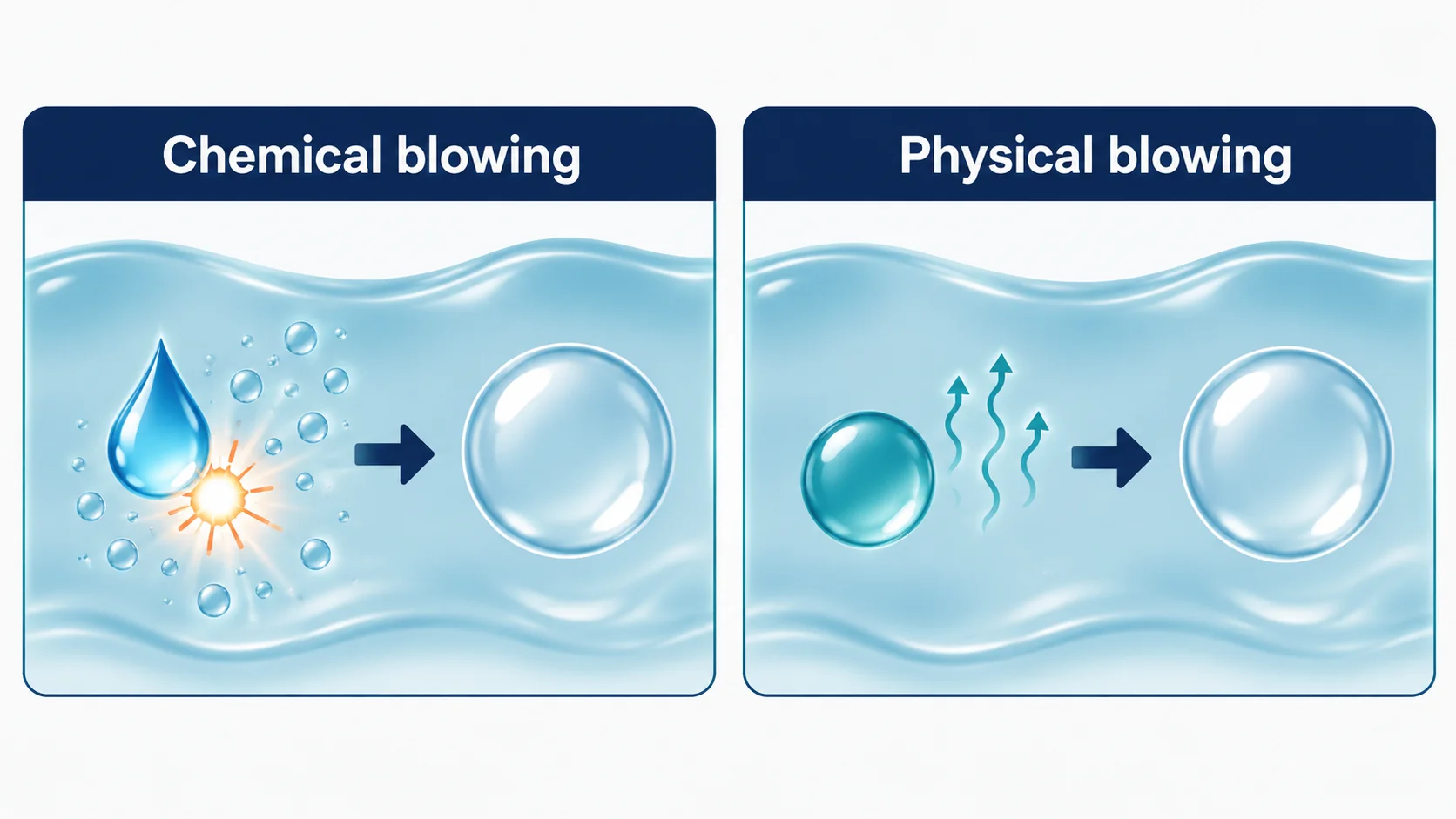
The engineering challenge is that the blowing agent does not act alone. The gas is generated while the isocyanate-polyol reaction is building molecular weight. If gas generation peaks before enough viscosity develops, cells can collapse or coalesce. If the polymer sets too quickly, the foam cannot rise to target density. Blowing and gelling must be balanced through catalyst selection, mixing quality, and material temperature control.
Physical Blowing Agents: Low-Boiling Liquids and Gases
Physical blowing agents volatilize under the heat of the exothermic reaction. The most important categories today are hydrocarbons, hydrofluorocarbons, hydrofluoroolefins, and liquid carbon dioxide.
Representative ODP and GWP values for comparison are compiled from [1], [2], [3], [4].
| Blowing agent | ODP | 100-year GWP, approximate | Flammability | Typical use |
|---|---|---|---|---|
| CFC-11, legacy | 1 | ~4,660 | Non-flammable | Historical closed-cell foam |
| HCFC-141b | ~0.11 | ~725 | Non-flammable | Appliance and spray foam, phaseout |
| HFC-245fa | 0 | ~858–1,030 | Non-flammable | Spray foam, appliance foam |
| HFC-365mfc | 0 | ~794 | Flammable at high concentration | Rigid insulation |
| HFO-1233zd(E) | 0 | <7 | Low/non-flammable | Spray foam, appliance foam |
| HFO-1336mzz(Z) | 0 | <7 | Low/non-flammable | Spray and panel foam |
| Cyclopentane | 0 | <10 | Highly flammable | Appliance panels, insulated panels |
| Liquid CO₂ | 0 | 1 | Non-flammable | Flexible slabstock, rigid foam |
| Water, chemical | 0 | 1 | Non-flammable | Nearly all polyurethane foam types |
Pentanes, especially cyclopentane and n-pentane, remain common in continuous rigid panel and appliance lines because they give fine cells and low gas-phase thermal conductivity at low cost. The trade-off is process safety: pentane vapor is flammable and requires explosion-proof dosing, storage, and ventilation.
HFC-245fa and HFC-365mfc became the main non-flammable alternatives after HCFC phaseout, but their high GWP has made them regulatory liabilities. HFOs such as HFO-1233zd(E) and HFO-1336mzz(Z) now occupy a similar non-flammable processing window with much lower GWP, which is why many spray foam and appliance reformulation projects have moved in that direction.
Spray-applied insulation depends on a balance between blowing pressure and cell formation. What Is Spray Polyurethane Foam Composition And Application covers how the composition is tuned for spray application, adhesion, and long-term insulation performance.
Liquid CO₂ is attractive because of its zero ODP and minimal GWP, but it requires pressurized metering and careful pressure letdown. If gas breakout is not controlled, cell size becomes coarse and insulation performance falls.
Water as a Chemical Blowing Agent
Water is the most widely used chemical blowing agent in polyurethane. It reacts with isocyanate to generate CO₂ while forming a urea linkage. Each water molecule consumes two NCO groups as the gas is released [5]. Because the reaction liberates heat, water-blown systems carry an extra exotherm that can help cure thick sections but can also scorch large molded parts if not managed.
Water has two practical limits. First, density reduction is tied directly to formulation balance: more water means more gas, but it also means more urea and higher hard-segment content. Second, the CO₂ escapes more readily from the cells than some low-conductivity physical gases, so water-blown rigid foam typically does not reach the same insulation value as an optimized HFO or hydrocarbon system.
In flexible slabstock and many molded flexible parts, those trade-offs are acceptable because softness, recovery, and cost matter more than ultra-low thermal conductivity. In rigid insulation, water is often blended with a physical blowing agent to help reduce foam density while the physical agent manages lambda.
Water-blown systems tie density control to the speed of the gelling reaction. The Role Of Rise Time In Polyurethane Foaming covers how blowing and gelling compete in the first seconds after mixing.
Dimensional stability is the other variable to watch. If the foam gels too late, CO₂ that escapes after the polymer has begun to set can leave cells partially collapsed. If the foam gels too early, trapped gas can build internal pressure and then relax as the part cools.
Dimensional stability after demold is part of the blowing agent decision. Causes Of Shrinkage In Polyurethane Foam How To Control It covers why gas loss and cell structure can leave a molded part undersized.
Regulatory Drivers: ODP, GWP, and Phasedown
The Montreal Protocol eliminated CFCs and set HCFCs on a phaseout schedule [1]. The Kigali Amendment extended that framework to HFCs through national and regional phase-down commitments [2]. In the European Union, the F-gas regulation progressively cut HFC availability and now tightens GWP limits in many foam sectors [3]. In the United States, the AIM Act and associated technology-transition rules restrict specific HFC uses and guide sectors toward low-GWP alternatives [4].

The practical consequence is that a blowing agent choice made only on processing ease can become a reformulation project a few years later. Selection should therefore treat current cost and future regulatory risk as a single variable, not two separate decisions.
How to Match a Blowing Agent to the Part and Process
The right blowing package is not universal. It depends on target density, thermal conductivity requirement, cell structure, mechanical properties, processing conditions, and the existing production line.
| Application | Common first-choice blowing package | Reason |
|---|---|---|
| Rigid appliance panels | Cyclopentane or HFO | Low lambda and low GWP |
| Spray-applied insulation | HFO or water/HFO blend | Low GWP plus sprayable cell structure |
| Flexible slabstock | Water, liquid CO₂ | Softness, cost, open cells |
| Molded flexible foam | Water | Density control and curing balance |
| Integral skin and microcellular parts | Water or water/physical blend | Surface formation and cycle time |
| Footwear and low-density soles | Water | Fine cells and mold fill |
For rigid insulation, thermal conductivity is usually the ranking criterion. That favors physical agents with low gas-phase conductivity, provided the dispensing equipment can handle their storage and metering requirements. For flexible foam, the ranking criterion is usually density and feel, which favors water or liquid CO₂. For structural or microcellular parts, the ranking criterion is often cycle time and surface quality, which pushes the decision toward a water-based package or a controlled water/physical blend.
A reformulation that reduces GWP but widens density variation by 1 kg/m³ may cost more in scrap than it saves in raw material. The selection should therefore be tested across the full operating window, not only at the nominal recipe point.
Equipment Implications: What Changes on the Foaming Line
Changing the blowing package is rarely a drop-in change. Hydrocarbons require explosion-proof storage, dosing, and ventilation. Liquid CO₂ requires pressurized tanks and precise letdown control. HFOs generally fit existing non-flammable handling systems better, but their lower boiling points can still demand changes to material temperature control and mixing-head pressure.
Water-blown systems place extra weight on metering accuracy. A small error in water or isocyanate flow directly changes gas generation and, in turn, the density of every part. Closed-loop servo metering becomes more valuable when the blowing agent is part of the reaction chemistry rather than an independently controlled physical side stream.
A real equipment review should confirm whether the current tanks, pumps, mixing head, and venting can support the new blowing package at the required output. On a recent solvent-free conversion, the line produced acceptable foam only after the gas-removal and metering conditions were verified together; the blowing package and the dispensing equipment could not be optimized separately.
If you are building a shortlist, send the material data sheet and current operating window to Info@chinahaifeng.com or WhatsApp:86 13566296633 before committing to a line change. The review should clarify what the chosen blowing package requires from metering, tank conditioning, and mixing head design.
A Practical Selection Checklist
- Define the ranking criterion first: thermal conductivity, density, softness, cycle time, or surface quality.
- Confirm whether the target application is rigid, flexible, integral skin, or microcellular.
- Check ODP and current GWP limits in the relevant production and export markets.
- Verify flammability classification for hydrocarbon or mildly flammable HFO blends.
- Test whether water alone can reach the target density without excessive exotherm or shrinkage.
- Confirm storage temperature, pressure, and ventilation requirements for physical agents.
- Run trials across the full output range, not only at nominal conditions.
- Measure density variation batch over batch before approving the new formulation.
- Revalidate dimensional stability, compression set, or thermal conductivity after demold and aging.
Frequently Asked Questions
What is the difference between physical and chemical blowing agents?
A physical blowing agent volatilizes from liquid to gas using reaction heat. A chemical blowing agent is generated by a reaction, most commonly the reaction of water with isocyanate to form CO₂. Physical agents can offer lower gas-phase thermal conductivity in rigid foam, while water is simpler to handle and avoids most storage-pressure issues.
Can I simply replace an HFC with water?
Not always. Water changes the polymer chemistry by forming urea linkages and raising the exotherm. It may also reduce insulation value in rigid foam and increase shrinkage sensitivity. Some HFC replacements may need a blend of water and a low-GWP physical agent.
Are HFOs drop-in replacements for HFC-245fa?
HFOs are often closer to HFC handling than hydrocarbons, but they are not always a true drop-in. Boiling point, solubility in the polyol, mixing pressure, and catalyst balance can all shift. Testing across the full operating window is still necessary.
Which blowing agent gives the lowest thermal conductivity?
In optimized rigid foam, low-GWP physical agents such as HFOs and fine-cell cyclopentane systems typically deliver lower thermal conductivity than water-blown foam at the same density. Exact performance depends on cell size, density, and aging behavior.
Does water-blown foam always have poor dimensional stability?
No. Dimensional stability depends on the balance between gelling and gas generation, catalyst selection, and mold or line conditions. A poorly balanced physical-blown system can shrink just as much as an improperly catalyzed water-blown system.
How does blowing agent choice affect mixing head and metering?
Physical agents may require pressurized or explosion-rated metering, while water-based systems place more demand on ratio accuracy and temperature control. The mixing head must also handle the gas breakout pattern without creating coarse or collapsed cells.
Get a Process-First Blowing Agent Review
Reformulating around a new blowing agent is rarely limited to the chemical bench. The final choice must work with your current tank temperatures, metering accuracy, mixing head, and line output. If you are evaluating a switch between water, pentane, CO₂, or HFO-based systems, send your target density, output rate, and current material data to Info@chinahaifeng.com or WhatsApp:86 13566296633. Haifeng Polyurethane Machinery works from metering precision and line integration data, not brochure assumptions.
References
[1] UNEP Ozone Secretariat, “The Montreal Protocol on Substances That Deplete the Ozone Layer,” 1987. [Online]. Available: https://ozone.unep.org/treaties/montreal-protocol
[2] UNEP Ozone Secretariat, “The Kigali Amendment to the Montreal Protocol,” 2016. [Online]. Available: https://ozone.unep.org/treaties/montreal-protocol/amendments/kigali-amendment
[3] European Parliament and Council, “Regulation (EU) No 517/2014 on fluorinated greenhouse gases,” Official Journal of the European Union, L 150, 2014. [Online]. Available: https://eur-lex.europa.eu/legal-content/EN/TXT/?uri=CELEX%3A32014R0517
[4] U.S. Environmental Protection Agency, “Technology Transitions: Restrictions on the Use of Certain HFCs under the AIM Act.” [Online]. Available: https://www.epa.gov/climate-hfcs-reduction
[5] G. Oertel, Ed., Polyurethane Handbook, 2nd ed. Munich, Germany: Hanser Publishers, 1994.
If you’re interested, check out these related articles:
What Is Spray Polyurethane Foam Composition And Application
What Is Semi Rigid Polyurethane Foam





