
Composite Autoclave | Prepreg Curing
A monitored pressure-vessel curing package with zoned heating, gas pressurization and independent tooling vacuum circuits.
Precision High-Pressure Autoclave Consolidation for Aerospace Composites
A monitored pressure-vessel curing package with zoned heating, gas pressurization and independent tooling vacuum circuits.
A monitored pressure-vessel curing package with zoned heating, gas pressurization and independent tooling vacuum circuits.
Specified vessel/door, heating/circulation, pressurization, vacuum circuits and controls. Tooling, prepreg, gas supply, facility design and applicable pressure-vessel documentation are separately agreed.
Clear working envelope and total vessel volume are separate dimensions. The 3.5 m × 12 m cylindrical envelope is approximately 115.5 m³; the supplied approximately 130 m³ value describes vessel volume. Ultrasonic inspection, quantitative laminate porosity and aerospace qualification are separate acceptance tasks.
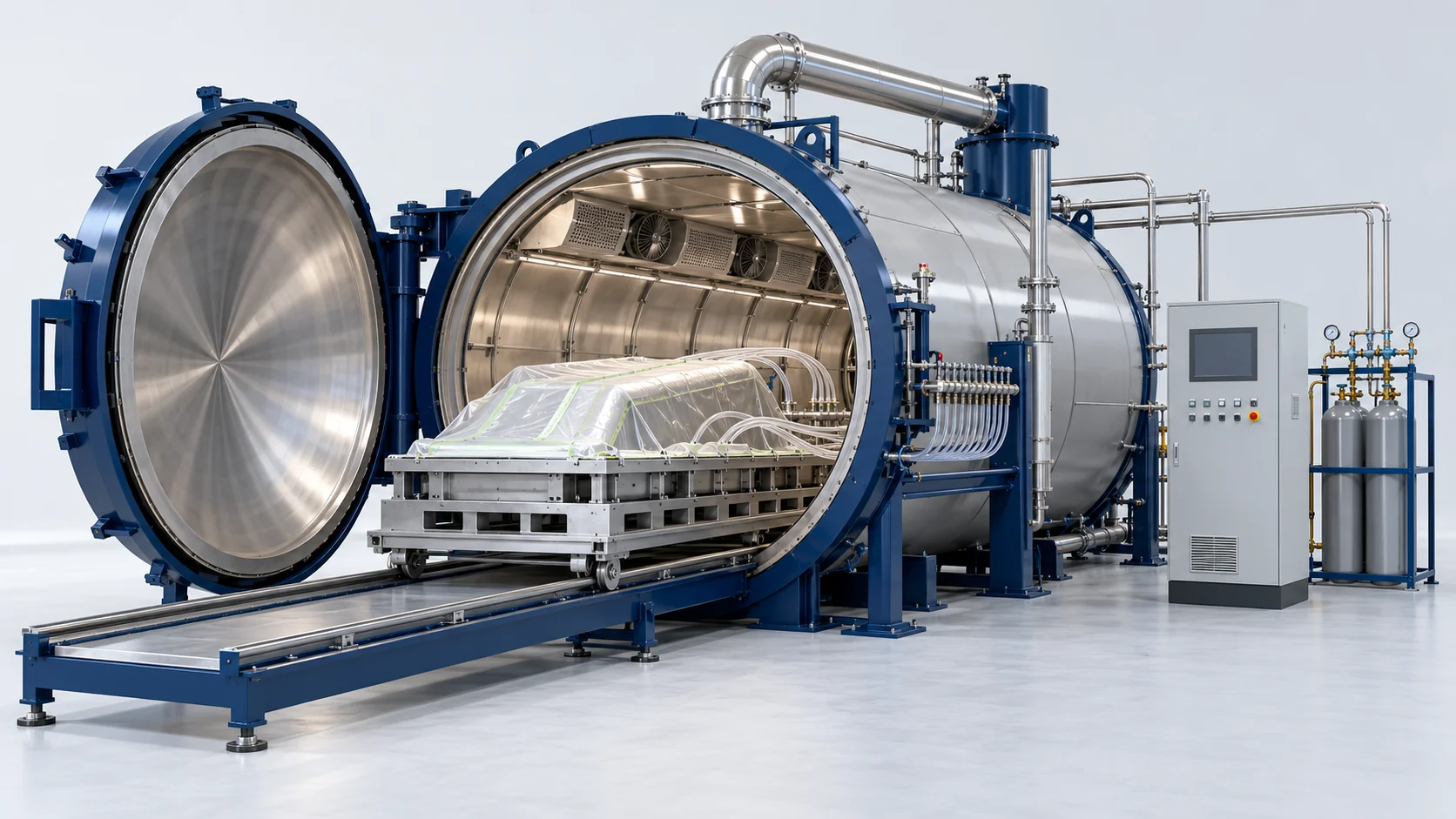
Concept illustration: Generated concept illustration for process discussion; not a photograph of the specified machine, a customer facility or a delivered project.
Material Flow and Working Principle
Prepreg Bagging & Multi-Port Vacuum Coupling
Automated fiber placement (AFP) prepreg layups on Invar tools are sealed in vacuum bags; parts are shuttled into the autoclave on motorized rail beds and connected to 48 vacuum sensing lines.
Interlocked Door Sealing & Nitrogen Pressurization
The quick-opening breech-lock door rotates shut under triple safety interlocks; high-pressure nitrogen gas pressurizes the vessel up to 1.5 MPa, compressing laminate plies under hydrostatic force.
Multi-Zone Convective Heating & Ramp Control
Multi-stage electric finned heaters and high-velocity circulation blowers elevate chamber temperatures at a programmed 1.5°C/min ramp to 180°C, holding working zone temperatures within ±1.5°C.
Isothermal Dwell & In-Situ Viscosity Curing
The vessel dwells isothermally at 180°C under 1.5 MPa pressure for 120 minutes while vacuum levels are vented to atmospheric baseline as resin flows, consolidating plies without entrapped air.
Controlled Cooling & Ultrasonic C-Scan Audit
Closed-loop heat exchangers ramp cooling at 2.0°C/min; the vessel depressurizes, and parts are extracted for 100% phased-array ultrasonic C-scan non-destructive inspection.
Model and Technical Parameters
Supplied HF-ACV35-AERO configuration references for the selected material, tooling and operating conditions. Clear working envelope and total vessel volume are separate dimensions. The 3.5 m × 12 m cylindrical envelope is approximately 115.5 m³; the supplied approximately 130 m³ value describes vessel volume. Ultrasonic inspection, quantitative laminate porosity and aerospace qualification are separate acceptance tasks.
| Technical Parameter | HF-ACV35-AERO |
|---|---|
| Components | Solid preform or prepreg tooling; no liquid proportioning |
| Power Supply | 380V, 3-Phase, 50Hz (Custom 440V/480V 60Hz optional) |
| Working Pressure | 0.1 to 1.5 MPa (Nitrogen gas pressurization inside vessel) |
| Weight | 78,000 kg (Empty pressure vessel and door assembly) |
| Dimensions (L×W×H) | 15,500 mm x 5,200 mm x 4,800 mm |
| Maximum Operating Temperature | 250°C (Continuous electrical heating); Vessel interior working air; configuration-specific reference |
| Thermal Heating/Cooling Ramp | 0.5 to 2.5°C/min (Continuously controlled); Closed-loop PID modulation; configuration-specific reference |
| Laminate porosity acceptance reference | < 0.2% supplied part target; quantitative porosity method and coupon acceptance are separate from ultrasonic C-scan coverage |
| Vacuum Line Header Channels | 48 Independent Lines (Transducer monitored); Tooling vacuum extraction ports; configuration-specific reference |
| Clear working envelope | Effective Working Envelope: Ø 3,500 mm Diameter x 12,000 mm Length; configuration-specific reference |
| Supplied prepreg resin fraction | Prepreg Matrix Resin Content 33% to 38% (Solid batch cure); configuration-specific reference |
| Working-zone temperature uniformity | Temperature Uniformity within ±1.5°C across working zone; configuration-specific reference |
| Approximate pressure-vessel volume | Vessel internal volume: Approximately 130 m³; configuration-specific reference |
Key Equipment Features
Specified vessel/door, heating/circulation, pressurization, vacuum circuits and controls. Tooling, prepreg, gas supply, facility design and applicable pressure-vessel documentation are separately agreed.
±1.5°C Multi-Zone Temperature Uniformity
The supplied ±1.5°C working-zone reference uses the configured circulation and zoned heating; loaded survey and part thermal response are separate acceptance tasks.
1.5 MPa Hydrostatic Consolidation
The supplied gas pressure up to 1.5 MPa supports consolidation. The below-0.2% laminate porosity target requires defined part/coupon measurement; pressure alone does not guarantee it.
0.5–2.5°C/min Controlled Ramp
Supplied configuration reference: Precision thermal ramp control prevents exothermic thermal spikes in massive 40 mm thick monolithic laminates. Actual capability requires material and tooling validation.
48-Channel Vacuum Header
Supplied configuration reference: Independent vacuum lines with real-time pressure transducers detect bag leaks immediately during pressurized cure. Actual capability requires material and tooling validation.


