

Polyurethane density figures are comparable only when the specimen and measurement basis are the same. Distinguish the apparent overall density of a foam specimen, its apparent core density and the loose bulk density of scrap or granules. The word “bulk” is also used by some suppliers for apparent foam density, so confirm the definition rather than treating the name as a separate physical property.
Define the Specimen Before Comparing Density
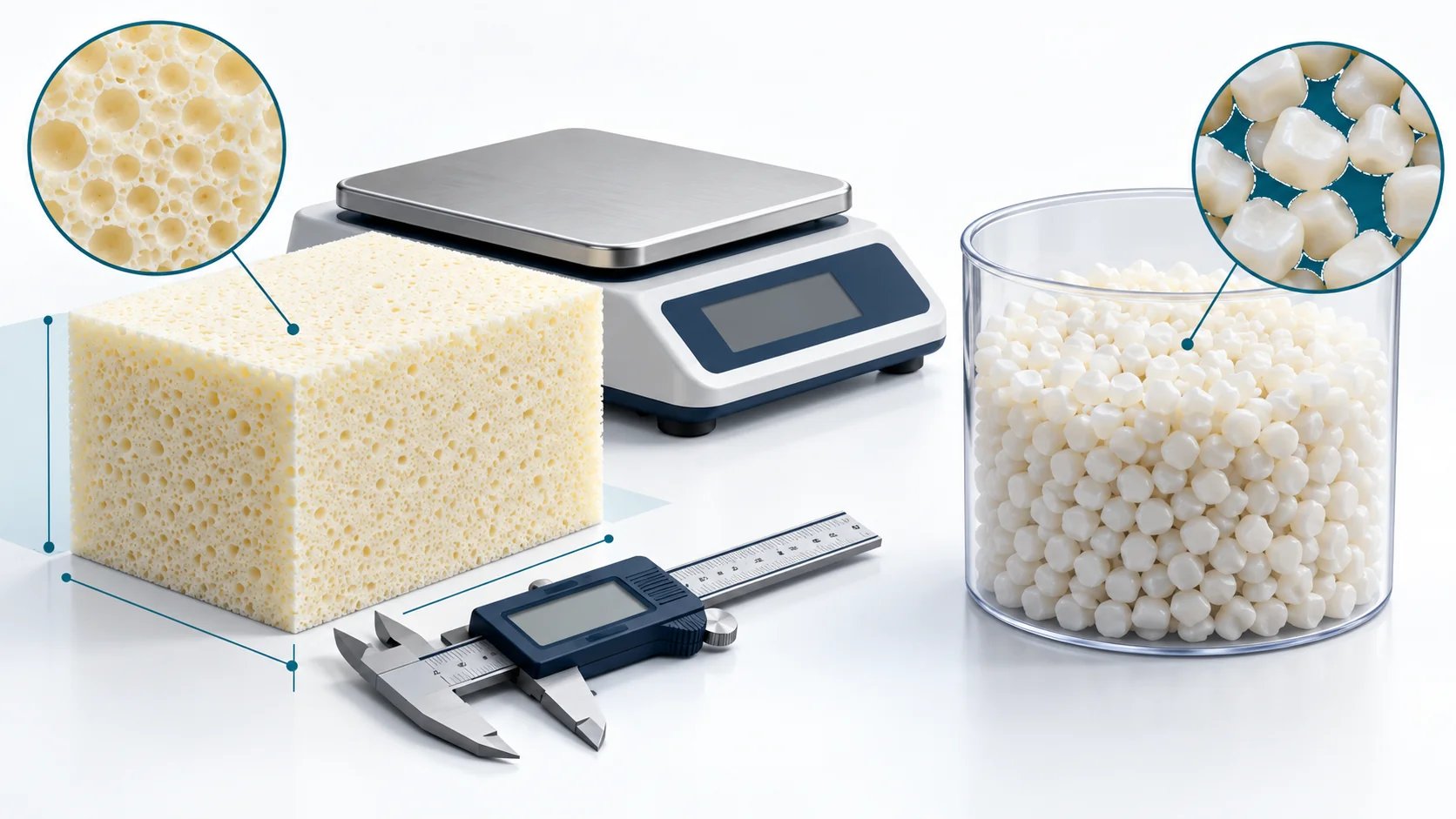
Apparent overall foam density is the mass of the specified foam specimen divided by its external volume, including a surface skin when the method and specimen definition retain it. Its volume includes the gas-filled cells; it is not the density of solid polyurethane polymer.
Apparent core density is measured on a core specimen with the specified skins removed. Record the sampling location and conditioning. It can differ from overall density when molded skins or through-thickness density gradients are present.
Loose bulk density of particulate material is the mass of foam crumb, regrind or granules occupying a defined container volume under a stated filling procedure. Inter-particle spaces affect this value. Loose, tapped and compacted results are different measurement conditions.
The density of a complete sandwich panel may include metal or other facings, adhesive and foam. It cannot be compared directly with a foam-core result. Similarly, free-rise and molded foam results refer to different preparation conditions; specify them alongside the density definition.
Use a Consistent Measurement Basis
ISO 845 provides methods for apparent overall and apparent core density of cellular plastics and rubbers. Use the applicable specimen preparation, dimensional measurement and conditioning procedure. Record units, mass, volume, retained skins, sample age and sampling location.
For a loose particulate-material result, also record particle size distribution, moisture, container geometry, filling method and whether the material was tapped or compressed. Do not apply a foam-specimen result to a hopper volume without a handling-material measurement.
Connect Each Density to Its Production Use
Use the agreed foam density definition for product specification, sampling and process comparison. Density alone does not establish strength, resilience, compression set or thermal performance. Those properties require their own tests under the intended material and service conditions.
Use loose bulk density when sizing hoppers, conveying systems, storage or volumetric feeders for particulate material. Changes in particle size and settling can change volumetric feed mass without changing the density of the original foam. Weigh the actual dose when the formulation requires a controlled mass loading.
Metering, material conditioning, mixing, mold fill and cure can affect foam production, but a density result alone does not diagnose the direction of a ratio error. Compare component outputs, raw-material data and repeatable specimens before changing a recipe.
A Density Comparison Checklist
- Identify the material and whether the result describes foam, a complete assembly or loose particles.
- State overall or core density, and whether skins or facings are included.
- Record free-rise or molded preparation, sampling position, sample age and conditioning.
- Use the same mass, volume and measurement method for each comparison.
- For particles, state loose, tapped or compacted filling and the particle-size range.
- Verify performance independently; higher density is not a universal improvement in insulation or mechanical behaviour.
How To Calculate Shot Weight In Polyurethane · The Role Of Rise Time In Polyurethane Foaming
Frequently Asked Questions
Is foam density always different from bulk density?
No. Some suppliers use bulk density to mean apparent foam density. For loose scrap or granules, it instead includes inter-particle spaces. Ask for the specimen and procedure before comparing values.
Can a core result be compared with a skinned foam part?
Only when the specification makes the basis explicit. Overall and core density can differ, so retain or remove skins consistently with the selected method.
Does a sandwich-panel density describe the foam core?
Not necessarily. A whole-panel mass includes facings and other materials. Report foam-core and complete-assembly values separately.
Does a high density reading prove that the A/B ratio is wrong?
No. First verify the measurement basis, shot mass, mold fill, material condition and actual component outputs. Multiple formulation and process factors can affect density.
References and Further Reading
ISO 845:2006 — Cellular plastics and rubbers: determination of apparent density. Use a method appropriate to the material form and state the specimen basis.





