Most cell-structure problems in polyurethane foam are decided before the foam visibly rises. They are decided at the moment gas comes out of solution and forms a bubble. That moment — nucleation — sets the upper limit on how many cells can exist. Every downstream mixing, pressure, and temperature choice either preserves that bubble population or throws part of it away. This article explains how nucleation controls cell size and uniformity, which variables matter most, and how to read the result in a production part.
If you are chasing inconsistent cell size from batch to batch, start with the conditions at the mixing head and the pressure-drop path immediately after it — not always the formulation itself. For a specific line review, contact Haifeng at info@chinahaifeng.com.
Where Nucleation Fits in the Foaming Reaction
In a conventional polyurethane foam, a liquid phase becomes a cellular solid through two coupled processes: gas generation and polymer network growth. Blowing agents either evaporate from reaction heat or generate CO₂ from the isocyanate–water reaction. Before that gas can create useful structure, it must form discrete bubbles. That formation is nucleation, and it is not automatic. Gas molecules prefer to remain dissolved or diffuse to existing surfaces rather than create a new interface inside a viscous liquid.
Nucleation can be homogeneous or heterogeneous. Homogeneous nucleation depends on local supersaturation and is difficult to control in production. Heterogeneous nucleation uses fine solid particles, filler surfaces, or micro-bubbles already present in the liquid to lower the energy barrier. Most practical foaming systems are dominated by heterogeneous nucleation, even when the formula is not labeled as “nucleated” [1,2]. This is why a filter change, a new raw-material lot, or a shift in nucleating-agent dispersion can alter cell structure without any change in the stated isocyanate index.
Nucleation density — the number of stable bubbles per unit volume — largely decides final cell size. If a formula produces ten times as many stable nuclei before gelation, the same volume of gas divides into ten times as many cells under otherwise equal conditions. The relationship is not perfectly linear because coalescence, drainage, and cell opening remove part of that population, but the starting bubble count is still the ceiling.
How a Bubble Becomes a Cell
Once a bubble nucleates, it grows because gas diffuses into it and because the polymer matrix is still fluid enough to be displaced. Growth continues until the matrix viscosity builds past the point where cell walls can stretch without tearing. In water-blown flexible foam, CO₂ generation, urea formation, and chain extension proceed in parallel. If gelation overtakes bubble growth too early, cells remain small but internal pressure may stay high. If gas generation continues after the walls become too stiff, that pressure can drive defects instead of orderly cell expansion [2].
Growth is also competitive. Larger bubbles have lower internal pressure and can absorb gas from smaller neighbors — the polymeric-fluid equivalent of Ostwald ripening. The result is visible as cell-size broadening: a coarse core, a finer skin, or a gradient from one face to another. A uniform starting bubble population reduces this competitive coarsening but does not eliminate it.
[Rise time controls how long the cell matrix has to expand before the polymer gels.] <The Role Of Rise Time In Polyurethane Foaming> covers the timing half of the same foaming event and how to use rise time as a production diagnostic.
The Variables That Decide Cell Size and Uniformity
Cell structure is a response to several coupled inputs. The table below separates the main levers and what to watch on a production line.
| Variable | Influence on nucleation and cell structure | What to watch on the line |
|---|---|---|
| Nucleating agent or filler dispersion | Increases stable heterogeneous nuclei; poor dispersion can create coarse foci or stress points | Check for agglomerates, filter loading, and batch-to-batch particle variation |
| Mixing head energy and shear | Disperses nucleating particles and generates controlled micro-bubbles; low shear produces coarse streaks and uneven cells | Verify actual mixer speed under full material viscosity |
| Pressure drop after the mixhead | Controls how rapidly gas comes out of solution; a sudden consistent drop promotes dense bubble formation | Record pour pressure, nozzle condition, and mix-chamber cleanliness |
| Temperature profile | Sets the viscosity ramp that determines bubble growth, drainage, and cell-wall stability | Log tank, day-tank, mold, and environment temperatures |
| Mold surface and release agent | Acts as a heterogeneous nucleation boundary and creates a rapid surface skin | Inspect surface cell pattern, release application, and mold temperature |
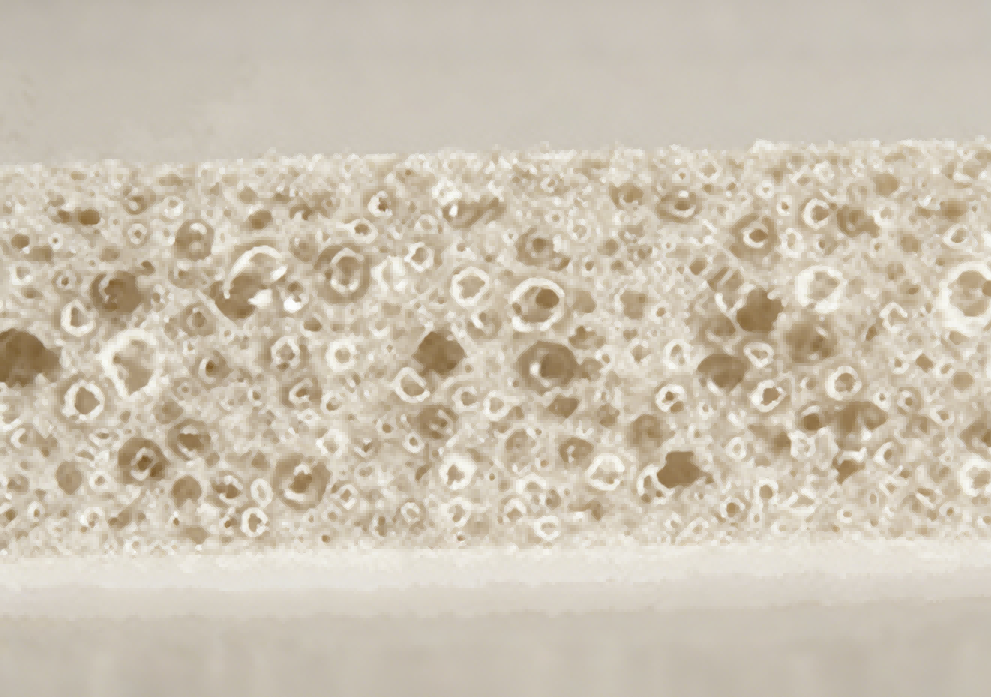
These variables cannot be tuned independently. Raising mixer speed may refine cells but also shear-heat the material. Raising mold temperature may open cells but also shorten rise time and change density distribution. The useful approach is to change one variable, photograph the cut face with a scale reference, and compare the result before changing another.
If you have already changed nucleating-agent dosage and still see coarse cells, the fault may not be in the formulation. Check whether the mixer is operating at the set speed under real viscosity, whether the metering pumps hold ratio through pressure swings, and whether the mixhead pressure letdown repeats from cycle to cycle. For an equipment-level review, email info@chinahaifeng.com or message +86 13566296633 on WhatsApp.
What Cell Structure Changes in the Finished Foam
Cell size does more than change appearance. It changes density distribution, mechanical response, insulation value, and dimensional stability. In flexible foams, smaller and more uniform cells generally produce a smoother compression curve, but open-cell content and polymer stiffness still dominate recovery and support [2]. A fine-cell foam can be hard, soft, resilient, or flat depending on wall thickness and cell openness.
Cell count and average diameter are usually reported from a cut section or by microscopy. ASTM D3574 includes cell-count evaluation procedures for flexible cellular materials, while density is commonly determined according to ISO 845 [3,4]. Open-cell content for rigid foams and closed-cell insulation is tested separately, for example to ASTM D6226 or ISO 4590 [5,6].
| Foam property | Fine, uniform cells | Coarse, broad cell-size distribution |
|---|---|---|
| Closed-cell thermal insulation | Better potential for low thermal conductivity if cells remain small and closed | Higher risk of weak insulation and density variation |
| Surface appearance | Smoother molded surface, less visible openness | More visible porosity, pinholing, or uneven texture |
| Mechanical consistency | More repeatable compression and recovery from part to part | Wider variation in feel, support, and compression set |
| Dimensional behavior | Better balance of internal pressure after demolding when cell opening is controlled | Higher risk of shrinkage or local collapse |
[Cell size and cell openness directly change how a foam stores and returns energy under load.] <Measuring Polyurethane Foam Resilience A Practical Test Guide> covers the test methods that turn those property differences into production decisions.
In production, cell structure should be read as a process fingerprint. A coarse center with a fine skin often points to temperature or pressure non-uniformity. A sudden batch-to-batch shift with no recipe change usually points to raw-material variation, mixer condition, or metering drift — not to aging of the foam itself.
[Shrinkage often appears when cell structure and internal pressure are out of balance after demolding.] <Causes Of Shrinkage In Polyurethane Foam How To Control It> covers the downstream defects that can be traced back to the nucleation and cell-opening stage.
Equipment Levers That Protect the Nucleation Window
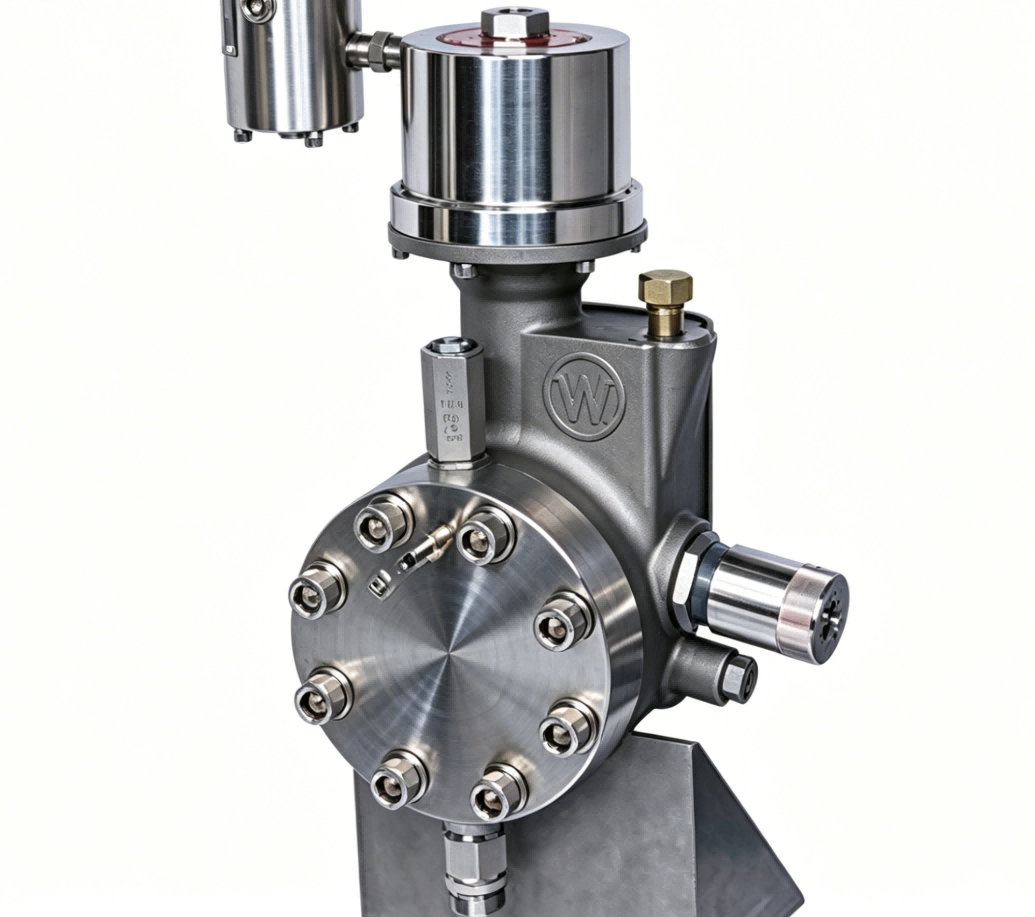
The machine is part of the nucleation system. A formulation can be well designed and still produce poor cells if metering, mixing, or pressure control is unstable.
| Equipment parameter | Effect on cell structure | Practical check |
|---|---|---|
| Component ratio stability | Shifts the reaction/growth balance and the viscosity ramp | Compare metering deviation across the full pressure range |
| Mixer speed and chamber fill | Changes micro-bubble generation and nucleating-agent dispersion | Confirm actual speed, not just the setpoint |
| Controlled pressure drop | Creates the repeatable burst of gas release that drives nucleation | Record pour pressure and keep the mix chamber clean |
| Material temperature control | Changes viscosity, flow, and bubble growth rate | Log tank and mold temperatures every shift |
| Recirculation flow | Prevents stagnant high-viscosity zones and keeps dispersion consistent | Inspect return flow and filter differential pressure |
High-shear impingement mixing refines cell structure because it disperses particles and introduces controlled micro-bubbles into the liquid phase. But shear alone is not enough. The metering system must deliver a consistent ratio under changing pressure. If component ratio drifts during the pour, the viscosity ramp changes, and the same nucleation event can produce different cells at the start, middle, and end of the shot.
Controlled pressure release is equally important. A stable pressure drop after the mixhead acts as a repeatable template for bubble formation. If the nozzle, mix chamber, or return line changes, the nucleation template changes with it.

Production Support for Cell-Structure Control
If you have a target cell size or density and the current process cannot hold it, a machine-level review usually finds the failure faster than reformulating alone. Send the following material to info@chinahaifeng.com, or message +86 13566296633 on WhatsApp:
- Target density, hardness, and cell-size requirement.
- Current machine type and mixing head configuration.
- Observed cell size with a scale reference in the photograph.
- Formulation brief: nucleating agent, filler, blowing agent, and polyol type.
- Photos of both acceptable and defective cut faces.
Haifeng Polyurethane Machinery works on metering precision and turnkey line integration for exactly these process failures. The goal is to make the nucleation window repeatable, shot after shot.
FAQ
Does more nucleating agent always make smaller cells?
No. A higher nucleating-agent loading often raises the bubble count, but there is a practical limit. Overdosing can create agglomerates, local stress, and coarse defects. The result is not a linear reduction in cell size.
Why do cells near the mold surface differ from the core?
The mold wall cools the material quickly and acts as a heterogeneous nucleation boundary. Rapid viscosity build-up near the surface limits bubble growth, while the core stays hotter and grows coarser. Mold temperature and release-agent condition are the usual levers.
What is the difference between gas formation and nucleation?
Gas formation creates the potential volume. Nucleation creates the discrete bubbles that organize that volume into cells. A foam can generate plenty of gas and still have large voids or coarse texture if nucleation is poor.
Can machine settings change cell structure without a formulation change?
Yes. Mixer speed, pressure drop, temperature control, and metering stability all affect nucleation and bubble growth. Within limits, a machine change can refine or coarsen cells without touching the formula.
How is cell size measured in production?
A cut section is inspected under low magnification or an optical comparator against a known scale. Formal methods include cell-count procedures in ASTM D3574 for flexible foam, with density checked by ISO 845 or an equivalent method [3,4].
What should I check if cells are fine at the start of the pour but coarse at the end?
Look for ratio drift during the shot, temperature stratification in the material tanks, or a change in backpressure as the pour progresses. The cause is usually a time-dependent change in viscosity or gas release, not the nucleating agent by itself.
References
[1] G. Oertel, Polyurethane Handbook: Chemistry—Raw Materials—Processing—Application—Properties, 2nd ed., Hanser Publishers, 1993.
[2] R. Herrington and K. Hock, eds., Flexible Polyurethane Foams, 2nd ed., Dow Chemical, 1997.
[3] ISO 845:2006, Cellular Plastics and Rubbers — Determination of Apparent Density, International Organization for Standardization, 2006.
[4] ASTM D3574-17, Standard Test Methods for Flexible Cellular Materials—Slab, Bonded, and Molded Urethane Foams, ASTM International, 2017.
[5] ASTM D6226-21, Standard Test Method for Open Cell Content of Rigid Cellular Plastics, ASTM International, 2021.
[6] ISO 4590:2016, Rigid Cellular Plastics — Determination of the Volume Percentage of Open Cells and of Closed Cells, International Organization for Standardization, 2016.
If you’re interested, check out these related articles:
RRIM Vs RIM Which Process Suits Your Structural Part
What Is Spray Polyurethane Foam Composition And Application
Measuring Polyurethane Foam Resilience A Practical Test Guide