
Carbon Composite HP-CRTM Solution
High-pressure resin metering and surface injection coordinated with compression-RTM tooling and press movement.
High-Throughput Consolidation for Oversized Structural Composites
High-pressure resin metering and surface injection coordinated with compression-RTM tooling and press movement.
Equipment and process scope
Resin preparation, metering/mixing skid, tool injection interfaces and coordinated controls. Press, preform handling, mold and material validation are agreed external scope.
Validation and production planning
The stated 12–20 MPa is the metering/impingement circuit, distinct from cavity pressure. The supplied sub-120-second reference covers complete loading-to-demolding with the selected resin, tooling, cure and handling sequence; it is not an injection-only or universal cycle rating.
The stated 12–20 MPa is the metering/impingement circuit, distinct from cavity pressure. The supplied sub-120-second reference covers complete loading-to-demolding with the selected resin, tooling, cure and handling sequence; it is not an injection-only or universal cycle rating.
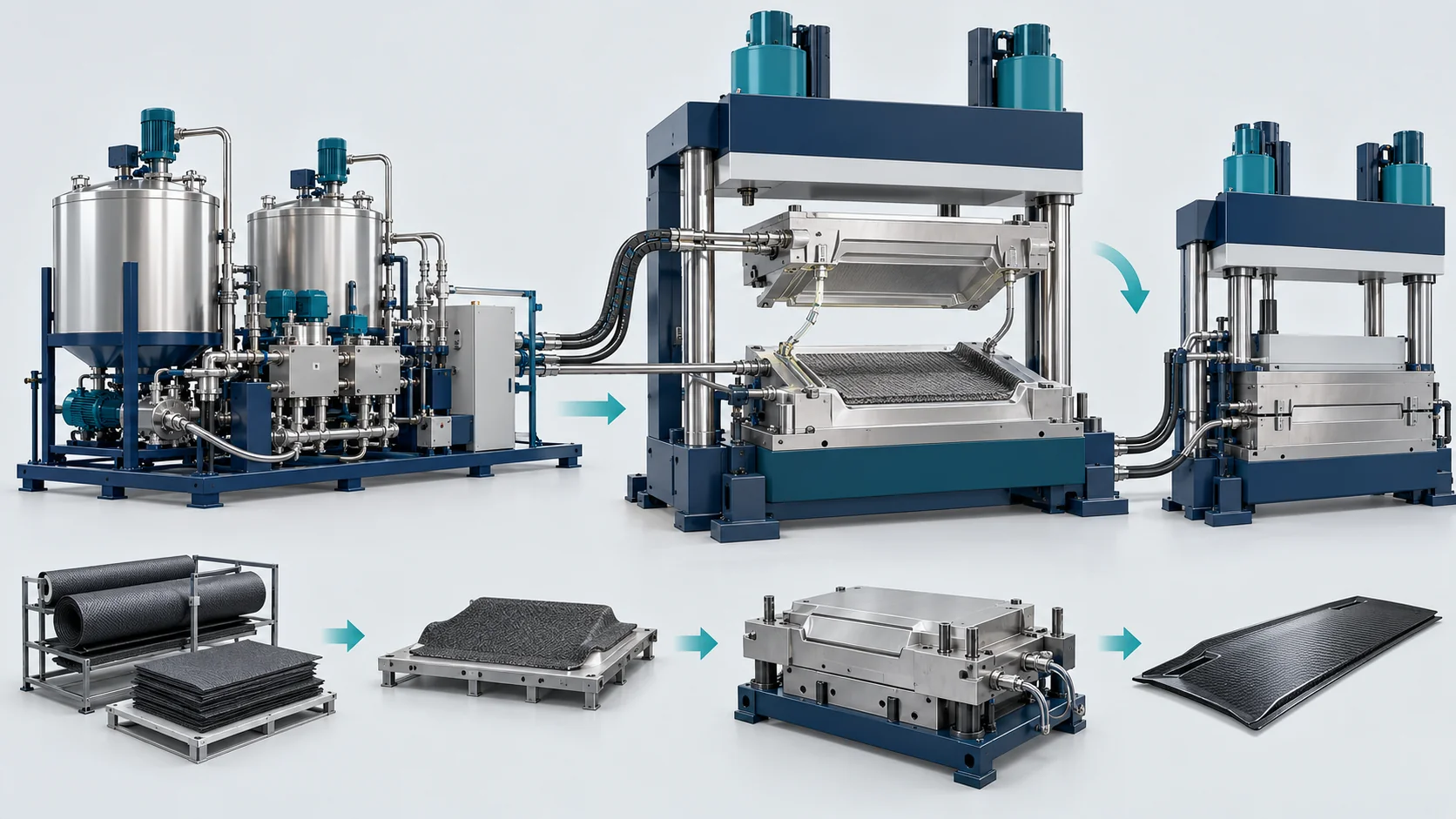
Turnkey Large-Area HP-CRTM Manufacturing Workflow
The sequence describes the supplied configuration. Final settings, cycle boundaries and acceptance are defined for the selected material and tooling. The stated 12–20 MPa is the metering/impingement circuit, distinct from cavity pressure. The supplied sub-120-second reference covers complete loading-to-demolding with the selected resin, tooling, cure and handling sequence; it is not an injection-only or universal cycle rating.
Carbon Preform Loading & Micro-Gap Setting
Supplied process reference: The 3D carbon preform (NCF fabrics, V_f ≥ 55%) is placed in the tool; the press closes to a 1.2 mm micro-gap under 0.05 kPa vacuum.
18 MPa High-Pressure Impingement Metering
Supplied process reference: Servo axial piston pumps meter fast-curing epoxy at 18.0 MPa under Coriolis feedback, holding stoichiometric accuracy within ±0.2%.
Low-Drag Surface Resin Distribution
Supplied process reference: The tool-mounted head dispenses 2,650 g in 9.5 seconds for the selected surface-distribution sequence. Fiber displacement is assessed on the actual preform and tool.
Reference Solution Engineering Envelope
Supplied configuration and validation references; material/component results are separate from equipment ratings.
| Parameter | Value / Unit | Applicable Configuration / Conditions |
|---|---|---|
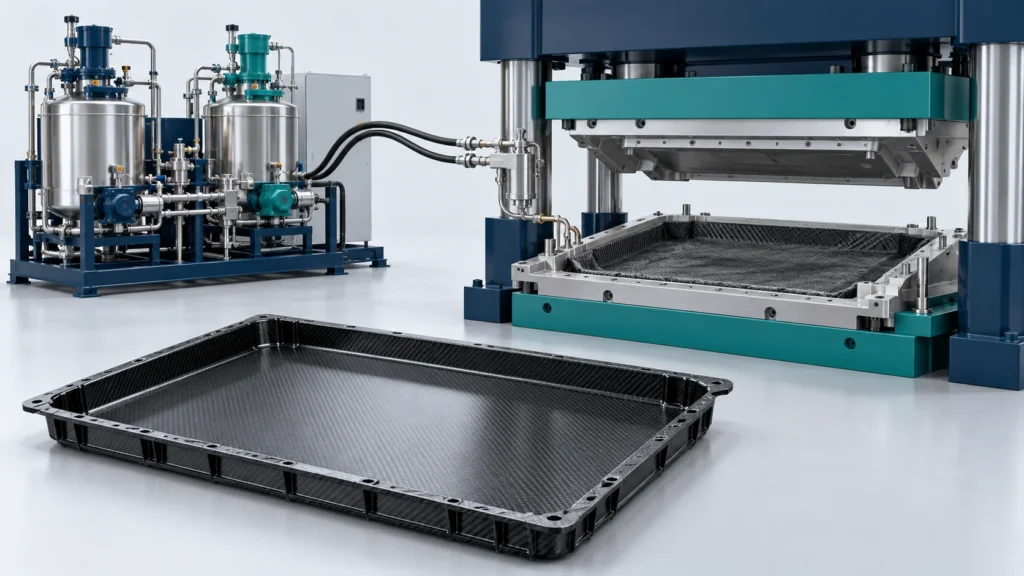
| Molded Component Surface Area | Up to 3.52 m² (2,200 mm× 1,600 mm) | Oversized structural composite battery trays and floor pans; configuration-specific reference or part acceptance target |
| Hydraulic Compaction Velocity | Up to 300 mm/s | Fast-acting 3,000-ton servo press with active parallel leveling; configuration-specific reference or part acceptance target |
| Injection Delivery Flow Output | 20.0 to 300.0 g/s | Continuous variable servo-hydraulic impingement proportioner; configuration-specific reference or part acceptance target |
| Micro-Gap Dynamic Positioning | 0.5 to 2.0 mm (Tolerance ±0.02 mm) | Optical linear scale closed-loop press position feedback; configuration-specific reference or part acceptance target |
| Mold Cavity Evacuation Level | Down to 0.05 kPa (Absolute) | High-speed multi-stage vacuum pump with tool silicone seals; configuration-specific reference or part acceptance target |
| Total Part Molding Cycle Time | Less than or equal to 120 seconds | From preform loading to demolding with fast-cure epoxy; configuration-specific reference or part acceptance target |
Core Equipment for This Solution
Resin preparation, metering/mixing skid, tool injection interfaces and coordinated controls. Press, preform handling, mold and material validation are agreed external scope.
Core Advantages of Haifeng HP-CRTM Systems
Configured equipment functions and interfaces for the selected material and tooling.
Fiber Displacement Control
Micro-gap surface distribution and the compression stroke are coordinated to manage preform movement; zero fiber displacement is not guaranteed.
High-Throughput 120s Cycles
The supplied 120-second complete-cycle reference uses its specified resin, cure, press and handling sequence; press speed alone does not establish cycle time.
35% Weight Reduction vs Metal
The supplied 35% tray-weight comparison concerns the stated aluminum baseline and composite design, not a machine-wide or vehicle-wide guarantee.
Defined Porosity Acceptance
The supplied below-0.5% laminate porosity reference requires a defined quantitative method and part acceptance; cavity vacuum alone does not establish aerospace qualification.
Related Project Draft
The related carbon-tray brief reports its own complete cycle, weight baseline and inspected component configuration.
Frequently Asked Questions
How does HP-CRTM differ from standard HP-RTM when molding large panels?
Why is 4-corner active leveling required on the hydraulic press?
What maintains continuous vacuum sealing during the 1.2 mm micro-gap state?
Can this solution mold complex stepped geometries with variable thickness?
Discuss Your Production Goals
Share your product or drawing, material system, target output, automation needs and factory utilities so the equipment and interfaces can be configured.


