Una línea de paneles puede cumplir las especificaciones de densidad y aun así perder rendimiento de aislamiento porque el gas de las celdas se difundió más rápido de lo esperado. La conductividad térmica es el valor que refleja ese fallo. Para el aislamiento de poliuretano rígido (PUR) y poliisocianurato (PIR), la espuma de celda cerrada nueva suele presentar valores en el rango de 0,022–0,028 W/(m·K), mientras que el valor envejecido o declarado suele ser superior [1], [2]. La diferencia entre esos dos valores es donde aparecen las pérdidas energéticas y las disputas de cumplimiento.
Qué describe realmente el valor K
La conductividad térmica, escrita como λ en la mayoría de las fichas técnicas, indica cuánto calor atraviesa 1 metro de material por cada 1 K de diferencia de temperatura a través de él. La unidad es W/(m·K). Un valor más bajo es mejor porque escapa o entra menos calor.
But λ is not the same as U-value or R-value. U-value includes the whole building element: insulation thickness, surface films, and thermal bridges. R-value is thermal resistance. The basic relation is:
R = thickness / λ
y
U = 1 / R
A 100 mm thick foam core with λ of 0.025 W/(m·K) gives an R-value of about 4.0 m²·K/W before adding surface resistances. That surface correction matters for thin panels [3]. This is why chasing only the raw K-value without fixing thickness or installation quality can produce a specification that does not match the built performance.
Cómo se mide el valor K
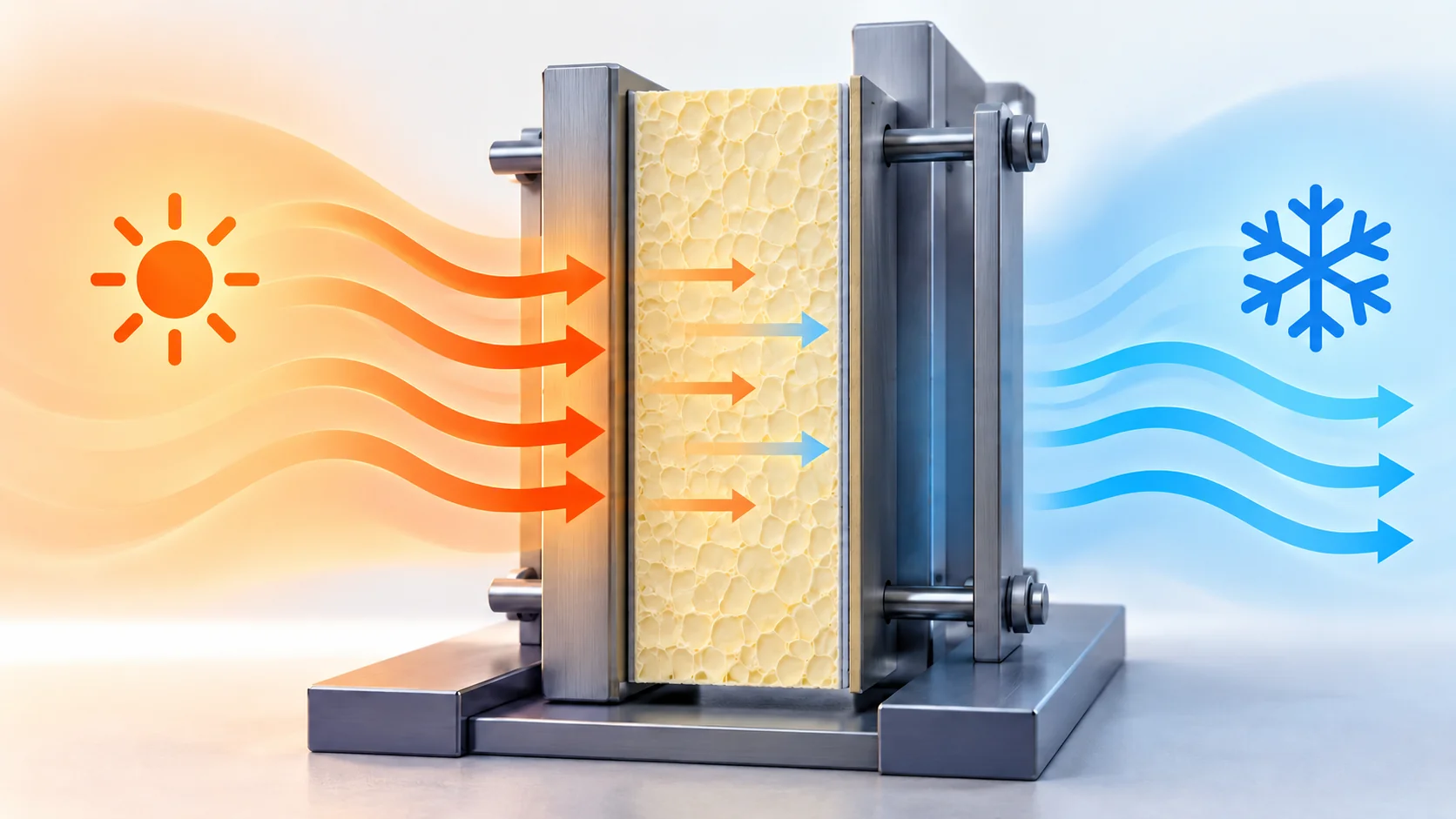
Most polyurethane insulation data is generated by heat flow meter or guarded hot plate methods. ASTM C518 and ISO 8301 are the common heat flow meter procedures [1], [4]. A sample is conditioned, placed between hot and cold plates at a set mean temperature, and the steady-state heat flux is measured.
Three measurement details change the result:
- Mean temperature: λ rises with temperature, so a value measured at 10 °C cannot be compared directly with one measured at 40 °C.
- Sample condition: freshly foamed specimens still retain low-conductivity blowing agent that will later diffuse out.
- Aged value: European building datasets use a declared lambda that includes an aging and safety margin, not the best initial test result [2].
A spray-applied insulation roof adds field variability that board-stock testing cannot capture. Thickness per pass, substrate temperature, wind, and gun movement all change cell structure and gas retention.
Spray-applied rigid foam is a field-built insulation system rather than a uniform board, so thickness and cell gas retention vary with ambient conditions. ¿Qué es la espuma de poliuretano proyectada? Composición y aplicación covers how the A-side/B-side chemistry and application conditions change the final foam.
Qué determina la conductividad térmica en la espuma rígida de PU
Agente espumante y gas de las celdas
A closed polyurethane cell conducts less heat than the polymer cell wall. Much of the thermal resistance comes from the stationary gas in the cell, not the polyurethane itself. Cyclopentane, HFOs, and similar blowing agents have lower thermal conductivity than air, which is why fresh foam can test near 0.022 W/(m·K).
Over time the blowing agent diffuses out and air diffuses in. Air has a higher λ than most closed-cell blowing gases, so the K-value drifts upward. This is a material-aging process, not a manufacturing defect [2]. The faster the diffusion, the larger the gap between initial and declared performance.
Tamaño de celda, contenido de celda cerrada y densidad
Smaller cells reduce radiation transfer across the foam. Closed-cell content above roughly 90% is typical for low-λ rigid insulation because open cells allow gas movement and can hold moisture [2]. If closed-cell content drops, thermal conductivity rises even when the foam looks dense and uniform.
Density has a practical window. Too low, and cell walls become thin and mechanically weak, allowing collapse or poor dimensional stability. Too high, and solid polymer conduction increases because there is more polyurethane material per unit volume. Most insulation optimization happens inside a relatively narrow density band, and the process determines whether cells form consistently inside that band.
Rigid insulation sits at one end of the PU stiffness range, and semi-rigid formulations trade some of that compressive behavior for flexibility. Qué es la espuma de poliuretano semirrígida covers what separates semi-rigid from rigid systems and where the transition matters.
Humedad y envejecimiento
Moisture always moves the K-value in the wrong direction. Water has much higher thermal conductivity than stagnant air, and adsorbed moisture also displaces gas at the cell wall. A panel that develops microcracks, poor adhesion, or dimensional movement will admit moisture into the core.
Shrinkage is one of the main entry points for that failure. If the foam pulls away from a metal facing or pipe wall, a thin air gap forms, and the effective insulation resistance drops faster than any K-value model predicts.
Moisture uptake and dimensional movement both reduce effective insulation performance in enclosed metal panels or pipe insulation. Causas de la contracción en la espuma de poliuretano y cómo controlarla covers how shrinkage changes cell structure and which process controls manage it.
Variables de proceso que se reflejan en el valor K
The best formulation still needs a stable foaming line. A small ratio deviation changes reaction completeness, density, and cell formation. A mixing pressure drop produces coarse or uneven cells. A temperature shift changes viscosity and nucleation, so the same recipe can produce different lambda values on different days.
This is where metering and mixing control matter more than nominal throughput. On a high-pressure insulation machine, hold two-component ratio within ±0.3%, keep mixing pressure in the design range, and record the result shot by shot. On the HF-HPM-2A2B-ColdRoom, for example, mixing is designed for an 10–18 MPa band with dynamic metering and multi-formula storage. That does not make a panel colder by itself; it makes the cell structure repeatable enough for the K-value test to mean something across a full production run.
If you are trying to reduce K-value spread across a panel line or pipe insulation process, send the line speed, panel or pipe dimensions, target λ, current blowing agent, and current scrap rate to info@chinahaifeng.com. This is usually a metering and laydown problem first, not a raw-material negotiation.
Especificar el aislamiento sin comprar un número malo
When comparing suppliers, ask for the following in the same report format:
- Thermal conductivity measured per ASTM C518 or ISO 8301, not an unstated in-house method.
- The mean temperature at which λ was measured.
- The declared aged value and the aging method, not only a fresh-foam result.
- Closed-cell content and foam core density, not just overall board weight.
- Dimensional stability under heat, cold, and moisture aging.
- Face adhesion or substrate adhesion for sandwich panels and pipe insulation.
A supplier that reports only one favorable K-value without test conditions has not given you a specification. A proper value is repeatable, temperature-labeled, and tied to a recognized test method [1], [2], [4].
¿Necesita eliminar la deriva del valor K mediante el diseño?
The lowest advertised lambda does not help if the cell structure varies from center to edge of the panel or if the blowing agent diffuses faster than the design assumes. Haifeng works on metering accuracy, mixing pressure, flow control, and line integration so the foam delivered to the mold keeps consistent gas content and cell size from first shot to last.
Send an inquiry with these basic inputs:
- Line speed or required output
- Panel, pipe, or cavity geometry and thickness
- Target foam density and λ
- Current blowing agent and flame-retardant requirement
- Current scrap rate or failed area
Correo electrónico: info@chinahaifeng.com
WhatsApp: +86 13566296633
Preguntas frecuentes sobre la conductividad térmica del aislamiento de poliuretano
¿Qué es una buena conductividad térmica para el aislamiento de poliuretano?
Fresh closed-cell rigid boards commonly fall between 0.022 and 0.028 W/(m·K). Declared values for building applications are often slightly higher after aging corrections and safety margins are applied [2].
¿Cómo se compara el poliuretano con la lana mineral o el EPS?
Rigid PU and PIR generally offer lower thermal conductivity at a given thickness than typical EPS or mineral wool products. A comparison is only valid at the same mean temperature and moisture condition [2], [5]. Installation and air-tightness can change the ranking in a real wall or roof assembly.
¿Por qué empeora el valor K con el tiempo?
The low-conductivity blowing agent in the cells slowly diffuses out while air or moisture diffuses in. Cell changes, shrinkage, and face-separation effects add further losses. This is built into declared lambda values through aging tests [2], [5].
¿Qué espesor se necesita para alcanzar un valor U?
Use R = thickness / λ and add the resistance of surface films and facings. For example, with λ = 0.025 W/(m·K), 100 mm of foam gives an R-value of about 4.0 m²·K/W. The required thickness depends on the building regulation target, the panel facings, thermal bridges, and installation quality [3].
Referencias
[1] ASTM International. ASTM C518-21, Standard Test Method for Steady-State Thermal Transmission Properties by Means of the Heat Flow Meter Apparatus. West Conshohocken, PA: ASTM International, 2021.
[2] European Committee for Standardization. EN 13165:2012+A2:2016, Thermal insulation products for buildings — Factory made rigid polyurethane foam (PUR) products — Specification. Brussels: CEN, 2016.
[3] European Committee for Standardization. EN ISO 6946:2017, Building components and building elements — Thermal resistance and thermal transmittance — Calculation methods. Brussels: CEN, 2017.
[4] International Organization for Standardization. ISO 8301:1991, Thermal insulation — Determination of steady-state thermal resistance and related properties — Heat flow meter apparatus. Geneva: ISO, 1991.
[5] ASHRAE. ASHRAE Handbook—Fundamentals. Atlanta: ASHRAE, 2021.
Si te interesa, echa un vistazo a estos artículos relacionados:
El papel del tiempo de subida en el espumado de poliuretano
Causas de la contracción en la espuma de poliuretano y cómo controlarla
Cómo calcular el peso de dosificación en poliuretano
¿Qué es la espuma de poliuretano proyectada? Composición y aplicación
Medición de la resiliencia de la espuma de poliuretano: guía práctica de ensayo