
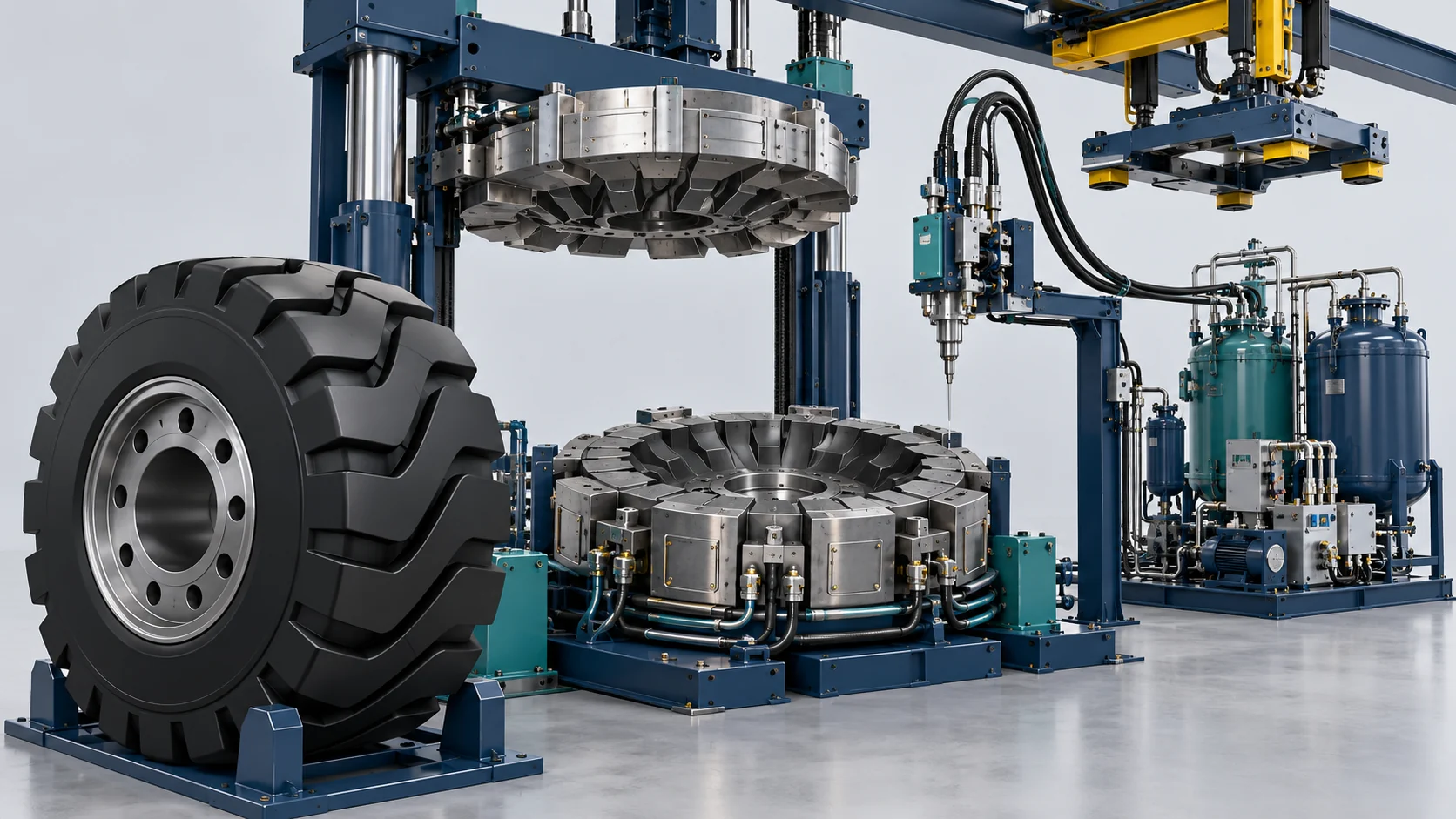
Off-Road Heavy Equipment Solid PU Tire Molding Solution
Review closed-mold manufacture of PU wheel assemblies for a specified off-road application. Select hub, mold, formulation and metering interfaces together. Filling an existing rubber tire casing is a separate route.
Off-Road Heavy Equipment PU Wheel Manufacturing Configuration
Review closed-mold manufacture of PU wheel assemblies for a specified off-road application. Select hub, mold, formulation and metering interfaces together. Filling an existing rubber tire casing is a separate route.
Wheel Assembly Requirements
Define geometry, hub fit, load, speed, terrain and chemical exposure for the actual component. Equipment selection is based on these inputs.
Process and Equipment Scope
Identify metering, mixing, tooling, handling and post-treatment in the agreed equipment schedule. Listed case or brief values describe their own configurations.
Define the supplied equipment, installation, commissioning, operator training and service responsibilities in the project agreement.
Off-Road OTR PU Tire Casting Workflow
Coordinate the wheel assembly and material requirements through the selected production sequence.
Prepare the Hub and Mold
Select cleaning, primer, preheating and mold preparation for the hub, formulation and wheel geometry.
Meter, Mix and Fill
Choose compatible metering and mixing, set the shot from the wheel cavity and validate the filling sequence.
Cure in the Selected Tooling
Coordinate the mold arrangement and thermal conditions with the formulation and required demolding readiness.
Configuration References and Selection Conditions
Equipment ranges are supplied-brief references. Wheel load, wear and environmental performance require component-specific evaluation.
| Item | Reference / Selection Input | Conditions |
|---|---|---|
| Application | Specified off-road wheel assemblies subject to component evaluation | Define the actual wheel and operating duty. |
| Material | Selected cast PU formulation | Final material processing and properties follow the selected formulation. |
| Density reference | Formulation-specific | Any numerical range is from the supplied configuration brief, subject to formulation trials. |
| Diameter reference | 20–45 inches | Brief configuration range; tooling and hub geometry are selected separately. |
| Metering output reference | Confirm the metering configuration and operating window | Brief equipment reference, not finished wheels per hour. |
| Submitted time reference | Confirm the complete entry-to-demold sequence | Original timing endpoints require confirmation. Record entry-to-demold cycle separately from output interval. |
| Load, wear and chemical resistance | Specified for the actual wheel assembly | No universal load rating, comparative wear-life multiplier or chemical-resistance outcome is asserted. |
Production Planning Considerations
Match process functions to the specified wheel and factory requirements.
Hub and Tooling Interfaces
Coordinate part drawings, hub preparation, molds and demolding.
Material Processing
Select metering, mixing and thermal settings for the formulation.
Production Organization
Plan station count, mold cavities, working hours and downstream stages.
Component Evaluation
Define the load, wear, bonding and exposure tests relevant to the actual wheel.
Related Project Case
Explore related project references. Each project has its own configuration, reference values and evidence conditions.
Frequently Asked Questions
Process selection, tooling, commissioning and line integration.
Does this page establish a wheel load or wear-life rating?
Can one equipment configuration cover every wheel size?
How is production output calculated?
What information is needed for process selection?
Discuss Your Tire and Wheel Production Project
Send wheel and hub drawings, material data, operating duty, shot size, mold cavities, daily working hours, target output and factory layout to define the configuration.


