Производство колёс из ПУ оправдывает автоматическую линию, когда ограничение сместилось с самой заливочной станции. Это происходит, когда целевые объёмы выпуска больше нельзя достичь за счёт добавления операторов, когда брак объясняется дрейфом соотношения или массы заливки, а не конструкцией формы, или когда заказчик требует пооперационных записей по каждой заливке, которые никто не сможет вести вручную. Один лишь объём — слабый повод. Завод, отливающий узкий ассортимент крупных колёс при умеренном объёме, может годами работать на полуавтоматическом оборудовании, а завод, отливающий мелкие ролики по множеству марок твёрдости, может достичь порога автоматизации при доле такого тоннажа. Решение зависит от того, какой параметр вы больше не можете контролировать вручную и справится ли с ним оборудование лучше человека.
Четыре признака того, что ручной цикл заливки достиг своего предела
Автоматические линии для колёс обычно продают, отталкиваясь от объёма выпуска. Обоснование, которое выдерживает проверку после пусконаладки, уже, и обычно сводится к одному из четырёх условий.
Первое — потолок, задаваемый темпом оператора. Одна заливочная станция выдаёт столько, сколько один человек успевает залить, закрыть и извлечь в пределах окна гелеобразования. Как только смена выстраивается вокруг возможностей этого человека, вторая станция означает второго оператора, и затраты растут вместе с выпуском, а не снижаются. Когда ваш лучший день совпадает со средним лишь потому, что все работают на пределе темпа, процесс держится на усилиях, а не на оборудовании.
Второе — повторяемость, которую нельзя объяснить формой. Разброс массы и твёрдости, не подчиняющийся никакой закономерности по гнёздам, указывает на дозирование, стабильность соотношения или последовательность заливки. Проблема формы повторяется в одном и том же гнезде. Проблема дозирования перемещается.
Третье — время переналадки. По мере роста списка SKU часы, уходящие на замену форм, промывку цвета и повторный выход на температуру, начинают конкурировать с продуктивной заливкой. Ручная переналадка — не проблема квалификации; это последовательность, которую нужно выполнять вручную в строго определённом порядке.
Четвёртое — документация. Покупатели роликов, медицинских колёс и колёс для весов всё чаще запрашивают записи по каждой заливке: соотношение, масса заливки, температура формы и оператор или станция. Если такие записи восстанавливают задним числом, это не записи.

Как оценить дефицит мощности перед покупкой автоматизации
Прежде чем сравнивать коммерческие предложения, переведите производственный план в формы и циклы. Требуемое годовое количество деталей, разделённое на число гнёзд в форме, циклов в час и продуктивных часов, даёт число форм, необходимое плану. Если это число уже превышает и площадь цеха, и имеющиеся у вас формы, никакая система управления разрыв не закроет.
Ловушка — считать время цикла параметром оборудования. Заливка, гелеобразование и извлечение задаются рецептурой. Заливочная машина может сократить заливку и убрать простои между формами, но не может заставить рецептуру отвердевать раньше, чем позволяет её химия. Автоматизация на самом деле меняет то, насколько цикл зависит от человеческого фактора: положение при заливке, интервал между заполнением и закрытием и момент, когда деталь покидает форму.
Просчитайте дважды: один раз с текущим циклом и один раз с циклом, из которого убрано каждое зависящее от оператора движение. Разница между этими двумя числами и есть всё обоснование автоматизации по производительности. Если разница мала, ваш предел кроется в химии или оснастке, и решать его нужно там.
Число гнёзд становится показателем производительности только тогда, когда известна масса заливки для каждой формы, а масса заливки зависит от объёма гнезда, плотности материала и числа потоков, питающих форму. <Как рассчитать массу впрыска в полиуретане> рассказывает, как определить это число до того, как будут зафиксированы размер насоса или число станций.
| Элемент | Ручная станция | Полуавтоматическая | Автоматическая линия |
|---|---|---|---|
| Позиционирование заливки | Оператор наводит головку | Фиксированная головка, загрузка оператором | Программируемая траектория для каждой формы |
| Повторяемость массы заливки | Зависит от действий оператора | Дозирование контролируется, последовательность операций — вручную | Дозирование и последовательность операций сблокированы |
| Обращение с формами | Переносятся вручную | Ручная загрузка, механический зажим | Карусель или конвейер с позиционированием по станциям |
| Переход | Полностью ручная продувка и сброс | Сохранённые параметры, ручная продувка | Сохранённые параметры с циклом продувки |
| Производственные записи | Записываются после смены | Частичное протоколирование | Протоколирование по каждому заливу |
| Затраты труда на станцию | Один оператор на станцию | Один оператор на несколько форм | Один оператор на линию плюс контроль |
Где сосредоточены затраты, прежде чем проблемой станет объём выпуска
Брак при литье колёс редко проявляется сразу как показатель доли брака. Он даёт о себе знать сортировкой, возвращёнными партиями и формами, снятыми с линии на очистку после неудачной заливки. Если твёрдость выходит за пределы диапазона, указанного на чертеже, приходится вводить 100-процентный контроль, а контроль на таком уровне обходится дороже, чем та операция литья, которую он проверяет.
Здесь полезны записи по проектам с сопоставимых линий литья PU при условии, что каждая запись хранится вместе с условиями, в которых она была получена.
| Записать | Operating conditions | What the record supports | What it does not support |
|---|---|---|---|
| Servo-fed centrifugal casting for e-bike tires | One part family, one material system, feeding accuracy about ±2 g with casting and centrifuge interlocked | Yield improved from 96% to 99.2% on that line | That any caster line gains the same yield from servo feeding |
| Low-pressure caster line with eight-station mold carriers | Manual cycle of 8 to 12 minutes per tire before the upgrade | A stable carrier cycle removed the operator pacing limit | That casters are inherently slow parts |
| High-pressure caster lines with formula storage and closed-loop temperature control | Three lines, mixed specification range, EU low-VOC materials | Changeover efficiency and capacity gains measured on that SKU mix | That formula storage alone delivers the same changeover gain |
| Compact rotary disc cell for rail pads | Narrow workshop, split-modular build, simplified interface | A small plant can automate part of the cycle and recover the investment quickly | That wheels follow the same economics as rail pads |
The boundary matters more than the numbers. Those records come from specific parts, materials, and building constraints. They show what controlled metering and stable mold handling did in those plants; they do not predict a figure for your line. What they do establish is the pattern: in every one of those projects the gain came from removing a variable that people were managing by attention.
Какие части цикла действительно берёт на себя автоматическая линия
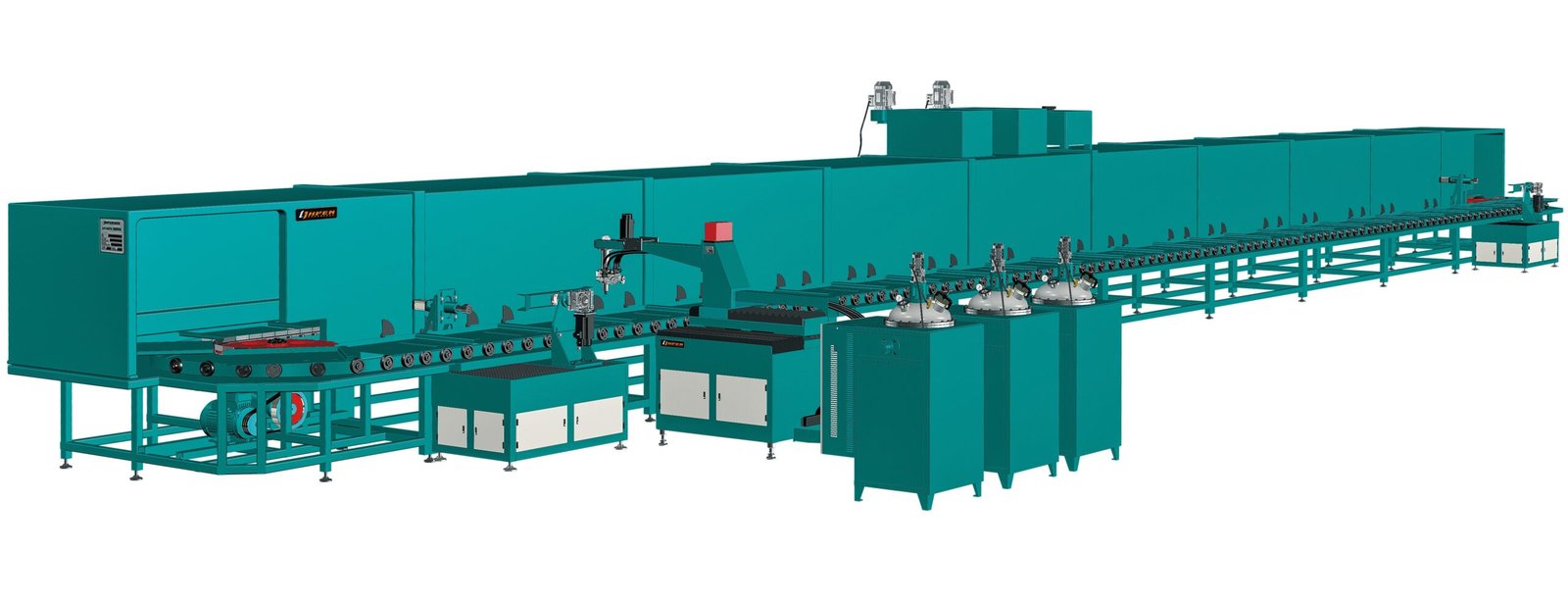
Automation is not one decision. It is a set of transfers of responsibility from the operator to the machine, and each transfer has its own payback.
Metering and mixing come first. A two-component casting unit with dynamic metering accuracy within ±0.3% of full range, independent tank temperature control, and a switchable chain-extender system removes ratio drift from the list of daily variables. This is where most of the scrap improvement originates, and it is also the cheapest part of automation to adopt on its own.
Pour path comes second. A fixed head relies on the mold arriving in the right place; a programmed or robotic path controls how material enters the cavity. For wheels with a central hub and a rim section, the pour sequence affects air entrapment and knit lines, so path control is a quality measure as much as a labor measure.
Mold transport comes third. Rotary carriers and indexing conveyors set the interval between pour and demold mechanically, which is what converts a chemistry-determined cycle into a repeatable output figure.
Clamping, opening, and extraction come fourth. These are the heaviest and least skilled tasks, and they are also where a tired operator damages molds.
What stays manual is worth stating plainly: core and insert placement, release agent application, first-article checks, material drum changes, and final inspection. Automation moves the labor; it does not remove the judgment. A line that assumes otherwise ends up with the same headcount in different job titles.
Pour path and cure time together decide how much of the cycle an operator still touches, and roller casting runs the same sequence at a larger scale. <Как изготавливают полиуретановые валки: от литья до отверждения> covers the casting-to-cure stages that a wheel line compresses into a much shorter cycle.
For smaller wheels and weighing wheels, the practical entry point is often a single 1A1B casting unit rather than a full line, such as the configuration Haifeng Polyurethane Machinery builds for industrial weighing wheels: 50 to 800 g/s pour rate, dosing accuracy within ±0.3%, and separate temperature control on each tank. That arrangement pairs controlled metering with manual mold handling, which is enough when the constraint is ratio stability rather than throughput.
Что автоматическая линия исправить не может
A casting line controls delivery. It does not control the chemistry that receives the delivery.
Gel time, cream time, and demold time come from the formulation. If parts tear at demold, more stations only add molds waiting in a queue. If the mix is sensitive to moisture, an automatic line will reproduce the resulting voids more consistently than a person did.
Mold design is the second limit. Venting, gate position, shrinkage allowance, and thermal layout determine whether a wheel fills without laps and releases without distortion. A line built around a poorly vented mold will produce scrap at a higher rate, faster.
Material conditioning is the third. Drum temperature, moisture control, and the handling of crystallizing isocyanate affect viscosity, and viscosity affects the pour. Automation narrows the acceptable window for material variation because the machine does the same thing every cycle, including the same thing wrong.
Part design is the fourth. Thick hub sections cool more slowly than thin rims, and differential shrinkage can appear as a dimensional problem that looks like a metering problem. Sizing a line will not correct it.
Finally, post-cure and machining stay outside the casting cell. If a wheel needs a machined bore or a post-cure cycle before it holds tolerance, those steps belong in the plan and in the headcount.
Hardness range is the specification that most often exposes a line sized on output alone, and the scale has to be named before any tolerance is agreed. <Твердость по Шору A и по Шору D в полиуретане> covers how the two scales differ and where each applies.
Как составить спецификацию автоматической линии для колёс из PU без размытых цифр
Most weak enquiries ask for an automatic line at a stated output. Output is a result, not a specification. The fields below are what a supplier actually needs to size metering, station count, and tooling.
| Поле RFQ | Что запрашивать | Предотвращаемый дефект |
|---|---|---|
| Part range | Wheel diameter, width, finished weight, and cavity count per mold | A pump sized for the largest part that cannot meter the smallest one |
| Hardness range | Shore A or Shore D values with test method, temperature, and conditioning time | Hardness arguments after delivery that were never defined |
| Shot weight range | Minimum and maximum shot, with the metering accuracy basis stated as a percentage of full range or of setpoint | A guarantee that reads well on paper and disappears at low shots |
| Cycle requirement | Pour time, gel window, demold time, and required output per hour per station | A line whose station count cannot physically meet the plan |
| Changeover target | Number of grades per shift and acceptable purge loss per change | A line that meets output on one grade and loses it on the next |
| Data to be logged | Which values, at what frequency, and how long retained | A traceability promise that does not match the audit requirement |
Two enquiry lines show the difference. A weak line reads: automatic PU casting line required, 400 wheels per hour, please quote. A usable line reads: wheel diameter range 80 to 200 mm, shot weight 90 to 420 g per part, hardness 70 to 90 Shore A across four grades, gel window that currently allows 4 minutes before demold, three grade changes per shift, and per-shot logging of ratio, shot weight, and mold temperature retained for two years. The second version lets a supplier state where their equipment meets the requirement and where it does not.
Когда полуавтоматическая линия остаётся более выгодным вложением
Automation is a response to a bottleneck you can name. When the bottleneck is absent, the same money usually does more elsewhere.
Stay semi-automatic when the SKU list is short and stable, when the scrap you are fighting traces to a specific cavity, when no customer requires shot-level records, and when the building or the utilities impose limits that would consume the capital before the line runs. In those cases, metering upgrades and mold rework return more per unit of investment than a robotic cell.
If the direction is right but the budget is not, phase it. Metering and closed-loop temperature control first, because they attack ratio drift and hardness scatter directly. Mold carriers second, because they convert cycle time into a repeatable figure. Pour path automation third, once the process window is stable enough that a programmed path is a quality tool rather than a way to reproduce an unstable pour faster. Each phase should be justified by the variable it removes, and each phase should be measured before the next one is ordered.
Отправьте номенклатуру деталей до запроса коммерческого предложения
The fastest way to get a usable proposal is to send the production facts rather than the target output. Tell us the wheel diameter and finished weight range, the hardness range with the test method you will accept, the cavity count per mold, your current cycle time and where it comes from, your scrap rate with the dominant failure mode, the material system and gel window, the number of grade changes per shift, and the production records your customers require.
With those inputs a supplier can say where an automatic line earns its cost and where a metering upgrade would do the same job for less, which is a more useful answer than a quotation built on a single output figure.
Haifeng Polyurethane Machinery
Info@chinahaifeng.com
WhatsApp: 86 13566296633
Часто задаваемые вопросы
Какой объём выпуска оправдывает автоматическую линию для колёс из PU?
There is no universal tonnage. The trigger is a gap between the cycle your formulation allows and the cycle your operators can sustain. If adding one operator per station still leaves molds idle, or if hardness and weight scatter cannot be traced to a cavity, output level is secondary. A plant casting few, large wheels at low volume may never reach that point. A plant casting many small casters across several hardness grades can reach it early, because changeover and ratio control, not tonnage, become the constraint.
Можно ли модернизировать ручную линию для колёс из PU поэтапно?
Yes, and staged upgrades usually fail for one reason: the stages are bought out of order. Metering and temperature control come first because they remove ratio drift, which is the variable that invalidates every comparison made afterwards. Mold carriers come next, since they fix the pour-to-demold interval. Pour path automation comes last, once the process window is stable. Buying the robot first and the metering later means the line reproduces an unstable process consistently, and the scrap rate stays where it was.
Снижает ли автоматическая линия численность персонала?
It relocates work more often than it removes it. Casting, mold handling, and demolding demand fewer people per unit of output, but insert placement, release agent, first-article checks, material changes, and inspection remain. Plants that expect a headcount reduction across the whole cell are usually disappointed. Plants that expect the same people to produce more, with the labor moved to the tasks machines cannot judge, tend to get what they planned for. Plan the post-automation staffing by task, not by a percentage.
Чем вызывается разброс веса литых колёс из PU?
Four causes account for most of it. Ratio drift between the two components changes density and hardness together. Shot weight variation changes fill and can leave a short or overweight part. Pour sequencing and venting determine whether air escapes or stays in the cavity. Mold temperature variation changes cure and demold behavior, which changes final dimensions. Separating these is straightforward: log ratio, shot weight, and mold temperature per shot for a shift. A variation pattern that follows the mold is tooling; one that follows time or grade is metering.
Какие размеры колёс плохо подходят для полностью автоматической линии?
Very large, low-volume wheels and very small, high-cavity wheels both strain a standard line for different reasons. Large wheels need long pour and cure times, so a carousel sized for station turnover ends up mostly empty. Small wheels in high-cavity molds need fast, low-shot metering with tight accuracy at the bottom of the pump range, and a unit sized for larger parts may not hold that accuracy. Both cases are solvable, but the equipment must be specified around the extreme of the range rather than the average.
Нужна ли роботизированная рука для заливки?
Not always. A fixed head with accurate mold positioning covers many wheel designs where the pour point sits at the center of a symmetric cavity. A programmed or robotic path earns its cost when the cavity is off-center, when the part has thin sections that need a moving pour, or when several mold sizes share one line and manual repositioning would otherwise consume the changeover budget. Decide this from the part geometry, not from the equipment brochure.
Если вам интересно, ознакомьтесь с этими статьями по теме:
Что такое полужесткий пенополиуретан
Измерение упругости пенополиуретана: практическое руководство по испытаниям
SRIM Explained Structural Reaction Injection Molding Basics
Причины усадки пенополиуретана и способы её контроля
RRIM или RIM: какой процесс подходит для вашей конструкционной детали