
Dos líneas de producción pueden usar lo que parece el mismo poliol, el mismo isocianato y la misma proporción A/B y aun así producir piezas con diferente dureza, densidad y comportamiento de desmoldeo. La variable oculta suele ser el índice de isocianato. No es lo mismo que la proporción de mezcla, y un pequeño error en el cálculo se propaga por toda la reacción.

Qué es realmente el índice de isocianato
El índice de isocianato compara los grupos isocianato realmente aportados con los grupos isocianato que en teoría se requieren para reaccionar con todos los hidrógenos reactivos del sistema [1]. La forma estándar es:
Índice de isocianato = (equivalentes de NCO reales / equivalentes de NCO teóricos) × 100
Un índice de 100 es la base estequiométrica. Por encima de 100 queda un exceso de NCO; por debajo de 100 queda hidrógeno reactivo sin reaccionar [1]. La demanda teórica de NCO procede del valor de hidroxilo medido y del contenido de agua medido, no del nivel del tanque ni de proporciones de mezcla supuestas [2]. Para el control de materias primas, el contenido de NCO se mide por separado mediante valoración o un método equivalente [3].
Por qué el índice cambia la reacción, no solo la proporción
Con un exceso de NCO, a las reacciones primarias de uretano y urea les siguen reacciones secundarias como la formación de alofanato y biuret, que elevan la densidad de reticulación [4]. Esto suele aumentar la dureza y el módulo y puede mejorar la resistencia térmica, hasta cierto punto.
Con un déficit de NCO, la extensión de cadena es incompleta. Las piezas tienden a ser más blandas, tardan más en alcanzar la resistencia en verde y son más sensibles a la humedad. El agua es especialmente importante en sistemas expandidos con agua: cada molécula de agua consume dos grupos NCO, por lo que ignorar el contenido de agua en el cálculo del índice hace que el índice real sea menor de lo previsto [1].
Efectos del índice según la dirección
| Condición del índice | Qué determina | Lo que suele aparecer en la línea |
|---|---|---|
| Por debajo de 100 | Menor densidad de reticulación, extensión de cadena incompleta | Desmoldeo blando o pegajoso, baja resistencia en verde inicial, sensibilidad a la humedad |
| En 100 | Base estequiométrica | Curado predecible; no es automáticamente el mejor conjunto de propiedades |
| Por encima de 100, exceso moderado | Más reticulaciones de alofanato/biuret, mayor módulo | Mayor dureza y resistencia térmica; posible fragilidad si se excede |
| Muy por encima del intervalo práctico | Exotermia alta, reacción de expansión más intensa, riesgo de quemado | Quemado interno en secciones gruesas, pieles frágiles, tensión dimensional |
Estos efectos siguen siendo cualitativos porque el índice óptimo depende del sistema concreto [4]. Un valor que funciona para una espuma rígida de aislamiento no es automáticamente adecuado para un elastómero colado de dureza Shore A 60.

La dureza es uno de los indicadores más inmediatos de un cambio de índice en piezas macizas y microcelulares. También es uno de los más fáciles de malinterpretar.
La dureza es uno de los indicadores más inmediatos de un cambio de índice en piezas macizas y microcelulares. Dureza Shore A frente a Shore D en poliuretano aborda cómo el ensayo de durómetro separa la dureza superficial de la rigidez del conjunto.
Cómo se manifiestan los errores de índice en planta
Index errors rarely announce themselves as a chemistry alarm. They show up as patterns in production: hardness scatter across a mold run, density drift over an afternoon, changing cell structure, residual tack at demold, longer cure time, or dimensional instability.
Shrinkage is a common late signal. A part may leave the mold within spec, then continue changing after cooling or post-cure.
If a formulation change moves the index and only later shows up as dimensional loss, do not assume a mold problem first. Causas de la contracción en la espuma de poliuretano y cómo controlarla covers what drives foam shrinkage and how process adjustments interact with formulation.
Por qué la máquina forma parte del índice
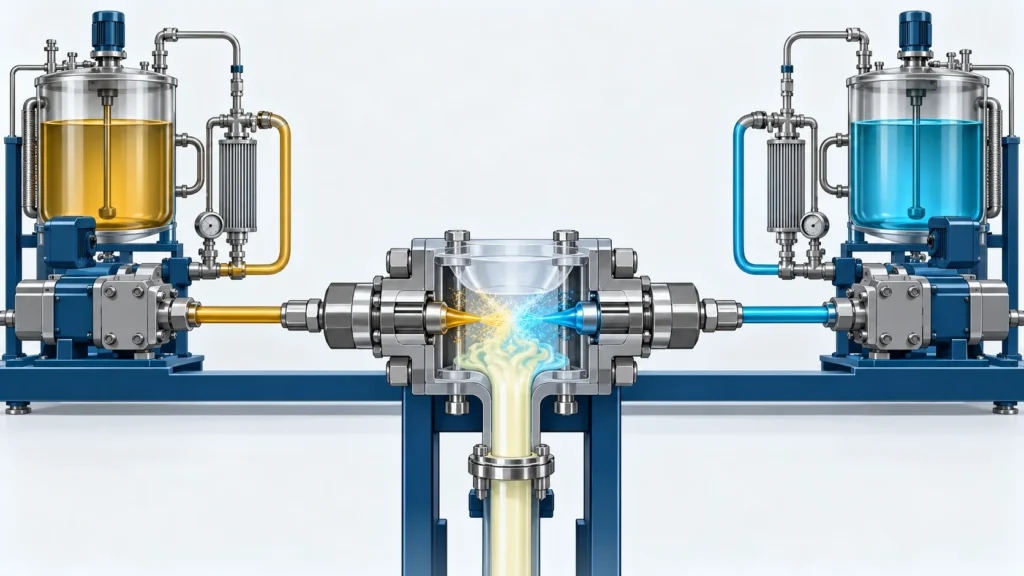
A correct formulation still has to survive the metering system. The machine delivers the index as a mass or volume ratio, and that ratio is affected by temperature, viscosity, pump calibration, recirculation behavior, and shot-size changes.
On Haifeng two-component pouring and casting systems, dynamic metering accuracy is specified at ≤ ±0.3% across the full pouring range, with closed-loop servo control for ratio stability. That matters because the index is only as repeatable as the actual NCO delivery, not the number typed into the panel.
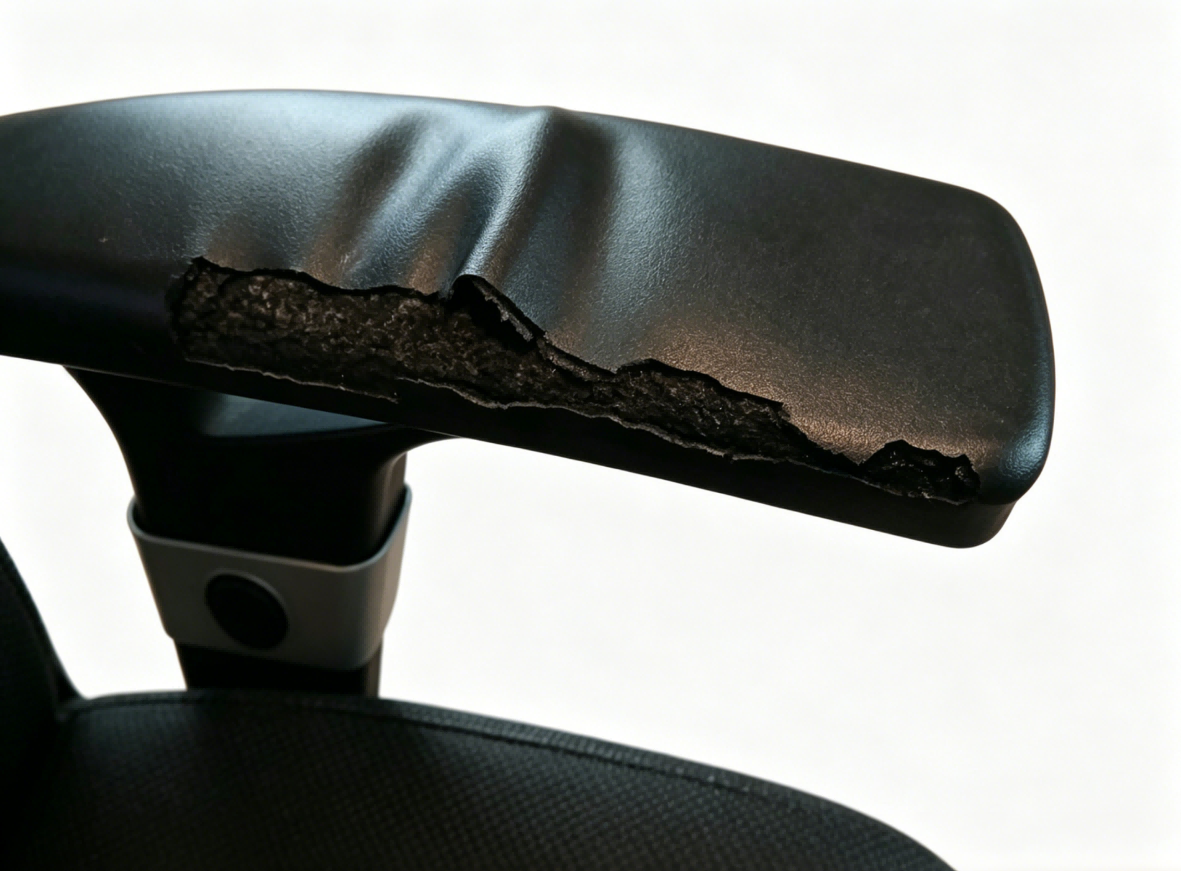
In one automotive damping-parts application, ratio drift first surfaced as hardness scatter and dimensional variation. After the line moved to closed-loop high-pressure metering, part tolerance tightened from ±1.2 mm to ±0.3 mm and defect rate fell from 5.2% to 2.0%. The change was not a new polyol — it was control of what the polyol and isocyanate actually received.
Shot weight also interacts with index control. If the mold is underfilled or overfilled, the index may be correct on paper and wrong in rubber.
If the shot weight is off, the index can be perfect on paper and wrong in the mold because fill density changes. Cómo calcular el peso de dosificación en poliuretano covers how to translate part geometry and density into the correct pour weight.
Need a process-level index check before committing to a reformulation? Send the target index, current A/B setting, shot weight, and the hardness or density result you are getting to info@chinahaifeng.com. A ratio audit generally shows whether the issue is chemistry or metering within one review.
Una secuencia de trabajo para fijar el índice
- Confirm hydroxyl number and water content for each lot before calculating NCO demand [2].
- Confirm NCO content of the isocyanate side [3].
- Calculate the theoretical NCO requirement including water [1].
- Choose a starting index based on part type and property target, using supplier starting points and reference data as a range rather than an exact law [4].
- Run a small trial and record density, hardness, gel or tack-free time, and post-cure shrinkage.
- Adjust in small, traceable increments. Keep the ratio change logged against the part result.
- Lock the A/B ratio and verify metering stability at the actual shot weight.
Obtenga una comprobación del índice a nivel de dosificación
An index problem is often a process control problem wearing a chemistry label. Haifeng Polyurethane Machinery engineers two-component pouring, casting, and foaming systems for closed-loop ratio control and full-range dynamic metering accuracy of ≤ ±0.3%. If you are fighting hardness scatter, density drift, or sticky demold, send us the material data, target index, shot weight, and production photos. We will start with the calculation, not the catalog.
Correo electrónico: info@chinahaifeng.com
WhatsApp: 86 13566296633
Preguntas frecuentes
¿Cuál es la diferencia entre el índice de isocianato y la proporción de mezcla A/B?
The mix ratio is a machine setting expressed in mass or volume. The index is a chemical ratio based on NCO equivalents and reactive-hydrogen equivalents. Different polyol hydroxyl values or isocyanate NCO contents can produce the same mix ratio with different indexes.
¿Un índice más alto hace siempre más dura una pieza?
Not always. A moderate excess of NCO can raise crosslink density and hardness, but too much excess can create brittle, over-crosslinked, or over-gassed parts [4]. The practical effect depends on the system and the part thickness.
¿Cómo se calcula el índice en una espuma expandida con agua?
Water must be counted as part of the theoretical NCO demand. Each mole of water consumes two NCO groups. If water is ignored, the mixed system behaves as if the index is higher than the value written on the formulation sheet [1].
¿Cuál es el mejor índice inicial para los elastómeros colados?
There is no universal number. The starting point should come from the prepolymer NCO content, the chain extender, the target hardness, and the supplier’s formulation card. It should then be verified on the line through hardness, cure, and shrinkage checks.
¿Por qué se desvía el índice si la proporción A/B no cambia?
Raw material lot changes are the usual cause. Shifting hydroxyl value, water content, or NCO content changes the actual equivalents even when the machine ratio stays fixed [2], [3]. Temperature, viscosity, and metering pump wear can also change delivered mass.
Referencias
[1] G. Oertel, Ed., Polyurethane Handbook, 2.ª ed. Múnich, Alemania: Hanser Publishers, 1994.
[2] ISO 14900:2017, Plastics — Polyols for Use in the Production of Polyurethane Plastics — Determination of Hydroxyl Number. Geneva, Switzerland: ISO, 2017.
[3] ISO 14896:2009, Plastics — Polyurethane Raw Materials — Determination of Isocyanate Content. Geneva, Switzerland: ISO, 2009.
[4] K. Ashida, Polyurethane and Related Foams: Chemistry and Technology, 2nd ed. Boca Raton, FL, USA: CRC Press, 2006.
Si te interesa, echa un vistazo a estos artículos relacionados:
Medición de la resiliencia de la espuma de poliuretano: guía práctica de ensayo
RRIM frente a RIM: qué proceso se adapta mejor a tu pieza estructural